Scale-free network topology and multifractality in weighted planar stochastic lattice
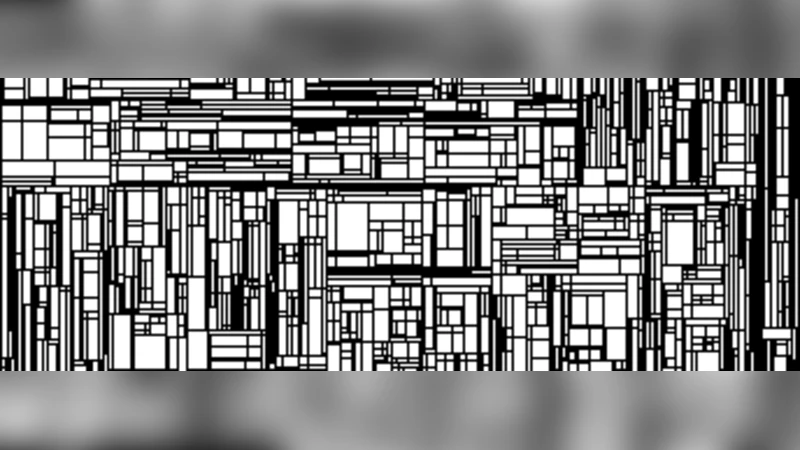
We propose a weighted planar stochastic lattice (WPSL) formed by the random sequential partition of a plane into contiguous and non-overlapping blocks and find that it evolves following several non-trivial conservation laws, namely $\sum_i^N x_i^{n-1} y_i^{4/n-1}$ is independent of time $\forall \ n$, where $x_i$ and $y_i$ are the length and width of the $i$th block. Its dual on the other hand, obtained by replacing each block with a node at its center and common border between blocks with an edge joining the two vertices, emerges as a network with a power-law degree distribution $P(k)\sim k^{-\gamma}$ where $\gamma=5.66$ revealing scale-free coordination number disorder since $P(k)$ also describes the fraction of blocks having $k$ neighbours. To quantify the size disorder, we show that if the $i$th block is populated with $p_i\sim x_i^3$ then its distribution in the WPSL exhibits multifractality.
💡 Research Summary
The paper introduces a novel stochastic geometric construction called the Weighted Planar Stochastic Lattice (WPSL). Starting from a single rectangular cell, the system evolves by repeatedly selecting a cell at random and partitioning it into four smaller rectangles using two orthogonal cuts placed at random positions within the cell. This sequential, non‑overlapping subdivision fills the plane completely while the number of cells grows linearly with time.
A striking theoretical result is the existence of an infinite family of conserved quantities. For any real exponent (n) the sum
\
Comments & Academic Discussion
Loading comments...
Leave a Comment