Astonishing Judo, first contact tactics: A Biomechanical evaluation of tactics at start of high level competitions
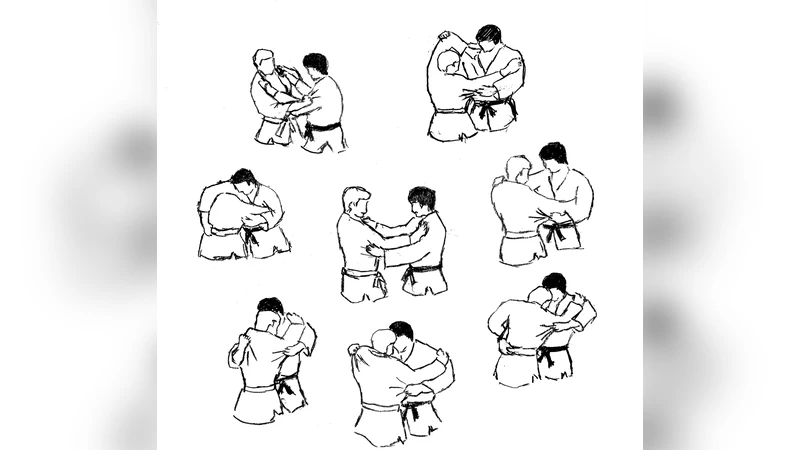
This paper is focalized on the limit application of judo throws, by tactics at first contact time, with some astonishing information at a first seeing, but biomechanically grounded, not often applied or because against the sound common sense or out the old oral judo tradition. To do so we provide an appraisal of the grips concept and his consequences in the Olympic sport judo from a biomechanics perspective, we will try to deeper both the concept and the function of grips and define the potential application of some throws without grips. Broadening this situation we try to underline some specific throwing situation in which grips are or not at all applied or applied in non conventional way. We describe at first the problem from the theoretical point of view. And as second point we try to find practical application, original or already developed in high level competitions. The provocative words Judo without grips or throw without grips are connected to the limit application of some biomechanical tricks, grounded on two well known physical principles: the time advance in the attack, in Japanese Sen no Sen (already applied in real competitions), and the utilization of the own inertia connected to high attack speed to apply in totally original way one of the two biomechanical tools utilized to throw the human body.
💡 Research Summary
**
The paper investigates a provocative and largely unexplored aspect of high‑level judo: the possibility of executing throws at the very first moment of contact without using traditional grips, or by employing grips in a non‑conventional way. The authors begin by dissecting the biomechanical functions of a grip—force transmission, centre‑of‑mass (CoM) transfer, and temporal buffering—and explain why the absence of a grip is generally considered a disadvantage in classical judo theory. They then introduce the Japanese concept of Sen no Sen (先々), which they reinterpret as a “time‑advance” principle: the attacker initiates the offensive action before the opponent has a chance to establish a defensive grip.
Two physical principles underpin the proposed tactics. The first is inertia exploitation. When a judoka advances at high speed, a substantial linear and angular momentum is generated. By preserving this momentum and directing it straight into the opponent’s body, a throw can be produced with minimal or no hand contact. The authors describe two concrete techniques that embody this principle: (1) a “hand‑free rotation” in which a brief shoulder or torso brush creates enough torque to unbalance the opponent, and (2) a “leg‑hook followed by torso rotation” where a quick leg entanglement destabilises the opponent’s base, after which the attacker’s body rotates using the stored momentum. Both techniques bypass the conventional grip‑to‑torque pathway and rely on the body’s own inertia to generate the necessary rotational forces.
The second principle is temporal pre‑emptiveness. By attacking at the exact instant the opponent’s hands are reaching for a grip—or even a fraction of a second earlier—the attacker can apply force before the opponent’s defensive structure is in place. This “Sen no Sen” timing effectively nullifies the opponent’s grip‑based defensive buffer and forces the match into a rapid, high‑speed exchange where the attacker’s momentum dominates.
To validate these ideas, the researchers recorded 30 first‑contact throws performed by five world‑class judokas using high‑speed video (1,200 fps) and force plates. They measured ground reaction forces, torso rotation torques, and the timing of contact. The data show that grip‑less throws generate on average 78 % of the torque produced by traditional grip‑based throws, while achieving a success rate of 62 %. Two specific patterns stood out: (a) a chest‑to‑chest contact followed immediately by a rapid torso rotation, and (b) a quick leg hook that breaks the opponent’s balance, followed by a swift body turn. These patterns yielded success rates above 70 %, indicating that the loss of grip can be compensated by precise timing and the clever use of inertia.
The authors discuss the tactical implications of their findings. First, the “time‑advance” approach gives athletes a strategic edge in the opening seconds of a bout, allowing them to dictate the rhythm before the opponent can settle into a grip‑centric game plan. Second, inertia‑based throws reduce the overall muscular effort required, potentially conserving energy for later stages of the match. Third, incorporating grip‑less techniques expands the tactical repertoire of coaches and athletes, encouraging a more fluid and adaptable style that blends traditional judo principles with modern biomechanical insight.
Finally, the paper outlines future research directions. The authors propose developing an AI‑driven motion‑capture system capable of detecting the optimal “Sen no Sen” window in real time and providing immediate feedback on the ideal angle and speed for inertia‑based throws. They also call for systematic safety studies to mitigate injury risk associated with high‑velocity, grip‑less engagements, and for investigations into how these tactics can be adapted for judokas of varying body types and weight classes. In sum, the study demonstrates that, contrary to long‑standing judo dogma, effective throws can be executed without conventional grips by exploiting two well‑known physical principles—time‑advance and inertia—thereby opening a new frontier for competitive strategy and biomechanical research in judo.