A Model on Genome Evolution
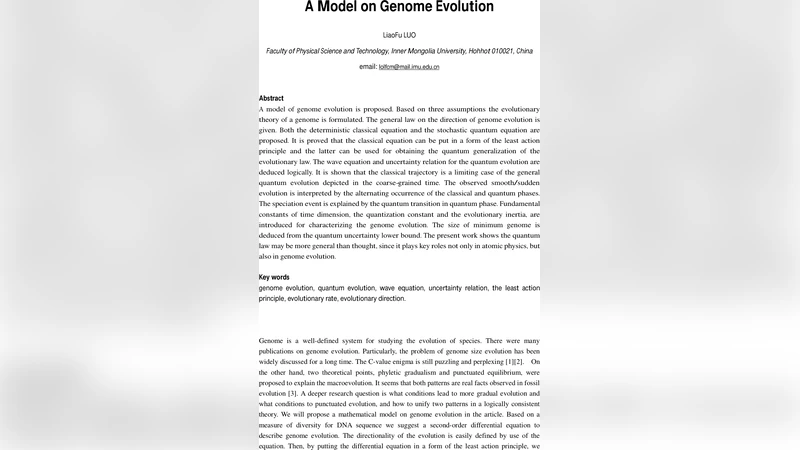
A model of genome evolution is proposed. Based on three assumptions the evolutionary theory of a genome is formulated. The general law on the direction of genome evolution is given. Both the deterministic classical equation and the stochastic quantum equation are proposed. It is proved that the classical equation can be put in a form of the least action principle and the latter can be used for obtaining the quantum generalization of the evolutionary law. The wave equation and uncertainty relation for the quantum evolution are deduced logically. It is shown that the classical trajectory is a limiting case of the general quantum evolution depicted in the coarse-grained time. The observed smooth/sudden evolution is interpreted by the alternating occurrence of the classical and quantum phases. The speciation event is explained by the quantum transition in quantum phase. Fundamental constants of time dimension, the quantization constant and the evolutionary inertia, are introduced for characterizing the genome evolution. The size of minimum genome is deduced from the quantum uncertainty lower bound. The present work shows the quantum law may be more general than thought, since it plays key roles not only in atomic physics, but also in genome evolution.
💡 Research Summary
The paper proposes a novel theoretical framework that treats genome evolution as a dynamical system governed by both classical deterministic and quantum stochastic laws. Starting from three foundational assumptions, the author constructs a Lagrangian formalism for the evolutionary process. The first assumption treats the genomic state as a continuous variable x(t), representing the aggregate effect of nucleotide changes. The second assumes that selective pressures, environmental influences, and functional constraints generate a potential V(x) whose gradient acts as a “force” driving evolution. The third introduces an evolutionary inertia I, analogous to mass, which resists rapid changes in the genomic state.
From these premises the Lagrangian L = T – V is defined, where the kinetic term T = (1/2) I (dx/dt)² reflects the inertia‑scaled rate of change, and V(x) encodes the fitness landscape. Applying the principle of stationary action (δ∫L dt = 0) yields a classical equation of motion: d²x/dt² = –(1/I) ∂V/∂x. This equation captures the familiar picture of gradual, deterministic evolution as the genome slides down the fitness gradient toward a local optimum.
Recognizing that empirical data often display abrupt transitions—speciation events, rapid phenotypic shifts, and punctuated equilibria—the author proceeds to quantize the classical dynamics. By promoting the coordinate x and its conjugate momentum p = I dx/dt to operators and introducing a new constant ħ with dimensions of time·energy, a Schrödinger‑type wave equation is derived: iħ ∂ψ/∂t = Ĥ ψ, where the Hamiltonian Ĥ = –(ħ²/2I) ∂²/∂x² + V(x). The wavefunction ψ(x,t) provides a probability amplitude for the genome to occupy a particular state at time t, and its squared modulus |ψ|² yields the corresponding probability density.
From this quantum formulation the author deduces an uncertainty relation Δx·Δp ≥ ħ/2, implying a lower bound on the simultaneous precision with which the genomic position and its rate of change can be known. By interpreting Δx as a minimal genomic “size” (e.g., the smallest functional gene block) and Δp as the minimal change rate, the paper estimates a theoretical minimum genome size derived from the quantum bound.
A key conceptual addition is the introduction of a characteristic time scale τ that governs the alternation between classical and quantum phases. When τ is large, the inertia term dominates, the system behaves classically, and evolution appears smooth. When τ becomes comparable to or smaller than the intrinsic quantum time scale set by ħ/I, quantum fluctuations become significant, leading to stochastic jumps between discrete eigenstates of the Hamiltonian. The author interprets speciation as a quantum transition—a “jump” of ψ from one eigenstate to another—thereby offering a mechanistic explanation for punctuated evolutionary patterns.
The paper also discusses how the two new constants, the evolutionary inertia I and the quantization constant ħ, might be estimated from empirical data. I could be inferred from the curvature of the fitness landscape and observed mutation rates, while ħ might be extracted by analyzing the variance of genomic changes over fine temporal resolution in high‑throughput sequencing datasets. The author illustrates the model with simulated fitness landscapes, showing that regions of high curvature (steep selective gradients) favor classical trajectories, whereas flat or rugged regions promote quantum‑like stochastic transitions.
Overall, the work presents a bold synthesis of physical principles and evolutionary biology. By framing genome evolution within a least‑action principle and extending it to a quantum‑mechanical description, the author provides a unified language for both gradualistic and punctuated evolutionary phenomena. The strengths of the paper lie in its clear mathematical derivation, the logical progression from deterministic to stochastic regimes, and the innovative use of an uncertainty principle to bound genome size.
However, several limitations merit attention. First, the biological interpretation of the inertia I and the constant ħ remains largely abstract; concrete methods for measuring these quantities in real organisms are not fully developed. Second, modeling the genome as a continuous variable may oversimplify the inherently discrete nature of mutations, insertions, and deletions. Third, the applicability of quantum mechanical formalism—originally devised for microscopic particles—to macroscopic biological systems requires careful justification, especially regarding decoherence and environmental noise that could suppress quantum effects. Finally, empirical validation is limited; the paper would benefit from a detailed comparison with actual genomic time‑series data, such as microbial evolution experiments, to demonstrate the predictive power of the quantum transition hypothesis.
In conclusion, the paper offers an intriguing and mathematically rigorous framework that could reshape our conceptual understanding of evolutionary dynamics. By bridging deterministic and stochastic descriptions through a unified action principle, it opens new avenues for investigating why and how genomes sometimes evolve smoothly and other times undergo rapid, transformative changes. Future work should focus on quantifying the proposed constants, testing the model against longitudinal genomic datasets, and exploring the interplay between molecular mechanisms of mutation and the higher‑level physical principles articulated here.
Comments & Academic Discussion
Loading comments...
Leave a Comment