Identifying User Behavior from Residual Data in Cloud-based Synchronized Apps
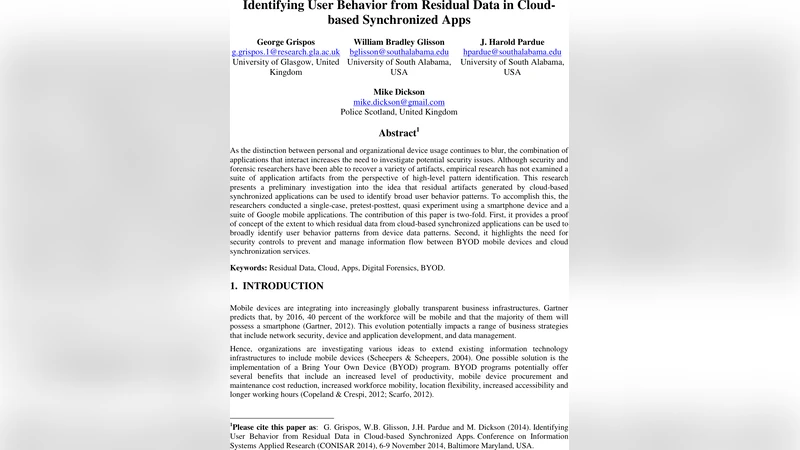
As the distinction between personal and organizational device usage continues to blur, the combination of applications that interact increases the need to investigate potential security issues. Although security and forensic researchers have been able to recover a variety of artifacts, empirical research has not examined a suite of application artifacts from the perspective of high-level pattern identification. This research presents a preliminary investigation into the idea that residual artifacts generated by cloud-based synchronized applications can be used to identify broad user behavior patterns. To accomplish this, the researchers conducted a single-case, pretest-posttest, quasi experiment using a smartphone device and a suite of Google mobile applications. The contribution of this paper is two-fold. First, it provides a proof of concept of the extent to which residual data from cloud-based synchronized applications can be used to broadly identify user behavior patterns from device data patterns. Second, it highlights the need for security controls to prevent and manage information flow between BYOD mobile devices and cloud synchronization services. Keywords: Residual Data, Cloud, Apps, Digital Forensics, BYOD
💡 Research Summary
The paper investigates whether residual artifacts left by cloud‑synchronized mobile applications can be leveraged to infer high‑level user behavior patterns, particularly in a BYOD (Bring Your Own Device) context where personal and corporate usage increasingly overlap. The authors conducted a single‑case, pre‑test/post‑test quasi‑experimental study using an Android smartphone loaded with a suite of Google applications (Google Calendar, Gmail, Google Drive, Google Photos, etc.).
In the pre‑test phase, the device was configured with default settings and allowed to synchronize normally with Google’s cloud services. After establishing a baseline, the researchers deliberately deleted local files and cleared application caches while keeping the synchronization settings active. Over a 48‑hour observation window, the participant used the device as usual, generating new calendar events, emails, documents, and photos. At the end of the period, forensic images were acquired from both the handset’s internal storage and the associated Google cloud accounts.
Data acquisition employed industry‑standard mobile forensic tools (Cellebrite UFED for logical and physical extraction, Autopsy and FTK Imager for analysis). The investigators focused on metadata such as timestamps, GPS coordinates embedded in EXIF data, IP addresses, file hashes, SQLite database entries, and server‑side logs. By correlating these artifacts, they reconstructed a timeline of user activities, identified location‑based patterns, and mapped the flow of information between the device and the cloud.
Key findings include: (1) Recoverability of Deleted Data – Even after local deletion, copies persisted in the cloud and were fully recoverable using forensic techniques. (2) Temporal Activity Patterns – Calendar events and email exchanges clustered during typical work hours (09:00‑18:00), while photo uploads peaked around lunch (12:00‑13:00) and post‑work periods (18:00‑20:00). (3) Spatial Patterns – GPS metadata from photos revealed distinct locations (office, café, home), allowing the reconstruction of the user’s movement trajectory. (4) Work‑Flow Reconstruction – Email content and Google Drive version histories exposed the sequence of project‑related tasks, document revisions, and collaboration events. Together, these artifacts demonstrated that residual data from synchronized apps can be synthesized into a coherent model of a user’s daily routine and professional activities.
From a security perspective, the study underscores the risk that automatic cloud synchronization poses in BYOD environments. Because data is continuously backed up to remote servers, loss or theft of the device does not eliminate the exposure of sensitive information; an adversary with cloud credentials or compromised accounts could retrieve the same artifacts. The authors recommend several mitigations: (a) end‑to‑end encryption for data in transit and at rest, (b) strict access controls including multi‑factor authentication and least‑privilege policies, (c) differentiated synchronization policies that restrict corporate data to managed cloud instances while allowing personal data to remain on the device, and (d) continuous monitoring of synchronization logs to detect anomalous activity.
The paper acknowledges limitations: the experiment involved only one device, a single operating system (Android), and a specific vendor’s ecosystem (Google). The observation period was relatively short, limiting insights into long‑term behavioral trends. No comparison was made with iOS or alternative cloud services such as Microsoft OneDrive or Dropbox. Consequently, the authors call for broader studies encompassing multiple platforms, larger participant pools, and diverse cloud providers to validate the generalizability of their proof‑of‑concept.
In conclusion, the research provides empirical evidence that residual artifacts from cloud‑synchronized mobile applications are a rich source of information for forensic analysts and can be used to infer user behavior at a macro level. It also highlights an urgent need for organizations to implement robust security controls and policies governing BYOD devices and cloud synchronization services, thereby mitigating the privacy and data‑leakage risks inherent in modern mobile work environments.