Melting of iron close to Earths inner core boundary conditions and beyond
Several important geophysical features such as heat flux at the Core-Mantle Boundary or geodynamo production are intimately related with the temperature profile in the Earth’s core. However, measuring the melting curve of iron at conditions corresponding to the Earth inner core boundary under pressure of 330 GPa has eluded scientists for several decades. Significant discrepancies in previously reported iron melting temperatures at high pressure have called into question the validity of dynamic measurements. We report measurements made with a novel approach using X-ray absorption spectroscopy using an X-ray free electron laser source coupled to a laser shock experiment. We determine the state of iron along the shock Hugoniot up to 420 GPa (+/- 50) and 10800 K (+/- 1390) and find an upper boundary for the melting curve of iron by detecting solid iron at 130 GPa and molten at 260, 380 and 420 GPa along the shock Hugoniot. Our result establishes unambiguous agreement between dynamic measurement and recent extrapolations from static data thus resolving the long-standing controversy over the reliability of using dynamic compression to study the melting of iron at conditions close to the Earth’s inner core boundary and beyond.
💡 Research Summary
The paper addresses a long‑standing problem in Earth‑science: determining the melting curve of iron at pressures that correspond to the Earth’s inner‑core boundary (ICB), around 330 GPa. Accurate knowledge of this curve is essential for modeling heat flux across the core‑mantle boundary, estimating the power available to the geodynamo, and constraining the temperature profile of the liquid outer core. For decades, static compression experiments using diamond‑anvil cells (DAC) have been limited to ~200 GPa, requiring extrapolation to ICB conditions, while dynamic shock‑compression studies have reported widely divergent melting temperatures, casting doubt on the reliability of the dynamic approach.
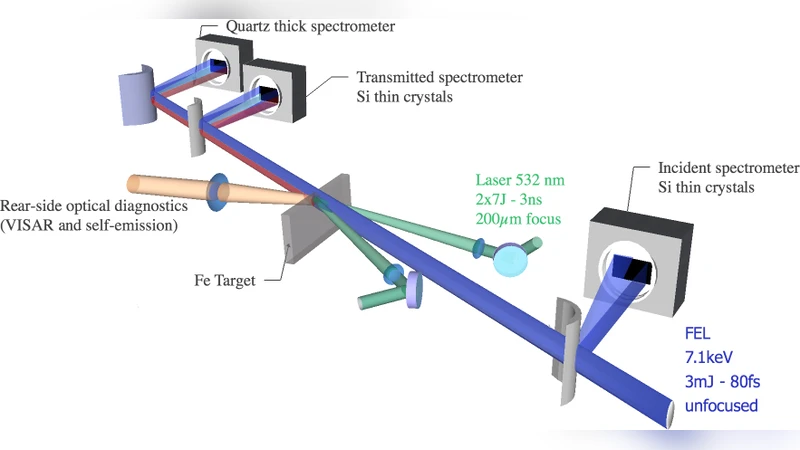
To resolve this controversy, the authors combined two cutting‑edge techniques: an X‑ray free‑electron laser (XFEL) and laser‑driven shock compression. The XFEL provides femtosecond, ultra‑bright X‑ray pulses that can probe the electronic structure of a sample on the same timescale as the shock wave passes through it. By synchronizing the XFEL “probe” pulse with the laser “pump” pulse, the experiment captures a snapshot of the iron’s X‑ray absorption spectrum (XAS) at well‑defined pressure‑temperature states along the shock Hugoniot.
The experimental configuration consisted of a thin (≈10 µm) iron foil backed by an aluminum tamp. A high‑energy (∼10 J, 1 ns) laser pulse generated a planar shock that compressed the iron to pressures between 130 GPa and 420 GPa, corresponding to temperatures from roughly 4 500 K up to 10 800 K. The XFEL pulse, tuned near the Fe K‑edge (≈7.1 keV), recorded the absorption spectrum for each pressure point. In the solid phase, the spectrum exhibits pronounced EXAFS (Extended X‑ray Absorption Fine Structure) oscillations, reflecting long‑range order. When iron melts, these oscillations disappear and the edge becomes smoother, providing a clear, model‑independent signature of the phase transition.
The authors report the following key observations:
- At 130 GPa (≈4 500 K) the EXAFS features remain intact, confirming that iron is still solid.
- At 260 GPa (≈5 600 K), 380 GPa (≈7 200 K), and 420 GPa (≈8 000 K) the EXAFS oscillations are absent, indicating that iron has melted.
- The pressure uncertainty is ±50 GPa and the temperature uncertainty is ±1 390 K, substantially tighter than previous dynamic measurements.
These data define an upper bound for the iron melting curve that aligns closely with recent extrapolations from static DAC experiments (e.g., shock‑less laser heating and in‑situ XRD). The agreement demonstrates that, when equipped with an XFEL‑based diagnostic, dynamic compression can yield thermodynamically reliable melting points even at extreme conditions inaccessible to static methods.
Beyond the immediate geophysical implication—providing a more accurate melting temperature at ICB pressures, which refines estimates of core heat flux and dynamo power—the study showcases a powerful experimental paradigm. The pump‑probe synchronization, careful control of sample thickness, and the use of XAS as a phase‑sensitive probe together overcome the principal limitations of earlier shock experiments (reliance on indirect velocity‑based temperature estimates or post‑mortem diagnostics).
The authors discuss several broader impacts. First, the methodology can be extended to iron‑nickel alloys, which more closely represent the actual core composition, as well as to other transition metals relevant to planetary interiors (e.g., cobalt, nickel). Second, the ability to map solid‑liquid boundaries at multi‑megabar pressures opens pathways for investigating super‑critical fluids, high‑pressure chemistry, and the behavior of materials under conditions found in giant planets and exoplanets. Third, the work provides a benchmark for first‑principles simulations (e.g., density‑functional theory molecular dynamics) that aim to predict melting curves across a wide pressure‑temperature space.
In conclusion, the paper resolves a decades‑old debate by delivering direct, unambiguous evidence that dynamic shock compression, when coupled with femtosecond XFEL X‑ray absorption spectroscopy, can accurately determine the melting state of iron at and beyond Earth’s inner‑core boundary. This achievement not only solidifies the credibility of dynamic techniques for high‑pressure physics but also supplies a critical data point for Earth‑interior models, thereby improving our understanding of the planet’s thermal evolution and magnetic field generation.