An index theorem in differential K-theory
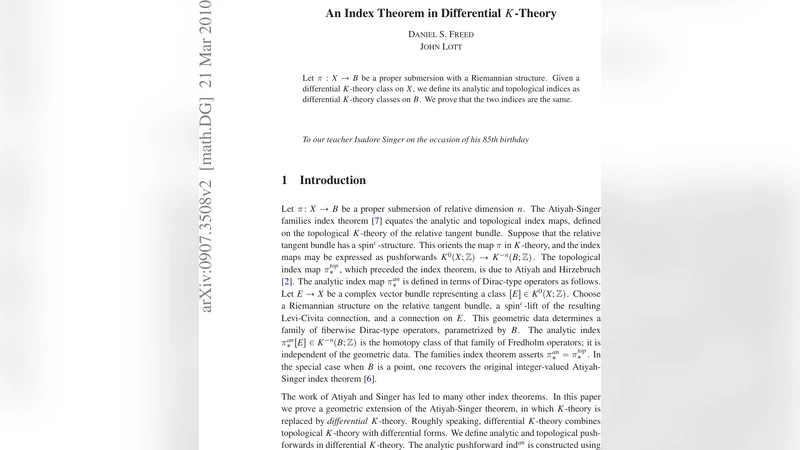
Let X –> B be a proper submersion with a Riemannian structure. Given a differential K-theory class on X, we define its analytic and topological indices as differential K-theory classes on B. We prove that the two indices are the same.
💡 Research Summary
The paper develops a differential‑K‑theoretic version of the Atiyah‑Singer family index theorem. Let π : X → B be a proper submersion equipped with a vertical Riemannian metric and a Spinⁿᶜ structure, so that a family of vertical Dirac operators D_π is defined. A differential K‑theory class α∈ĤK⁰(X) is represented by a triple (k, ω, h) consisting of an ordinary K‑class k, a differential form ω (the Chern‑Simons form), and a Cheeger‑Simons character h. The authors construct two indices for α, both landing in the differential K‑theory of the base B.
The analytic index Indₐ(α) is obtained by applying the family index of D_π, together with Bismut‑Freed’s η‑form, to the Chern character of α. Explicitly, Indₐ(α)=π_^{an}(ch(α)·Â(T^V X)) + a(η(D_π,∇^α)), where π_^{an} denotes the push‑forward in ordinary K‑theory, Â is the A‑roof genus of the vertical tangent bundle, η(D_π,∇^α) is the Bismut‑Freed transgression form built from the connection on α, and a lifts a differential form to a differential K‑class.
The topological index Indₜ(α) is defined by lifting the usual topological push‑forward π_! in K‑theory to differential K‑theory. This requires a refined push‑forward on differential forms, which incorporates the Todd class of the vertical bundle and the differential form component ω of α: Indₜ(α)=π_*^{top}(ch(α)·Â(T^V X)) + a(∫_{X/B}Td(T^V X)∧ω_α).
The central theorem states that for every α∈ĤK⁰(X) one has Indₐ(α)=Indₜ(α) in ĤK⁰(B). The proof proceeds by comparing the two constructions and showing that their difference is an exact element in the differential K‑theory exact sequence 0→Ω^{odd}(B)/im d→ĤK⁰(B)→K⁰(B)→0. The authors use the Bismut‑Lott superconnection formalism to express the analytic index as a sum of a topological term and a transgression term. The transgression term is precisely the η‑form, whose differential equals the difference between the Chern character of the analytic push‑forward and the fiberwise integral of the Chern character of α. By invoking the Cheeger‑Simons differential character theory, they identify this difference with the boundary of a differential form, which is killed by the map a. Consequently the two indices coincide.
Beyond the core theorem, the paper discusses several consequences. It recovers the classical family index theorem when the differential data are trivial, and it provides a refined index formula that includes both topological information (K‑theory class) and geometric information (connections, curvature). This refined index is particularly relevant for anomaly cancellation in quantum field theory, where the η‑form encodes global phase information, and for string theory, where D‑brane charges are naturally described by differential K‑theory. The authors also outline how their framework can be extended to twisted differential K‑theory and to manifolds with boundary, suggesting a broad program of integrating differential cohomology with index theory.
In summary, the work establishes a complete and natural index theorem in differential K‑theory, showing that the analytically defined index (via families of Dirac operators and η‑forms) agrees exactly with the topologically defined push‑forward, thereby unifying analytic and topological perspectives at the differential‑cohomological level.
Comments & Academic Discussion
Loading comments...
Leave a Comment