A cartesian presentation of weak n-categories
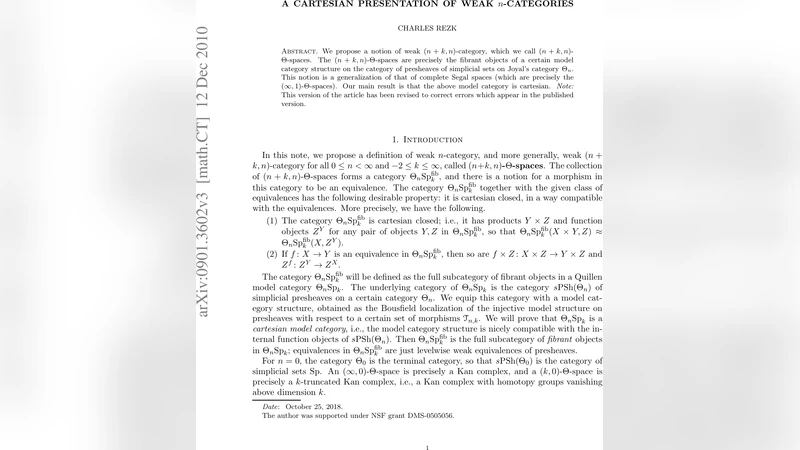
We propose a notion of weak (n+k,n)-category, which we call (n+k,n)-Theta-spaces. The (n+k,n)-Theta-spaces are precisely the fibrant objects of a certain model category structure on the category of presheaves of simplicial sets on Joyal’s category Theta_n. This notion is a generalization of that of complete Segal spaces (which are precisely the (infty,1)-Theta-spaces). Our main result is that the above model category is cartesian.
💡 Research Summary
The paper introduces a new homotopical framework for weak higher categories by exploiting Joyal’s Θₙ, a combinatorial category that encodes n‑dimensional tree‑like shapes and their face‑coface maps. The authors consider the presheaf category Fun(Θₙᵒᵖ, sSet) and endow it with a cofibrantly generated model structure in which cofibrations are monomorphisms and weak equivalences are local weak equivalences (i.e., maps that become weak equivalences after evaluating at each object of Θₙ).
Fibrant objects in this model are called (n + k, n)‑Theta‑spaces. They satisfy two key conditions: a Segal condition that forces the canonical Segal maps associated to the compositional structure of Θₙ to be weak equivalences, and a completeness (or normalization) condition that requires the “completeness map” to be a weak equivalence. When k = 0 the objects model fully complete n‑categories; when k = ∞ they recover Rezk’s (∞, 1)‑Theta‑spaces, i.e., complete Segal spaces. Thus (n + k, n)‑Theta‑spaces simultaneously generalize complete Segal spaces, n‑fold complete Segal spaces, and the various (∞, n)‑category models appearing in the literature.
The central theorem is that the resulting model category is cartesian: the product of two fibrant objects is again fibrant, and the product functor preserves cofibrations and trivial cofibrations. To prove this, the authors develop a detailed cellular description of Θₙ, identify generating (trivial) cofibrations, and introduce a “normalized box product” on presheaves that respects the cellular structure. They then apply the transfer theorem for model structures, showing that the cartesian product on sSet lifts to a cartesian product on Fun(Θₙᵒᵖ, sSet) compatible with the model structure. Left properness and combinatoriality are verified, guaranteeing good behavior of homotopy colimits and enabling the construction of internal hom‑objects.
Comparisons with existing models are provided. For Θ₁ the fibrant objects coincide with Rezk’s complete Segal spaces; for general n the authors exhibit Quillen equivalences with Barwick–Schommer‑Pries’s n‑fold complete Segal spaces and, after suitable localization, with Lurie’s (∞, n)‑category model. These equivalences are established by constructing explicit Quillen adjunctions that preserve the Segal and completeness conditions.
Finally, the paper outlines future directions. The cartesian nature of the model permits the definition of internal hom‑objects, leading to a notion of “mapping Theta‑space” between two (n + k, n)‑Theta‑spaces. This opens the door to enriched higher category theory, higher‑dimensional operads, and the development of (∞, n)‑topoi within the same framework. Moreover, the normalized box product and cellular induction techniques introduced here are expected to be useful for building cartesian model structures for other homotopical algebraic objects such as ∞‑operads or higher‑categorical sheaf theories.
Comments & Academic Discussion
Loading comments...
Leave a Comment