Asymptotic Geometry in the product of Hadamard spaces with rank one isometries
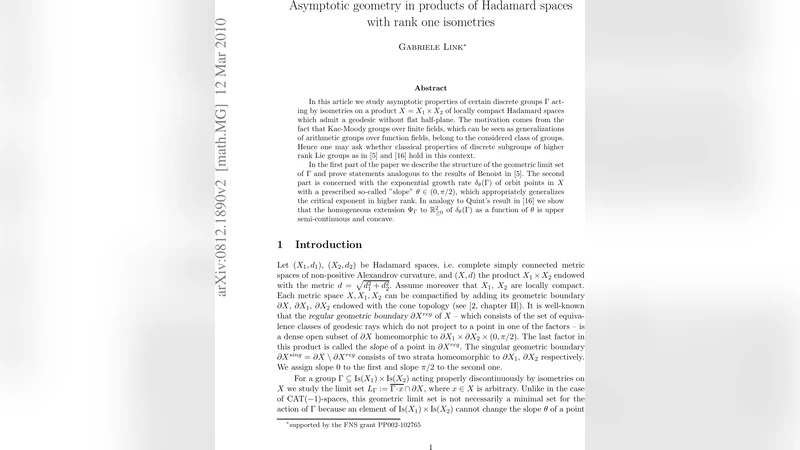
In this article we study asymptotic properties of certain discrete groups $\Gamma$ acting by isometries on a product $\XX=\XX_1\times \XX_2$ of locally compact Hadamard spaces. The motivation comes from the fact that Kac-Moody groups over finite fields, which can be seen as generalizations of arithmetic groups over function fields, belong to this class of groups. Hence one may ask whether classical properties of discrete subgroups of higher rank Lie groups as in [MR1437472] and [MR1933790] hold in this context. In the first part of the paper we describe the structure of the geometric limit set of $\Gamma$ and prove statements analogous to the results of Benoist in [MR1437472]. The second part is concerned with the exponential growth rate $\delta_\theta(\Gamma)$ of orbit points in $\XX$ with a prescribed so-called “slope” $\theta\in (0,\pi/2)$, which appropriately generalizes the critical exponent in higher rank. In analogy to Quint’s result in [MR1933790] we show that the homogeneous extension $\Psi_\Gamma$ to $\RR_{\ge 0}^2$ of $\delta_\theta(\Gamma)$ as a function of $\theta$ is upper semi-continuous and concave.
💡 Research Summary
The paper investigates the asymptotic geometry of discrete groups Γ acting by isometries on a product X = X₁ × X₂ of two locally compact Hadamard spaces. The motivation comes from the fact that Kac–Moody groups over finite fields, which generalise arithmetic groups over function fields, belong to this class. The authors ask whether classical results for discrete subgroups of higher‑rank Lie groups (Benoist, Quint) extend to this more singular setting.
In the first part the authors analyse the geometric limit set Λ(Γ) ⊂ ∂X. Because each factor X_i is a CAT(0) space of non‑positive curvature, its visual boundary ∂X_i is well defined, and the product boundary ∂X = ∂X₁ × ∂X₂ inherits a product structure. Assuming that Γ contains at least one rank‑one isometry in each factor, they prove that the projections π_i(Λ(Γ)) are Γ‑invariant closed subsets of ∂X_i and that Λ(Γ) actually equals the product of these projections: Λ(Γ) = Λ₁ × Λ₂. This mirrors Benoist’s description of limit sets for Zariski‑dense subgroups of semisimple Lie groups, but now holds for groups acting on non‑symmetric, possibly singular Hadamard spaces. The proof uses the dynamics of rank‑one axes, Patterson–Sullivan type measures on the boundary, and a careful analysis of how the two factors interact under the product action.
The second part introduces a “slope” parameter θ ∈ (0,π/2) to separate orbit points according to the ratio of their distances in the two factors. For a base point o = (o₁,o₂) and ε > 0 they define
δ_θ(Γ) = limsup_{R→∞} (1/R) log #{γ ∈ Γ : |d₁(o₁,γ₁o₁) – R cosθ| < ε, |d₂(o₂,γ₂o₂) – R sinθ| < ε}.
When θ varies, δ_θ(Γ) interpolates between the usual critical exponents of the projections of Γ to each factor. The authors then extend δ_θ homogeneously to a function Ψ_Γ : ℝ_{\ge0}² → ℝ_{\ge0} by setting
Ψ_Γ(t₁,t₂) = δ_{arctan(t₂/t₁)}(Γ)·√(t₁² + t₂²).
The main theorem of this section is that Ψ_Γ is upper semi‑continuous and concave on the whole non‑negative quadrant. This result is the exact analogue of Quint’s theorem for Anosov subgroups of higher‑rank semisimple groups, showing that the growth rate as a function of the direction in the Weyl chamber behaves nicely even in the non‑symmetric product setting.
To obtain these properties the authors construct θ‑dependent Patterson–Sullivan measures on the boundary, prove that they are Γ‑invariant, and relate their Hausdorff dimension to δ_θ(Γ). They then apply a subadditivity argument to the counting functions, together with a convexity lemma for the logarithm of the counting series, to deduce the concavity of Ψ_Γ. Upper semi‑continuity follows from a standard limiting argument using the definition of δ_θ as a limsup.
The paper also shows that δ_θ(Γ) varies continuously with θ, and that the limits as θ → 0 or θ → π/2 recover the critical exponents of the projections of Γ onto X₁ and X₂ respectively. This confirms that the product structure does not introduce pathological behaviour: the asymptotic growth in each factor is encoded faithfully in the slope‑dependent exponent.
Overall, the work provides a comprehensive extension of Benoist’s limit‑set description and Quint’s growth‑rate concavity to the setting of discrete groups acting on products of Hadamard spaces with rank‑one isometries. By doing so it lays the groundwork for a systematic study of Kac–Moody groups and other non‑linear, non‑symmetric arithmetic‑type groups using tools originally developed for higher‑rank Lie groups. The results suggest that many rigidity and counting phenomena known in the symmetric case may persist in this broader, more singular context.
Comments & Academic Discussion
Loading comments...
Leave a Comment