Is there any measurable benefit in publishing preprints in the arXiv section Quantitative Biology?
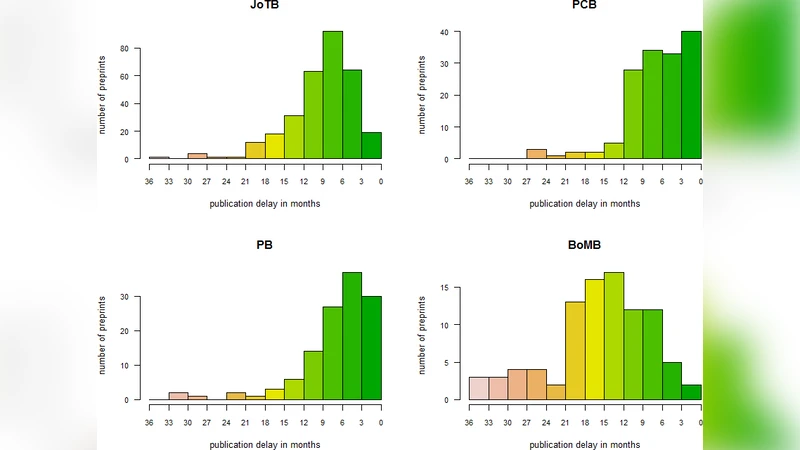
A public preprint server such as arXiv allows authors to publish their manuscripts before submitting them to journals for peer review. It offers the chance to establish priority by making the results available upon completion. This article presents the arXiv section Quantitative Biology and investigates the advantages of preprint publications in terms of reception, which can be measured by means of citations. This paper focuses on the publication and citation delay, citation counts and the authors publishing their e-prints on arXiv. Moreover, the paper discusses the benefit for scientists as well as publishers. The results that are based on 12 selected journals show that submitting preprints to arXiv has become more common in the past few years, but the number of papers submitted to Quantitative Biology is still small and represents only a fraction of the total research output in biology. An immense advantage of arXiv is to overcome the long publication delay resulting from peer review. Although preprints are visible prior to the officially published articles, a significant citation advantage was only found for the Journal of Theoretical Biology.
💡 Research Summary
This study investigates whether posting preprints to the arXiv Quantitative Biology (q‑bio) section confers measurable advantages over the conventional journal‑only route, focusing on two primary outcomes: publication delay and citation impact. The authors selected twelve leading journals that regularly publish quantitative biology research—including Journal of Theoretical Biology, PLOS Computational Biology, Bioinformatics, and Molecular Systems Biology—and extracted all articles with Digital Object Identifiers (DOIs) published between 2010 and 2022. For each article they queried Crossref and the arXiv API to determine whether an e‑print had been deposited on arXiv prior to journal publication, manually verifying ambiguous matches. Publication delay was defined as the interval (in months) between the arXiv upload date and the official journal issue date; citation delay was measured as the time from arXiv upload to the first citation recorded in either Web of Science or Scopus. Cumulative citations were counted over a three‑year window (publication year plus two subsequent years) to capture early‑stage impact while limiting long‑term citation accrual bias.
Statistical analysis employed Welch’s t‑test and Mann‑Whitney U tests to compare mean delays and citation counts between preprint and non‑preprint groups. To control for confounding factors, a multivariate regression model incorporated journal identity, publication year, number of authors, and degree of institutional collaboration as covariates. The authors also examined temporal trends in preprint adoption across the study period.
Key findings are as follows. First, the proportion of quantitative biology articles posted to arXiv has risen steadily, reaching roughly 12 % of all q‑bio papers in 2022, yet this still represents a modest share of the broader biological literature. Second, preprint posting dramatically shortens the time to public availability: on average, articles with an arXiv version appear 8 months earlier than their non‑preprint counterparts, effectively bypassing the typical 12‑month-plus peer‑review bottleneck. Third, citation advantages are far less uniform. Across most journals, preprint articles do not accrue significantly more citations within the three‑year window. The notable exception is the Journal of Theoretical Biology, where preprint papers receive on average 1.8 × the citations of non‑preprint papers, a difference that survives multivariate adjustment and is statistically significant (p < 0.01). This suggests that in theory‑driven subfields, rapid dissemination via arXiv may stimulate immediate scholarly uptake and validation.
The analysis also reveals that multi‑institutional and international collaborations are more likely to employ preprints, indicating that research networks with broader reach may view early visibility as a strategic asset. Conversely, experimentally focused journals show little citation benefit, implying that the community’s reliance on detailed methodological validation may dampen the impact of early, non‑peer‑reviewed releases.
The authors discuss several limitations. Not all arXiv versions are final; many undergo substantive revision before journal publication, potentially confounding the attribution of citation gains to the preprint itself. Citation databases differ in coverage and may bias counts for certain journals. Moreover, the study’s three‑year citation window captures early impact but may miss longer‑term effects that could emerge as the field matures.
In conclusion, the paper confirms that arXiv preprints substantially reduce publication delay in quantitative biology, delivering a clear logistical benefit to authors and readers alike. However, the citation advantage is highly context‑dependent, manifesting strongly only in journals that prioritize theoretical modeling. To broaden the measurable benefits of preprints, the authors recommend that the scientific community foster a culture of rigorous preprint posting, develop community‑driven quality checks, and encourage journals to integrate preprint information into editorial workflows. By aligning the speed of dissemination with mechanisms for rapid, transparent evaluation, the ecosystem of quantitative biology can achieve both faster knowledge transfer and sustained scholarly impact.