Bayesian parameter estimation of core collapse supernovae using gravitational wave simulations
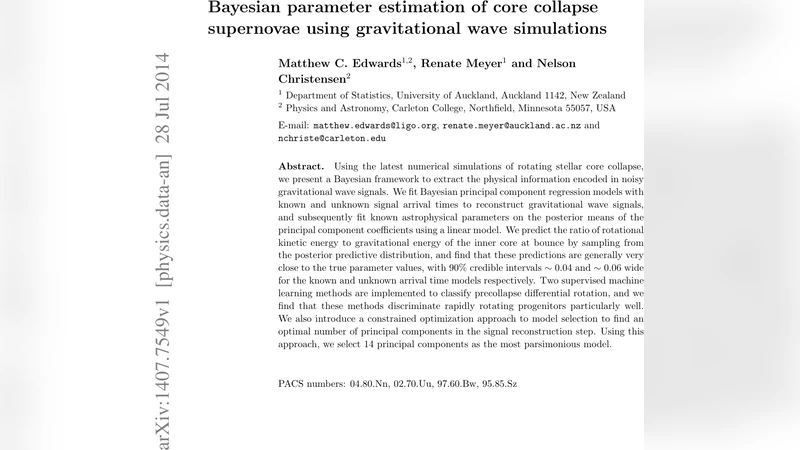
Using the latest numerical simulations of rotating stellar core collapse, we present a Bayesian framework to extract the physical information encoded in noisy gravitational wave signals. We fit Bayesian principal component regression models with known and unknown signal arrival times to reconstruct gravitational wave signals, and subsequently fit known astrophysical parameters on the posterior means of the principal component coefficients using a linear model. We predict the ratio of rotational kinetic energy to gravitational energy of the inner core at bounce by sampling from the posterior predictive distribution, and find that these predictions are generally very close to the true parameter values, with $90%$ credible intervals $\sim 0.04$ and $\sim 0.06$ wide for the known and unknown arrival time models respectively. Two supervised machine learning methods are implemented to classify precollapse differential rotation, and we find that these methods discriminate rapidly rotating progenitors particularly well. We also introduce a constrained optimization approach to model selection to find an optimal number of principal components in the signal reconstruction step. Using this approach, we select 14 principal components as the most parsimonious model.
💡 Research Summary
This paper introduces a comprehensive Bayesian framework for extracting physical information from noisy gravitational‑wave (GW) signals emitted by rotating core‑collapse supernovae (CCSNe). Using the Abdikamalov et al. catalogue of axisymmetric, general‑relativistic simulations, the authors first perform a principal component analysis (PCA) on a “base catalogue” (BC) of 92 waveforms, reducing the high‑dimensional waveform space to a small set of orthonormal basis vectors (principal components, PCs).
Two Bayesian models are constructed. Model 1 assumes the signal arrival time is known. In the frequency domain the data vector ỹ is modeled as ỹ = X̃α + ε, where X̃ contains the Fourier‑transformed PCs, α are the regression coefficients, and ε is coloured Gaussian noise with variance proportional to the pre‑estimated Advanced LIGO one‑sided power spectral density. Flat (improper uniform) priors are placed on α, yielding a multivariate normal posterior that can be sampled analytically without MCMC.
Model 2 relaxes the known‑arrival‑time assumption. An additional parameter τ (the unknown arrival time) is introduced, and a Metropolis‑within‑Gibbs sampler is employed: τ is updated via a Metropolis step, while α is drawn from its conditional normal distribution. This joint sampling allows simultaneous reconstruction of the waveform and estimation of τ, albeit with a modest increase in posterior uncertainty.
After reconstructing the signal, the posterior means of the PC coefficients are fed into a second‑stage linear model that maps them to the physical parameter β_ic,b (the ratio of rotational kinetic energy to gravitational binding energy of the inner core at bounce). By sampling from the posterior predictive distribution, the authors obtain point estimates and 90 % credible intervals for β_ic,b. For the known‑arrival‑time case the interval width is ≈0.04; for the unknown‑arrival‑time case it widens slightly to ≈0.06, still providing tight constraints.
The authors also address classification of the precollapse differential rotation parameter A, which takes five discrete levels. They train two supervised classifiers on the PC‑coefficient means: a naïve Bayes classifier (assuming conditional independence of PCs) and a k‑nearest‑neighbors (k‑NN) classifier (k = 5). Both methods perform especially well for rapidly rotating cores (β_ic,b ≈ 0.09), correctly identifying high‑A (weak differential rotation) versus low‑A (strong differential rotation) cases with >95 % accuracy.
Model selection is tackled via a constrained optimization approach: the number of PCs d is treated as a hyperparameter subject to a parsimony constraint (limiting model complexity). By minimizing the cross‑validated posterior predictive error under this constraint, the authors find that d = 14 PCs provide the most parsimonious yet accurate representation of the waveforms. This choice balances information retention against over‑fitting and is more flexible than the smaller d values used in earlier studies.
All experiments are conducted with injected signals at a fixed signal‑to‑noise ratio (SNR) of 20 in coloured Gaussian noise shaped by the Advanced LIGO noise curve. This SNR is deliberately conservative, as real Galactic CCSNe would likely yield higher SNRs. Nevertheless, the framework remains robust at this low SNR, demonstrating that Bayesian principal component regression (PCR) can reliably reconstruct CCSN waveforms and infer underlying astrophysical parameters where traditional template‑matching or maximum‑entropy methods struggle due to the high dimensionality of the parameter space.
In summary, the paper delivers a statistically rigorous, computationally efficient pipeline: (1) dimensionality reduction via PCA, (2) Bayesian PCR for waveform reconstruction (with or without known arrival time), (3) linear mapping from PC coefficients to β_ic,b, and (4) supervised classification of differential rotation. The constrained‑optimization model‑selection step identifies 14 PCs as optimal. The results show that even with modest SNR, the method yields accurate estimates of β_ic,b (credible‑interval widths ≤ 0.06) and discriminates rapidly rotating progenitors effectively, offering a promising tool for future gravitational‑wave data analysis of core‑collapse supernovae.
Comments & Academic Discussion
Loading comments...
Leave a Comment