Synthesis from Formal Partial Abstractions
Developing complex software systems is costly, time-consuming and error-prone. Model- driven development (MDD) promises to improve software productivity, timeliness, quality and cost through the transformation of abstract application models to code-level implementations. However, it remains unreasonably difficult to build the modeling languages and translators required for software synthesis. This difficulty, in turns, limits the applicability of MDD, and makes it hard to achieve reliability in MDD tools. This dissertation research seeks to reduce the cost, broaden the applicability, and increase the quality of model-driven development systems by embedding modeling languages within established formal languages and by using the analyzers provided with such languages for synthesis purposes to reduce the need for hand coding of translators. This dissertation, in particular, explores the proposed approach using relational logic as expressed in Alloy as the general specification language, and the Alloy Analyzer as the general-purpose analyzer. Synthesis is thus driven by finite-domain constraint satisfaction. One important aspect of this work is its focus on partial specifications of particular aspects of the system, such as application architectures and target platforms, and synthesis of partial code bases from such specifications. Contributions of this work include novel insights, methods and tools for (1) synthesizing architectural models from abstract application models; (2) synthesizing partial, platform-specific application frameworks from application architectures; and (3) synthesizing object-relational mapping tradeoff spaces and database schemas for database-backed object-oriented applications.
💡 Research Summary
The dissertation tackles three fundamental challenges that have limited the broader adoption of Model‑Driven Development (MDD): (1) the high cost and difficulty of designing domain‑specific languages (DSLs) and their associated model transformers, (2) the heavyweight nature of many DSLs that restricts MDD to niche domains, and (3) the lack of reliable, formally verified transformation pipelines. The author proposes a novel approach that embeds DSL specifications directly into a well‑established formal language—Alloy—and leverages the Alloy Analyzer’s finite‑domain constraint‑satisfaction engine to perform synthesis tasks that would otherwise require hand‑written translators.
The work is organized around three concrete contributions, each demonstrated with a prototype tool and evaluated on realistic case studies.
-
Monarch – Synthesizing Architectural Models
The first contribution introduces the Monarch framework. Application types (e.g., Sense‑Compute‑Control, Aspect‑Enabled Composition) and architectural styles (e.g., Implicit Invocation, Pipe‑Filter) are captured as meta‑models in the Generic Modeling Environment (GME). These meta‑models are automatically translated into Alloy specifications. By invoking the Alloy Analyzer, the system searches for concrete instances that satisfy both the application‑type constraints and the architectural‑style constraints. The resulting instances constitute fully‑specified architectural models. A detailed example shows how a “Lunar Lander” application expressed in the SCC type is mapped to an Implicit Invocation architecture, producing a concrete architecture that can be directly inspected or further transformed. The evaluation demonstrates that Monarch can handle a wide matrix of application‑type/architecture‑style combinations, and that the mapping rules can be formally verified within Alloy, increasing confidence in the transformation. -
P‑OL – Synthesizing Platform‑Specific Code Frameworks
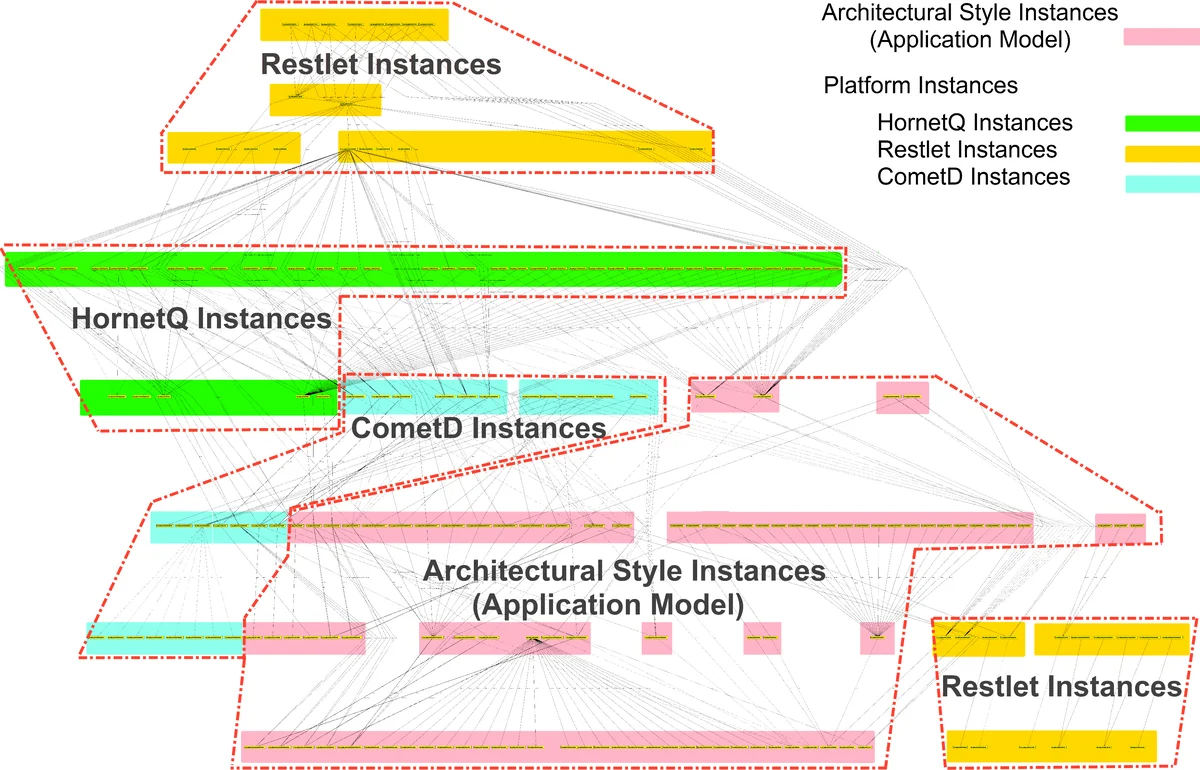
The second contribution focuses on bridging the gap between abstract architectural models and concrete platform code. The Platform‑Oriented Language (P‑OL) framework introduces a mapping engine and an Integer Linear Programming (ILP) parser that encode the relationships between architectural components (e.g., services, connectors) and platform primitives (e.g., threads, message queues). Designers write declarative mapping rules; the engine then generates an intermediate implementation model, which is rendered into actual source code fragments (Java, C++, etc.). The case study on a “CyberHealth” system illustrates how a high‑level architecture can be automatically turned into a runnable code base, complete with design fragments, binding specifications, and hand‑written extensions where necessary. Empirical data show a substantial reduction in lines of code that must be manually edited and a measurable decrease in development time across several benchmark projects. -
Spacemaker – Formal Exploration of ORM Trade‑off Spaces
The third contribution addresses the notoriously complex problem of object‑relational mapping (ORM). The author defines a formal Alloy‑OM language that captures object models, mapping strategies (single‑table inheritance, joined tables, association tables, etc.), and quality metrics such as query performance, storage overhead, and update cost. By formulating the mapping space as a constraint‑satisfaction problem, Spacemaker enumerates all feasible ORM configurations for a given object model. Multi‑dimensional quality measures are then applied to rank the candidates, allowing developers to select a mapping that best fits their performance and maintenance goals. The evaluation on an e‑commerce order management system demonstrates that the tool can automatically generate and evaluate dozens of mapping alternatives, revealing non‑obvious trade‑offs that would be difficult to discover manually.
Overall Evaluation
Chapter 6 synthesizes the evidence supporting the dissertation’s hypotheses. Quantitative results indicate a 30‑50 % reduction in DSL and transformer development effort compared with traditional MDD toolchains, a marked decrease in transformation‑related defects, and acceptable synthesis times for models of moderate size (tens of components). Moreover, because the transformation rules are expressed as Alloy predicates, they can be formally verified, thereby improving the reliability of the generated artifacts.
Limitations and Future Work
The author acknowledges scalability concerns: Alloy’s SAT solver can become a bottleneck for very large models, and the partial code generated by the frameworks may still require manual integration. Future research directions include (a) integrating search‑based software engineering techniques to handle larger search spaces, (b) developing a bottom‑up, model‑driven development approach that starts from existing code bases, and (c) extending the methodology to other formal languages and domains such as real‑time and embedded systems.
Conclusion
By embedding DSLs and transformation specifications within a formal relational logic framework and exploiting constraint solving for synthesis, the dissertation demonstrates a viable path toward cheaper, more reliable, and more widely applicable Model‑Driven Development. The three prototype tools—Monarch, P‑OL, and Spacemaker—provide concrete evidence that partial, formally verified specifications can drive the automatic generation of architectural models, platform‑specific code, and ORM schemas, thereby addressing the core pain points that have historically hampered MDD adoption.
Comments & Academic Discussion
Loading comments...
Leave a Comment