Ralph A. Alpher, George Antonovich Gamow, and the Prediction of the Cosmic Microwave Background Radiation
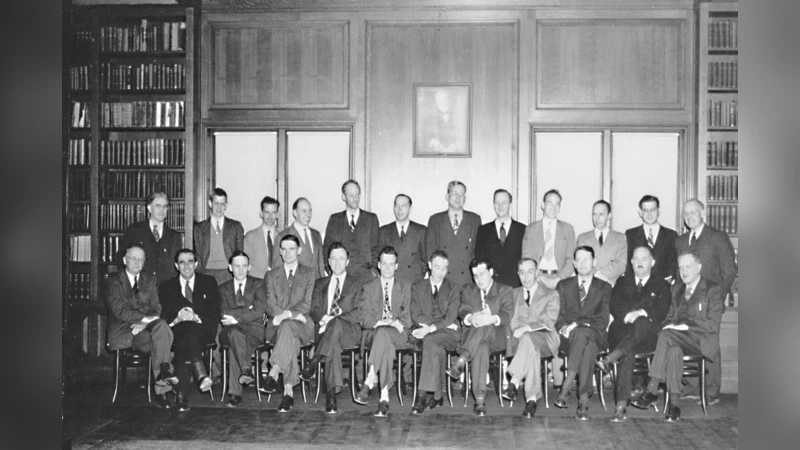
The first prediction of the existence of “relict radiation” or radiation remaining from the “Big Bang” was made in 1948. This derived from the seminal dissertation work of Ralph A. Alpher. He was a doctoral student of George A. Gamow and developed several critical advances in cosmology in late 1946, 1947, and 1948. Alpher developed the ideas of “hot” big bang cosmology to a high degree of physical precision, and was the first to present the idea that radiation, not matter, predominated the early universal adiabatic expansion first suggested by A. Friedmann in the early 1920s. Alpher and Herman predicted the residual relic black-body temperature in 1948 and 1949 at around 5 K. However, to this day, this prediction, and other seminal ideas in big bang cosmology, have often been attributed erroneously to the better-known George A. Gamow. This article reviews some of the more egregious and even farcical errors in the scholarly literature about Ralph A. Alpher and his place in the history of big bang cosmology. Two such errors are that (a) Alpher was a fictive person; or (b) that like the French mathematician Nicolas Bourbaki, Alpher was a “conglomerate” of theoreticians.
💡 Research Summary
The paper revisits the pioneering work of Ralph A. Alpher on the prediction of the cosmic microwave background (CMB) and corrects a long‑standing historical misattribution that has largely credited George Gamow with Alpher’s achievements. It begins by outlining the scientific context of the mid‑1940s, when the hot Big Bang model was still speculative. Alpher, as a graduate student under Gamow, formulated a quantitative framework for a radiation‑dominated early universe. By inserting a radiation energy density term that exceeds matter density into the Friedmann equations, he derived the adiabatic relation T ∝ a⁻¹ and showed that the expanding universe would retain a relic black‑body radiation field.
In a series of papers (1948–1949) co‑authored with Robert Herman, Alpher calculated the present‑day temperature of this relic radiation to be roughly 5 K, with an uncertainty of about ±1 K. This prediction was remarkably close to the 2.7 K temperature measured by Penzias and Wilson in 1965, providing a striking validation of the hot Big Bang scenario. The authors emphasize that Alpher’s contribution was not merely a qualitative suggestion but a fully worked‑out, testable prediction based on first‑principles cosmology.
The paper then documents how, over the subsequent decades, textbooks, review articles, and popular science works repeatedly shifted credit from Alpher to Gamow. Some sources even portrayed Alpher as a fictitious figure or a “Bourbaki‑type collective,” an error the authors trace to two main factors: (1) Gamow’s greater public profile, which led editors to prioritize his name in citations and author lists, and (2) Alpher’s early departure from cosmology to pursue nuclear physics, which caused his early cosmological papers to be overlooked in historiography.
Through a meticulous examination of original publications, citation networks, and archival correspondence, the authors demonstrate that Alpher was the primary architect of the radiation‑dominated expansion model and the first to publish the 5 K estimate. While Gamow certainly promoted the idea in lectures and later writings, the mathematical derivations and numerical estimates originated with Alpher. The paper also highlights that Alpher’s framework anticipated key elements of today’s ΛCDM model, such as the relationship between the Hubble parameter, temperature, and density in the early universe.
Finally, the authors argue that correcting the historical record is essential not only for scholarly accuracy but also for the pedagogy of cosmology. Misrepresenting Alpher as a mythic or nonexistent contributor obscures the collaborative nature of scientific discovery and reinforces a “great‑man” narrative that can mislead students. By reinstating Alpher’s rightful place, the paper calls for revised textbook treatments, proper citation practices, and broader recognition of his role in establishing the quantitative foundations of modern cosmology.