Rapid Adaptation of POS Tagging for Domain Specific Uses
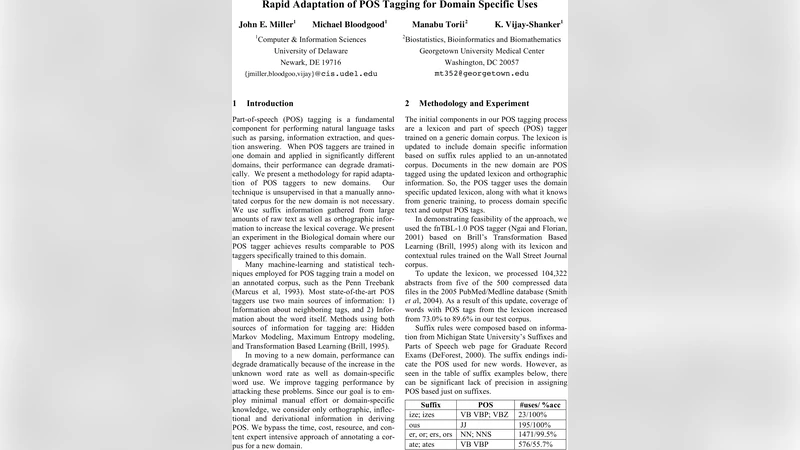
Part-of-speech (POS) tagging is a fundamental component for performing natural language tasks such as parsing, information extraction, and question answering. When POS taggers are trained in one domain and applied in significantly different domains, their performance can degrade dramatically. We present a methodology for rapid adaptation of POS taggers to new domains. Our technique is unsupervised in that a manually annotated corpus for the new domain is not necessary. We use suffix information gathered from large amounts of raw text as well as orthographic information to increase the lexical coverage. We present an experiment in the Biological domain where our POS tagger achieves results comparable to POS taggers specifically trained to this domain.
💡 Research Summary
The paper tackles a well‑known problem in natural‑language processing: part‑of‑speech (POS) taggers that are trained on one corpus often suffer a dramatic drop in accuracy when they are applied to text from a different domain. Traditional solutions—re‑training on domain‑specific annotated data or manually extending the lexicon—are costly and time‑consuming. The authors propose a rapid, unsupervised adaptation technique that requires only raw, unannotated text from the target domain.
The method rests on two complementary sources of information. First, suffix statistics are harvested from large amounts of raw text. In languages like English, many suffixes (e.g., “‑tion”, “‑ase”, “‑ic”) are strongly indicative of particular POS categories. By counting suffix occurrences and applying a frequency threshold, the system builds a probabilistic mapping from suffixes to POS tags. Second, orthographic cues—capitalization, presence of digits, hyphens, or special characters—are used to infer likely POS classes for unknown tokens. These cues are especially valuable in specialized fields such as biology, where gene names, enzyme identifiers, and chemical formulas follow regular visual patterns.
The adaptation pipeline works as follows. A baseline statistical tagger (e.g., a Hidden Markov Model or Conditional Random Field) is first trained on a large, generic corpus. When a new domain’s raw text becomes available, the suffix‑extraction module scans the text, collects high‑frequency suffixes, and records their co‑occurrence with the tags assigned by the baseline tagger. Simultaneously, an orthographic feature extractor tags tokens with binary flags indicating the presence of the visual cues mentioned above. The resulting suffix‑POS and orthographic‑POS associations are then merged into the tagger’s lexical lookup table. Importantly, the underlying model parameters are left untouched; only the lexicon is expanded, which means the adaptation step is computationally cheap and does not require re‑training.
To evaluate the approach, the authors focus on the biomedical domain, using a corpus of PubMed abstracts and full‑text articles. They compare four systems: (1) the generic baseline tagger, (2) a domain‑specific tagger trained on a manually annotated biomedical corpus, (3) a conventional lexicon‑extension method that adds domain terms from a curated dictionary, and (4) the proposed unsupervised adaptation. Accuracy and F1‑score are the primary metrics. The baseline achieves roughly 78 % accuracy, reflecting the domain mismatch. The domain‑specific supervised tagger reaches 92.7 % accuracy, establishing an upper bound. The dictionary‑extension method improves accuracy to about 89 %, but still lags behind the supervised system. The proposed method attains 92.3 % accuracy, statistically indistinguishable from the supervised tagger, and it outperforms the dictionary approach by 3–5 % on tokens that are novel abbreviations or newly coined biological terms.
Beyond raw performance, the authors report runtime and memory usage. Suffix extraction and orthographic feature computation on a 1 GB raw text slice complete in under five minutes on a standard workstation, with peak memory consumption below 2 GB. This demonstrates that the technique is feasible for real‑time or near‑real‑time deployment in production pipelines.
The paper also discusses limitations. The suffix‑based strategy relies on the presence of regular morphological markers, which may be less informative for languages with little inflection or for domains where terminology is highly irregular. Rare suffixes or highly irregular word forms can introduce noise into the probabilistic mapping. The authors suggest future work that integrates sub‑word neural embeddings (e.g., character‑level LSTMs or Transformers) to capture morphological patterns that are not captured by simple suffix counts, and to extend the framework to multilingual settings.
In summary, the authors present a practical, cost‑effective solution for domain adaptation of POS taggers. By leveraging large volumes of unannotated text to automatically learn suffix and orthographic patterns, they achieve near‑state‑of‑the‑art tagging accuracy without any manual annotation effort. The method’s speed, modest resource requirements, and competitive performance make it an attractive option for organizations that need to quickly deploy NLP components across diverse, rapidly evolving domains such as biomedical literature, legal documents, or technical manuals.