Proving programs terminate using well orderings, Ramsey Theory, and Matrices
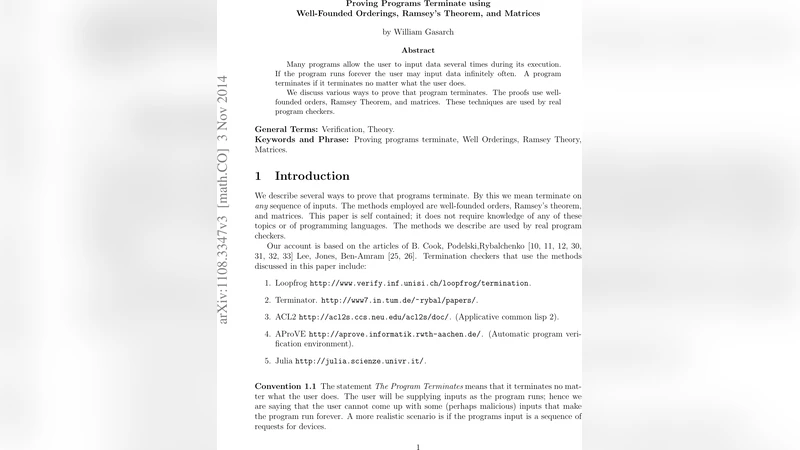
Many programs allow the user to input data several times during its execution. If the program runs forever the user may input data infinitely often. A program terminates if it terminates no matter what the user does. We discuss various ways to prove that program terminates. The proofs use well orderings, Ramsey Theory, and Matrices. These techniques are used by real program checkers.
💡 Research Summary
The paper addresses the fundamental problem of proving that a class of interactive, while‑loop programs always terminate regardless of the inputs supplied by a user. It models such programs as a triple PROG = (S, I, R) where S is a decidable set of states, I ⊆ S the set of possible initial states, and R ⊆ S × S a decidable transition relation that captures the body of the while loop together with a nondeterministic “control” choice supplied by the user. Termination is defined as the property that every computation (finite or infinite sequence of states respecting R) is finite.
The core contribution is a systematic exposition of three mathematically rigorous techniques that guarantee termination for this model: (1) well‑founded orderings, (2) Ramsey’s theorem, and (3) matrix‑based reasoning. For each technique the authors present concrete program examples, prove specific termination theorems, and then abstract the arguments into general theorems that can be used by automated termination checkers.
1. Well‑Founded Orderings
The authors begin with the classic approach of finding a measure f : S → P that strictly decreases on every transition, where (P, <ₚ) is a well‑founded order (no infinite descending chains). They illustrate this with Program 4, where the simple sum x + y + z decreases at each step, and with Program 5, where a lexicographic order on the 4‑tuple (w, x, y, z) ensures that the first component that changes always decreases. The central result, Theorem 5.2 (originally due to Floyd), states that the existence of such an f and a well‑founded order implies termination of any computation. This theorem is both necessary and sufficient: if a program terminates, a suitable well‑order can be constructed, albeit possibly contrived.
2. Ramsey’s Theorem
The second technique relaxes the requirement that a single measure decreases on every step. Instead, it only demands that for every finite computational segment there exists some variable (or more generally, some function of the variables) that strictly decreases from the segment’s start to its end. By coloring the edges of the infinite complete graph Kₙ with colors corresponding to which variable decreased, Ramsey’s theorem guarantees an infinite monochromatic set. In that monochromatic subsequence the same variable decreases indefinitely, forcing it eventually to become non‑positive and thereby breaking the loop condition. The authors formalize this in Theorem 7.1 (using variables directly) and Theorem 7.2 (using arbitrary decreasing functions f₁,…,f_M). The proofs show how the combinatorial principle replaces the need for a global well‑founded measure, allowing termination arguments for programs where no single linear ranking function exists.
3. Matrix‑Based Reasoning
The third approach encodes each program transition as an integer matrix acting on the vector of program variables. By analyzing the spectral properties or the monotonicity of these matrices, one can derive linear ranking functions or prove that a certain linear combination of variables decreases. Although the paper provides only a brief sketch, it references prior work (e.g., Ben‑Amram, Lee, Jones) that demonstrates how such matrix analyses can be automated and integrated into tools like AProVE. This method is particularly powerful for programs whose updates are affine transformations, because the matrix representation captures the entire transition system compactly.
Integration with Automated Tools
The authors list several existing termination checkers—Loopfrog, Terminator, ACL2s, AProVE, and Julia—and explain which of the three techniques each tool implements. Loopfrog and Terminator rely heavily on well‑founded orderings and ranking functions, ACL2s incorporates Ramsey‑style arguments through its inductive theorem prover, while AProVE combines ranking functions with matrix interpretations. By presenting the three techniques side by side, the paper clarifies why different tools succeed on different benchmarks and how a hybrid approach could improve overall coverage.
General Theorems and Limitations
The paper culminates in two families of general theorems. The first family (Theorem 5.2) captures the classic well‑ordering argument; the second family (Theorems 7.1 and 7.2) captures the Ramsey‑based argument, allowing either direct variable decrease or decrease of arbitrary integer‑valued functions. The authors discuss the trade‑offs: well‑ordering proofs are often easier to automate when a linear ranking function exists, but they fail for programs that require non‑linear or multi‑phase arguments. Ramsey‑based proofs are more flexible but rely on combinatorial explosion in the coloring step; practical implementations therefore need heuristics to identify promising decreasing functions.
Finally, the paper acknowledges that the matrix method, while theoretically elegant, can be computationally intensive for large systems, and that the choice of technique may depend on the structure of the program under analysis.
In summary, the paper provides a clear, mathematically rigorous roadmap for proving termination of interactive while‑loop programs. By unifying well‑founded orderings, Ramsey’s theorem, and matrix interpretations under a common formal model, it not only clarifies the theoretical foundations but also demonstrates concrete applicability to state‑of‑the‑art automated termination tools.
Comments & Academic Discussion
Loading comments...
Leave a Comment