Isometry groups of proper metric spaces
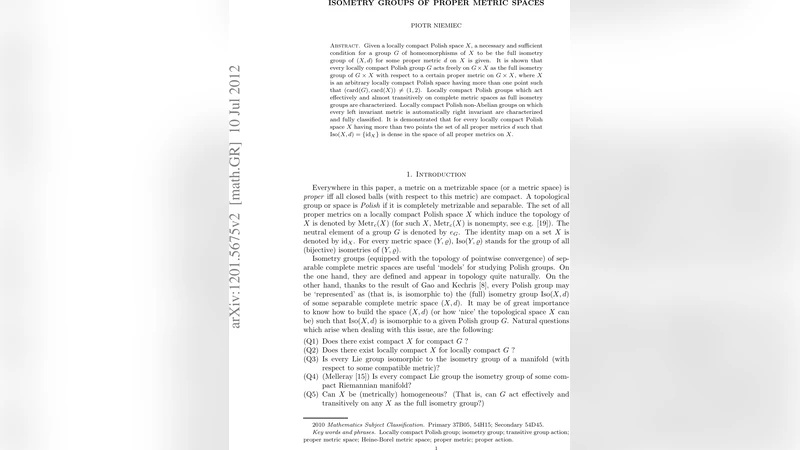
Given a locally compact Polish space X, a necessary and sufficient condition for a group G of homeomorphisms of X to be the full isometry group of (X,d) for some proper metric d on X is given. It is shown that every locally compact Polish group G acts freely on GxY as the full isometry group of GxY with respect to a certain proper metric on GxY, where Y is an arbitrary locally compact Polish space with (card(G),card(Y)) different from (1,2). Locally compact Polish groups which act effectively and almost transitively on complete metric spaces as full isometry groups are characterized. Locally compact Polish non-Abelian groups on which every left invariant metric is automatically right invariant are characterized and fully classified. It is demonstrated that for every locally compact Polish space X having more than two points the set of proper metrics d such that Iso(X,d) = {id} is dense in the space of all proper metrics on X.
💡 Research Summary
The paper investigates the relationship between proper metrics on locally compact Polish spaces and the structure of their full isometry groups. A proper metric is a distance function whose closed balls are compact; on such a space the metric topology coincides with the original Polish topology. The central problem is to determine when a given subgroup (G) of the homeomorphism group (\mathrm{Homeo}(X)) can be realized as the entire isometry group (\mathrm{Iso}(X,d)) for some proper metric (d) on (X).
Necessary and sufficient condition.
The author proves that (G) can be the full isometry group of a proper metric on (X) precisely when three conditions hold: (1) the action of (G) on (X) is free and each orbit is a closed, pairwise‑disjoint subset; (2) the restriction of (G) to any orbit is transitive, i.e., any two points in the same orbit can be connected by an element of (G); (3) the distances between distinct orbits can be chosen large enough to prevent any non‑trivial isometry from swapping or mixing orbits. Under these hypotheses the author constructs a metric in two stages. First, each orbit receives a (G)-invariant metric making the orbit itself a homogeneous metric space. Second, a large constant separates different orbits, guaranteeing the triangle inequality and compactness of closed balls. The resulting metric is proper and satisfies (\mathrm{Iso}(X,d)=G).
Product construction (G\times Y).
For any locally compact Polish space (Y) with ((\operatorname{card}G,\operatorname{card}Y)\neq(1,2)), the paper shows how to endow the product (G\times Y) with a proper metric (d’) such that (G) acts freely and transitively on the whole space and becomes the full isometry group. One starts with proper metrics (d_G) on (G) (coming from a left‑invariant proper metric on the locally compact group) and (d_Y) on (Y). The metric on the product is defined by
\
Comments & Academic Discussion
Loading comments...
Leave a Comment