Extending maps by injective $sigma$-$Z$-maps in Hilbert manifolds
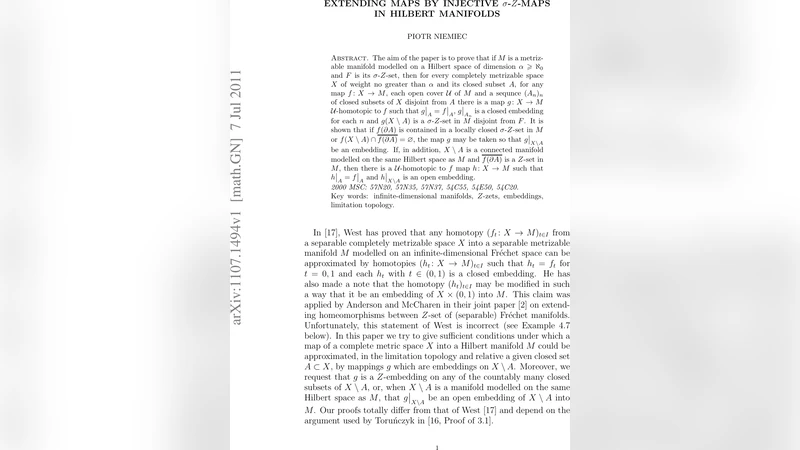
The aim of the paper is to prove that if $M$ is a metrizable manifold modelled on a Hilbert space of dimension $\alpha \geq \aleph_0$ and $F$ is its $\sigma$-$Z$-set, then for every completely metrizable space $X$ of weight no greater than $\alpha$ and its closed subset $A$, for any map $f: X \to M$, each open cover $\mathcal{U}$ of $M$ and a sequnce $(A_n)_n$ of closed subsets of $X$ disjoint from $A$ there is a map $g: X \to M$ $\mathcal{U}$-homotopic to $f$ such that $g\bigr|A = f\bigr|A$, $g\bigr|{A_n}$ is a closed embedding for each $n$ and $g(X \setminus A)$ is a $\sigma$-$Z$-set in $M$ disjoint from $F$. It is shown that if $f(\partial A)$ is contained in a locally closed $\sigma$-$Z$-set in $M$ or $f(X \setminus A) \cap \bar{f(\partial A)} = \empty$, the map $g$ may be taken so that $g\bigr|{X \setminus A}$ be an embedding. If, in addition, $X \setminus A$ is a connected manifold modelled on the same Hilbert space as $M$ and $\bar{f(\partial A)}$ is a $Z$-set in $M$, then there is a $\mathcal{U}$-homotopic to $f$ map $h: X \to M$ such that $h\bigr|_A = f\bigr|A$ and $h\bigr|{X \setminus A}$ is an open embedding.
💡 Research Summary
The paper investigates the problem of extending continuous maps from a completely metrizable space X into an infinite‑dimensional Hilbert manifold M while controlling the behavior of the extension on a prescribed closed subset A⊂X and on a countable family of disjoint closed subsets A₁,A₂,…⊂X∖A. The main setting is as follows: M is a metrizable manifold modeled on a Hilbert space of dimension α ≥ ℵ₀, F⊂M is a σ‑Z‑set, X is a completely metrizable space with weight w(X) ≤ α, and A is closed in X. For any map f:X→M, any open cover 𝒰 of M, and any sequence (Aₙ)ₙ of closed subsets of X disjoint from A, the author proves the existence of a map g:X→M satisfying three crucial properties:
- Relative agreement: g coincides with f on A (g|_A = f|_A).
- Z‑embedding on each Aₙ: for every n, the restriction g|_{Aₙ} is a closed embedding whose image is a Z‑set in M and avoids the given σ‑Z‑set F.
- σ‑Z‑set image off A: the set g(X∖A) is a σ‑Z‑set in M disjoint from F, and g|{X∖A} is 𝒰‑homotopic to f|{X∖A} (i.e., there exists a homotopy staying 𝒰‑close to f).
The construction proceeds by a sophisticated use of the limitation topology on function spaces, originally introduced by Toruńczyk, together with a Baire‑category argument (Lemma 1.1) that guarantees the density of countable intersections of dense open sets. The author first establishes a technical “main lemma” (Lemma 2.1) which, given an ANR P⊂Y, a family of dense Gδ‑subsets Gₙ⊂C(Aₙ,P), and a positive function λ on X∖A bounded away from zero on each Aₙ, produces a map h:X→Y that (i) agrees with f on A, (ii) lands in P on X∖A, (iii) belongs to each Gₙ on Aₙ, and (iv) stays within λ‑distance (with respect to a fixed metric) of f on X∖A. This lemma is the engine that drives the main theorem.
Next, the paper shows that any Hilbert manifold contains a σ‑Z‑set F such that every closed subset disjoint from F is itself a Z‑set (Lemma 3.2). Using Henderson’s theorem that Z‑sets in Hilbert manifolds are strong Z‑sets, the author proves that Z‑embeddings of a space X (with w(X)≤α) into M form a dense Gδ‑subset of C(X,M) (Corollary 3.3). Combining these facts with Lemma 2.1 yields the central Theorem 3.4, which delivers the map h (named g in the abstract) satisfying the three properties above.
The paper then refines the result under additional hypotheses. If the boundary image f(∂A) lies in a locally closed σ‑Z‑set of M, or if f(X∖A) is disjoint from the closure of f(∂A), Lemma 2.2 together with Lemma 1.7 allows the author to arrange that g|_{X∖A} is a global embedding (Corollary 3.6). Moreover, when X∖A itself is a connected Hilbert‑manifold of the same dimension as M and cl f(∂A) is a Z‑set, the extension can be made an open embedding (Theorem 4.5). These stronger conclusions are not merely cosmetic; they correct a previously claimed but false statement of West (the paper supplies a concrete counterexample in Example 4.7 showing that West’s original claim fails without the extra hypotheses).
Throughout, the author carefully tracks homotopy control: the constructed extensions are 𝒰‑homotopic to the original map, and when M is locally closed in a larger space Y, the homotopy can be taken in Y as well. The paper also discusses how the results generalize West’s theorem and strengthen earlier lemmas (e.g., Lemma 1.3).
In summary, the work provides a robust framework for extending maps into infinite‑dimensional Hilbert manifolds while preserving embedding properties on prescribed subsets and ensuring that the “new” part of the image forms a σ‑Z‑set disjoint from a given obstruction F. The methodology blends the limitation topology, Toruńczyk’s Baire‑category techniques, and deep properties of Z‑sets in Hilbert manifolds, thereby offering new tools for problems in infinite‑dimensional topology, manifold theory, and the study of embedding and approximation phenomena.
Comments & Academic Discussion
Loading comments...
Leave a Comment