Functor of continuation in Hilbert cube and Hilbert space
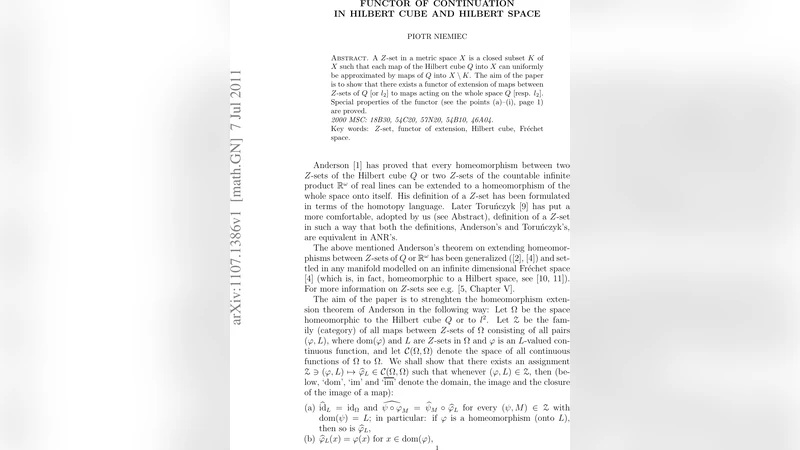
A $Z$-set in a metric space $X$ is a closed subset $K$ of $X$ such that each map of the Hilbert cube $Q$ into $X$ can uniformly be approximated by maps of $Q$ into $X \setminus K$. The aim of the paper is to show that there exists a functor of extension of maps between $Z$-sets of $Q$ [or $l_2$] to maps acting on the whole space $Q$ [resp. $l_2$]. Special properties of the functor are proved.
💡 Research Summary
The paper investigates the problem of extending continuous maps defined on Z‑sets of the Hilbert cube Q or the separable infinite‑dimensional Hilbert space ℓ₂ to continuous self‑maps of the whole space. A Z‑set K⊂X is a closed subset such that every map Q→X can be uniformly approximated by maps whose images avoid K. Anderson’s classical theorem states that any homeomorphism between two Z‑sets of Q (or of the countable product R^ω) extends to a homeomorphism of the whole space. The author seeks a stronger, functorial version: given any continuous map ϕ:K→L between Z‑sets, construct a canonical extension bϕ_L:Ω→Ω (Ω being Q or ℓ₂) satisfying a list of natural properties (a)–(i).
The construction proceeds in two stages. First, a general scheme is described: for a class K(Ω) of distinguished subsets (here the Z‑sets) one assumes axioms (AX1) and (AX2) guaranteeing invariance under homeomorphisms and a well‑defined “type” of the pair (Ω,K). One then introduces a functor Λ on the category of compact subsets satisfying five conditions (Λ1)–(Λ5): functoriality, each Λ(K) homeomorphic to Ω, an embedding δ_K:K→Λ(K) whose image is a Z‑set, compatibility δ_L∘f=Λ(f)∘δ_K, and metric extension properties. Using a homeomorphism H_K:(Λ(K),im δ_K)→(Ω,K) one defines the auxiliary map \bar{ϕ}_L and finally the extension bϕ_L=H_L∘Λ(\bar{ϕ}_L)∘H_K^{-1}. This abstract construction automatically yields (a) and (b) and, because Λ preserves many structural features, the remaining properties follow.
The second stage supplies concrete realizations of Λ for the two ambient spaces.
-
Hilbert cube Q: Keller’s theorem asserts that any compact infinite‑dimensional convex subset of a locally convex space is homeomorphic to Q. For a compact metrizable space C, the space M(C) of Borel probability measures (with the weak topology) is compact, convex, infinite‑dimensional, and thus homeomorphic to Q. The Dirac map δ_C:C→M(C) embeds C as a Z‑set when C is infinite. The Kantorovich metric M(d) induced by a bounded metric d on C extends d via M(d)(δ_x,δ_y)=d(x,y). For a continuous map ϕ:C→D, the push‑forward of measures M(ϕ):M(C)→M(D) is continuous, affine, and satisfies M(ϕ)∘δ_C=δ_D∘ϕ. This yields a functor M with all required properties, including isometry of the induced sup‑metrics. Consequently Λ=M∘I satisfies (a)–(i) for Q.
-
Hilbert space ℓ₂: The Bessaga–Pelczyński theorem states that for any separable completely metrizable space X with more than one point, the space M(X) of equivalence classes of Lebesgue‑measurable functions
Comments & Academic Discussion
Loading comments...
Leave a Comment