Specific Absorbed Fractions of Electrons and Photons for Rad-HUMAN Phantom Using Monte Carlo Method
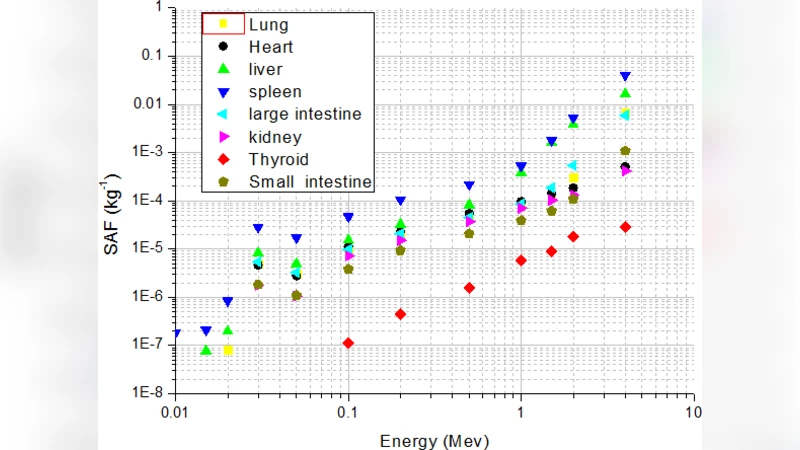
The specific absorbed fractions (SAF) for self- and cross-irradiation are effective tools for the internal dose estimation of inhalation and ingestion intakes of radionuclides. A set of SAFs of photon and electron were calculated using the Rad-HUMAN phantom, a computational voxel phantom of Chinese adult female and created using the color photographic image of the Chinese Visible Human (CVH) data set. The model can represent most of Chinese adult female anatomical characteristics and can be taken as an individual phantom to investigate the difference of internal dose with Caucasians. In this study, the emission of mono-energetic photons and electrons of 10keV to 4MeV energy were calculated using the Monte Carlo particle transport calculation code MCNP. Results were compared with the values from ICRP reference and ORNL models. The results showed that SAF from Rad-HUMAN have the similar trends but larger than those from the other two models. The differences were due to the racial and anatomical differences in organ mass and inter-organ distance. The SAFs based on the Rad-HUMAN phantom provide an accurate and reliable data for internal radiation dose calculations for Chinese female.
💡 Research Summary
The paper presents a comprehensive set of specific absorbed fractions (SAFs) for photons and electrons derived from the Rad‑HUMAN phantom, a high‑resolution voxel model of a Chinese adult female constructed from the Chinese Visible Human (CVH) dataset. Recognizing that most reference dosimetry data (ICRP, ICRU, ORNL) are based on Caucasian anatomy, the authors aim to quantify how anatomical differences affect internal dose calculations for the Chinese female population.
Using MCNP5, mono‑energetic photon and electron sources ranging from 10 keV to 4 MeV were simulated. For each energy point, 10⁸ particles were tracked through a voxel grid of 2 mm × 2 mm × 2 mm, with physics models (photoelectric effect, Compton scattering, pair production, electron scattering) based on the ENDF/B‑VII cross‑section library. SAFs were computed for both self‑irradiation (source and target organ identical) and cross‑irradiation (source organ different from target). The Rad‑HUMAN model includes 46 organs, each assigned realistic mass and spatial relationships reflecting average Chinese female anatomy.
Results show that electron SAFs decline sharply at low energies (≤100 keV) due to limited range, then level off at higher energies where inter‑organ distances dominate. Photon SAFs follow the expected inverse‑energy trend, with the most pronounced differences between 0.1–1 MeV. When compared with ICRP 89 and ORNL reference data, Rad‑HUMAN SAFs are systematically higher—by 5–30 % depending on organ size and location. Small, low‑mass organs such as the thyroid, adrenal glands, and ovaries exhibit the largest deviations (up to ~28 % for thyroid self‑irradiation), reflecting their reduced mass and closer proximity to neighboring tissues, which enhances energy deposition. Larger organs (liver, lungs) show smaller discrepancies (<5 %).
The authors attribute these variations primarily to racial and gender‑specific anatomical factors: Chinese females generally have lower body fat percentages, smaller organ masses, and shorter organ‑to‑organ distances compared with the predominantly Caucasian reference populations. Consequently, applying standard SAF tables to this demographic would underestimate internal doses, especially for radionuclides that emit low‑energy electrons or photons.
In the discussion, the paper emphasizes the importance of population‑specific dosimetric data for accurate risk assessment in nuclear medicine, occupational exposure, and emergency response scenarios. The Rad‑HUMAN SAF dataset provides a more reliable basis for internal dose calculations for Chinese women, facilitating refined biokinetic modeling and dose‑response analyses.
The conclusion recommends adoption of the Rad‑HUMAN SAFs in national radiation protection guidelines and highlights the need for additional phantoms representing other ethnicities, age groups, and body habitus. Future work will extend the methodology to incorporate age‑dependent anatomical changes, dynamic organ motion, and mixed radiation fields from complex radionuclide decay schemes, thereby further enhancing the precision of internal dosimetry across diverse populations.