From human mobility to renewable energies: Big data analysis to approach worldwide multiscale phenomena
We address and discuss recent trends in the analysis of big data sets, with the emphasis on studying multiscale phenomena. Applications of big data analysis in different scientific fields are described and two particular examples of multiscale phenomena are explored in more detail. The first one deals with wind power production at the scale of single wind turbines, the scale of entire wind farms and also at the scale of a whole country. Using open source data we show that the wind power production has an intermittent character at all those three scales, with implications for defining adequate strategies for stable energy production. The second example concerns the dynamics underlying human mobility, which presents different features at different scales. For that end, we analyze $12$-month data of the Eduroam database within Portuguese universities, and find that, at the smallest scales, typically within a set of a few adjacent buildings, the characteristic exponents of average displacements are different from the ones found at the scale of one country or one continent.
💡 Research Summary
The manuscript presents a comprehensive view of how big‑data techniques can be employed to study multiscale phenomena, focusing on two concrete examples: wind‑energy production and human mobility. After a brief historical overview of the “big‑data paradigm,” the authors argue that the current scientific landscape is defined not merely by the volume of data but by the statistical complexity of the problems addressed. They identify four enabling factors—low‑cost sensing, data completeness across scales, ubiquitous storage and processing capabilities, and the ability to combine heterogeneous data sources—and explain how these have opened the door to full‑scale, multiscale analyses in physics, geophysics, economics, and social science.
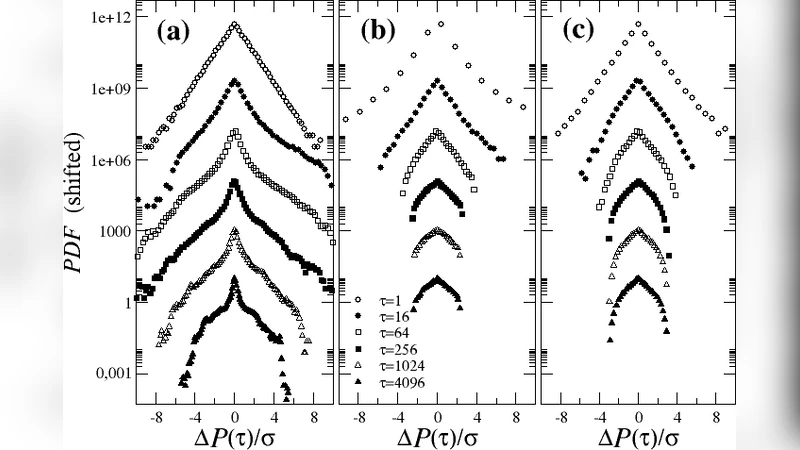
In the first case study, the authors analyze power‑output time series from three distinct spatial scales: a single offshore turbine in Germany (1‑second resolution), a large wind farm in Australia (5‑minute resolution), and the aggregate output of all wind farms in Ireland (15‑minute resolution). Using the increment definition ΔPτ(t)=P(t+τ)−P(t), they compute probability density functions for a range of τ values. All three datasets exhibit heavy‑tailed, Lévy‑stable‑like distributions at short τ, gradually converging toward Gaussian behavior as τ increases. This persistence of intermittency across scales is attributed to the underlying turbulent wind field, which is correlated over the entire weather system that typically covers a country like Ireland. Consequently, simply increasing the number of turbines does not guarantee a reduction of variability; instead, spatial decorrelation (e.g., aggregating turbines from different weather regimes) or hybridization with other renewables such as solar power is required to achieve a more stable grid supply.
The second case study tackles human mobility, a domain traditionally explored with coarse data such as dollar‑bill tracking or cellular‑tower logs. The authors exploit a high‑resolution Eduroam authentication dataset collected over twelve months from several Portuguese universities. Each log entry records the exact time a user connects to or disconnects from a wireless access point, allowing reconstruction of trajectories at the building‑to‑building level. By measuring average displacements ⟨Δr⟩ as a function of time lag τ, they discover a clear scale‑dependence: at the smallest spatial scales (within a few adjacent buildings) the relationship follows ⟨Δr⟩∝τ^0.5, indicative of normal Brownian diffusion, whereas at city, national, or continental scales the exponent rises to α≈0.8–1, reflecting super‑diffusive, power‑law travel patterns previously reported in the literature. This finding demonstrates that the “universal” mobility laws derived from sparse, low‑resolution data do not hold at fine spatial resolutions, and that distinct stochastic mechanisms dominate at different scales.
The paper concludes by emphasizing that both wind‑energy fluctuations and human‑mobility patterns share the hallmark of scale‑dependent statistics. For energy systems, this implies that grid operators must consider correlated weather patterns when designing storage or diversification strategies. For urban planners and epidemiologists, the multiscale mobility insight suggests that models of disease spread or transportation demand need to incorporate scale‑specific diffusion exponents. Overall, the work showcases how the convergence of massive, heterogeneous datasets and advanced statistical tools can reveal hidden structures in complex systems, and it calls for continued development of big‑data infrastructures to support such multiscale investigations across scientific domains.
Comments & Academic Discussion
Loading comments...
Leave a Comment