Unified spectral bounds on the chromatic number
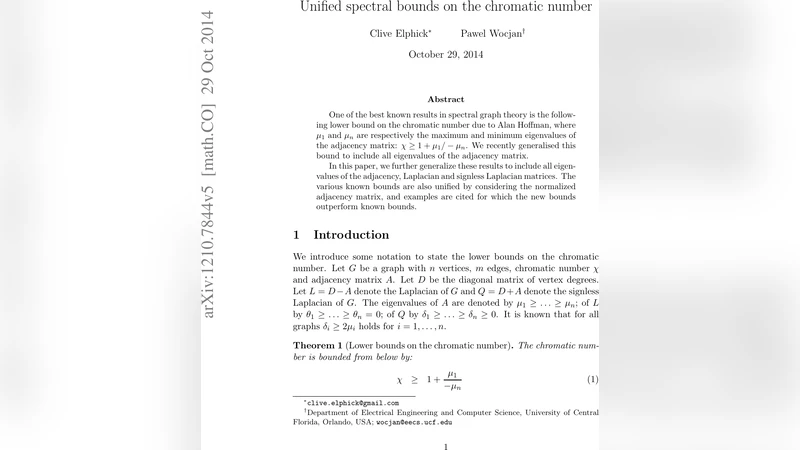
One of the best known results in spectral graph theory is the following lower bound on the chromatic number due to Alan Hoffman, where mu_1 and mu_n are respectively the maximum and minimum eigenvalues of the adjacency matrix: chi >= 1 + mu_1 / (- mu_n). We recently generalised this bound to include all eigenvalues of the adjacency matrix. In this paper, we further generalize these results to include all eigenvalues of the adjacency, Laplacian and signless Laplacian matrices. The various known bounds are also unified by considering the normalized adjacency matrix, and examples are cited for which the new bounds outperform known bounds.
💡 Research Summary
The paper presents a comprehensive unification and extension of spectral lower bounds for the chromatic number χ of a graph. It begins by recalling Hoffman’s classic inequality χ ≥ 1 + μ₁/(-μ_n), where μ₁ and μ_n denote the largest and smallest eigenvalues of the adjacency matrix A. While powerful, this bound uses only two eigenvalues and therefore ignores much of the spectral information contained in A. The authors first generalize this result by incorporating the entire spectrum of A. Using majorization theory and trace inequalities, they prove that for any integers k (1 ≤ k ≤ n) and r (1 ≤ r ≤ k),
χ ≥ 1 + (∑{i=1}^k μ_i) / (−∑{i=n−r+1}^n μ_i),
where μ_i are the eigenvalues of A sorted in descending order. This formula reduces to Hoffman’s bound when k = r = 1, but by choosing larger k and r one can obtain substantially tighter estimates.
The same methodology is applied to the combinatorial Laplacian L = D − A and the signless Laplacian Q = D + A (D is the degree matrix). For the Laplacian eigenvalues λ_i (λ_1 = 0) and signless Laplacian eigenvalues q_i, the authors derive
χ ≥ 1 + (∑{i=1}^k λ_i) / (∑{i=n−r+1}^n λ_i),
χ ≥ 1 + (∑{i=1}^k q_i) / (∑{i=n−r+1}^n q_i),
respectively. These bounds exploit the full set of non‑negative eigenvalues, thereby capturing connectivity (through λ_2) and bipartiteness (through λ_n) information that single‑eigenvalue bounds miss.
A further unifying step is achieved by introducing the normalized adjacency matrix 𝔄 = D^{−1/2} A D^{−1/2}. Its eigenvalues θ_i lie in
Comments & Academic Discussion
Loading comments...
Leave a Comment