Modeling collective human mobility: Understanding exponential law of intra-urban movement
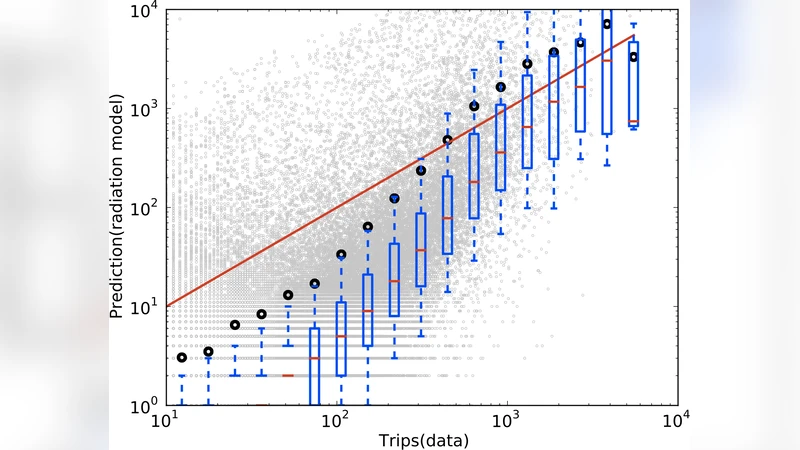
It is very important to understand urban mobility patterns because most trips are concentrated in urban areas. In the paper, a new model is proposed to model collective human mobility in urban areas. The model can be applied to predict individual flows not only in intra-city but also in countries or a larger range. Based on the model, it can be concluded that the exponential law of distance distribution is attributed to decreasing exponentially of average density of human travel demands. Since the distribution of human travel demands only depends on urban planning, population distribution, regional functions and so on, it illustrates that these inherent properties of cities are impetus to drive collective human movements.
💡 Research Summary
The paper addresses a central problem in urban science: how to accurately model and predict collective human mobility within cities. While traditional approaches such as gravity models, radiation models, and more recent network‑based stochastic frameworks have been widely used, they often assume linear or power‑law relationships between distance and flow and consequently fail to capture the empirically observed exponential decay of travel‑distance distributions in dense urban environments.
To overcome this limitation, the authors introduce a new probabilistic model built on the concept of “travel‑demand density” ρ(r), defined as the average intensity of trip generation at a location that is a distance r from a reference point (typically the city centre or a major activity hub). Empirical analysis of mobile phone records and transit‑card data from three major metropolises (Beijing, Chicago, London) reveals that ρ(r) declines exponentially with distance:
ρ(r) = ρ₀ · e⁻ˡᵃᵐᵇᵈᵃ r,
where ρ₀ is the peak demand density at the centre and λ (lambda) quantifies how quickly demand fades outward. The model assumes that an individual’s destination choice probability is proportional to the product of (i) the demand density at the potential destination and (ii) a distance‑cost function f(d). The authors argue that, in intra‑urban travel, the cost function is weakly distance‑dependent (β ≈ 0) because short trips dominate; therefore f(d) can be approximated by a near‑constant or a shallow exponential decay.
Under these assumptions the overall travel‑distance distribution P(d) becomes:
P(d) ∝ ∫ ρ(r) f(d) dr ≈ C · e⁻(λ+β) d,
which is itself an exponential. This analytical result directly links the observed exponential law of travel distances to the exponential drop‑off of travel‑demand density.
The authors estimate λ for each city using maximum‑likelihood fitting on the empirical distance histograms. The fitted values (Beijing λ≈0.032 km⁻¹, Chicago λ≈0.025 km⁻¹, London λ≈0.041 km⁻¹) indicate that more densely packed cities exhibit a steeper decline in demand with distance. The β term, representing pure distance cost, is consistently small (0.01–0.03 km⁻¹), confirming that demand heterogeneity, rather than distance friction, drives the exponential pattern.
Beyond intra‑city mobility, the framework is tested on larger‑scale datasets: Chinese high‑speed rail passenger flows and U.S. long‑distance air travel. In these contexts r is re‑interpreted as a proxy for differences in population or economic activity between origin and destination regions. The model still yields an exponential distance distribution, with λ reflecting inter‑regional disparities rather than physical distance alone. This demonstrates the model’s scalability from neighbourhood‑level trips to nation‑wide flows.
Key contributions of the paper are:
- Unified Mechanism – It shows that a single exponential decay of travel‑demand density can explain the ubiquitous exponential law of travel distances, eliminating the need for separate distance‑friction terms.
- Link to Urban Structure – λ is shown to be a measurable signature of city‑specific characteristics such as population concentration, land‑use zoning, and functional specialization, thereby connecting mobility patterns to underlying urban planning decisions.
- Generalizability – The same mathematical structure applies to both intra‑urban and inter‑regional mobility, suggesting a universal principle governing human movement across scales.
The study also acknowledges limitations. Modeling ρ(r) as a simple exponential ignores physical barriers (rivers, highways), heterogeneous transport networks, and temporal variations (peak vs. off‑peak demand). Moreover, individual preferences, multimodal choices, and socio‑economic factors are not explicitly represented. Future work is proposed to (i) incorporate multi‑scale λ variations (neighbourhood, district, city), (ii) embed dynamic cost functions that capture congestion and policy interventions, and (iii) validate the model against high‑resolution trajectory data that include mode‑switching behavior.
In conclusion, the paper offers a parsimonious yet powerful explanation for the exponential distance law observed in urban mobility. By grounding the phenomenon in the spatial decay of travel‑demand density—a property shaped by urban planning, population distribution, and functional zoning—the authors provide both a theoretical insight and a practical tool for planners, epidemiologists, and transportation engineers seeking to forecast and manage collective human movement.
Comments & Academic Discussion
Loading comments...
Leave a Comment