A Stability Formula for Plastic-Tipped Bullets Part 2: Experimental Testing
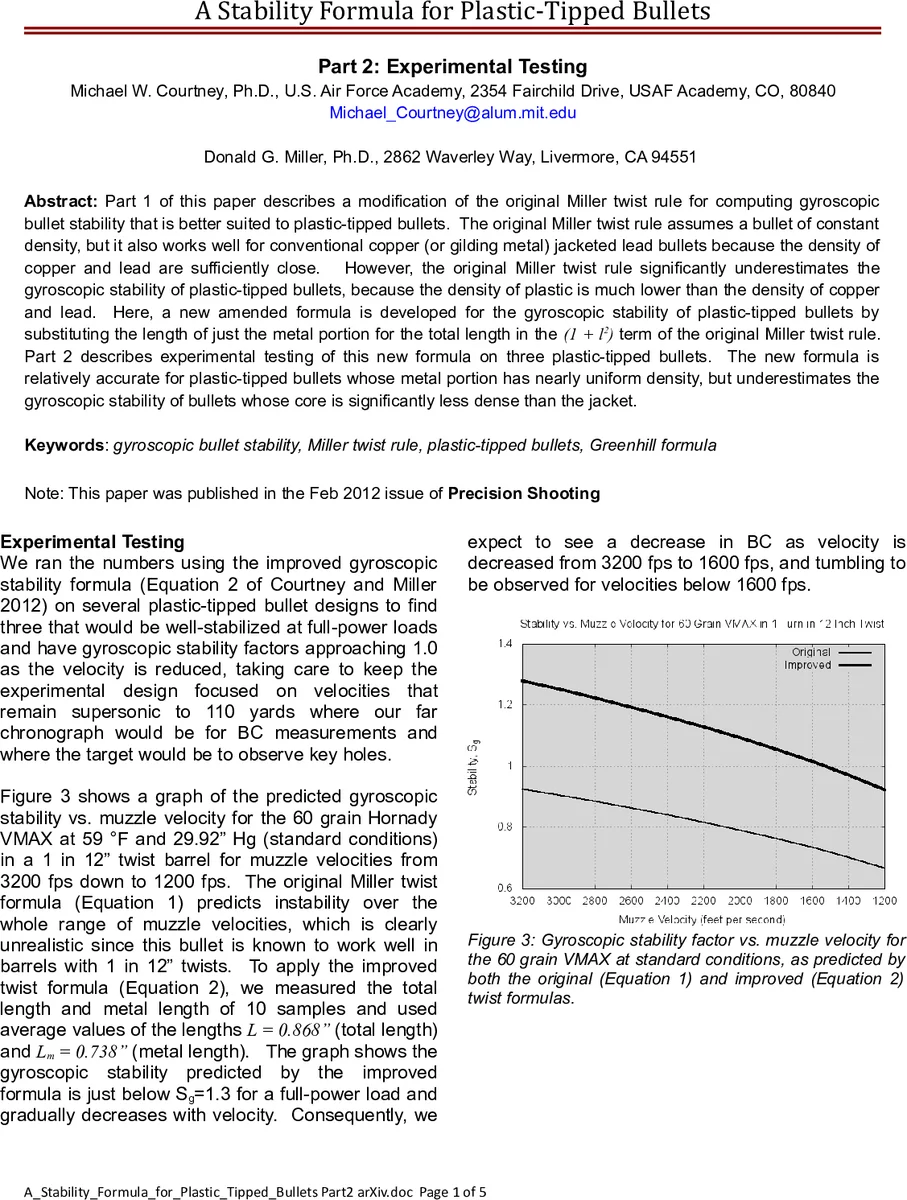
Part 1 of this paper describes a modification of the original Miller twist rule for computing gyroscopic bullet stability that is better suited to plastic-tipped bullets. The original Miller twist rule assumes a bullet of constant density, but it also works well for conventional copper (or gilding metal) jacketed lead bullets because the density of copper and lead are sufficiently close. However, the original Miller twist rule significantly underestimates the gyroscopic stability of plastic-tipped bullets, because the density of plastic is much lower than the density of copper and lead. Here, a new amended formula is developed for the gyroscopic stability of plastic-tipped bullets by substituting the length of just the metal portion for the total length in the (1 + L2) term of the original Miller twist rule. Part 2 describes experimental testing of this new formula on three plastic-tipped bullets. The new formula is relatively accurate for plastic-tipped bullets whose metal portion has nearly uniform density, but underestimates the gyroscopic stability of bullets whose core is significantly less dense than the jacket.
💡 Research Summary
The paper addresses a well‑known deficiency in the Miller twist rule when applied to plastic‑tipped bullets. The original Miller formula assumes a bullet of uniform density and incorporates the total bullet length (L) in the term (1 + L²) to account for length‑related stability effects. Because a plastic tip adds length without contributing appreciably to mass or rotational inertia, the original rule dramatically under‑predicts gyroscopic stability (Sg) for such projectiles. In Part 1 of the study, the authors derived a modified expression (Equation 2) that replaces the total length with the length of the metal portion (Lm) in the (1 + L²) term, yielding (1 + Lm²). This simple substitution is intended to restore the balance between aerodynamic overturning moments and the bullet’s actual spin‑stabilizing inertia.
Part 2 presents experimental validation of the new formula using three commercially available plastic‑tipped bullets: the 60 grain Hornady VMAX, the 53 grain Hornady VMAX, and the 40 grain Nosler Ballistic Tip. For each bullet, the authors measured total length and metal length on multiple samples, then calculated Sg across a wide range of muzzle velocities (≈ 1200–3200 fps) under standard atmospheric conditions (59 °F, 29.92 inHg) in a 1 in 12 twist barrel. Two chronographs placed at 30 ft and 330 ft recorded near‑ and far‑field velocities; the JBM ballistic‑coefficient calculator supplied G1 BC values. By plotting BC versus the predicted Sg, and by inspecting target paper for keyholes at 110 yd, the authors could directly assess whether the predicted stability matched observed flight behavior.
The 60 grain VMAX data showed a plateau in BC (≈ 0.246) for Sg > 1.25, a modest rise near Sg ≈ 1.23 (likely statistical noise), and a steady decline as Sg fell below 1.2. At Sg ≈ 0.99 the bullet began to tumble, confirming the modified formula’s prediction that stability drops sharply near Sg = 1.0. The 53 grain VMAX behaved similarly: no keyholes were observed for velocities corresponding to Sg ≈ 1.32–1.03, but at 1303 fps (Sg ≈ 1.03) all five shots produced keyholes, indicating loss of stability precisely where Equation 2 crossed the Sg = 1 threshold. By contrast, the original Miller rule (Equation 1) incorrectly labeled the entire velocity range as unstable for both VMAX loads, highlighting its unsuitability for plastic‑tipped designs.
The 40 grain Nosler Ballistic Tip presented a more complex picture. Equation 2 predicted instability for velocities below ≈ 1900 fps (Sg ≈ 0.94–0.97), yet the bullets remained stable and produced no keyholes even at the lowest tested speed (≈ 1717 fps). The authors attribute this discrepancy to the bullet’s construction: a low‑density powdered‑copper core surrounded by a heavy gilding‑metal jacket. This configuration raises the axial moment of inertia relative to the transverse moment of inertia, effectively increasing gyroscopic stability beyond what a uniform‑density model can capture. Consequently, both the original and modified Miller formulas underestimate stability for bullets with markedly non‑uniform metal densities.
Overall, the study demonstrates that the simple substitution of metal length for total length yields a practical, more accurate tool for estimating the gyroscopic stability of most plastic‑tipped bullets, especially those whose metal portion has near‑uniform density. However, it also reveals the limits of any empirical rule that ignores detailed mass distribution. For bullets with a light, low‑density core and a heavy jacket, the axial-to-transverse inertia ratio deviates substantially from the uniform‑density assumption, leading to systematic under‑prediction of Sg. The authors suggest that future work should incorporate explicit density‑ratio terms or directly measured moments of inertia to extend the model’s applicability. Such refinements would enable shooters and ballistic engineers to predict stability across an even broader spectrum of modern projectile designs, reducing the need for costly trial‑and‑error testing.
Comments & Academic Discussion
Loading comments...
Leave a Comment