Gharibi_FaceCard for Contacts and Easy Personal - Information Exchange
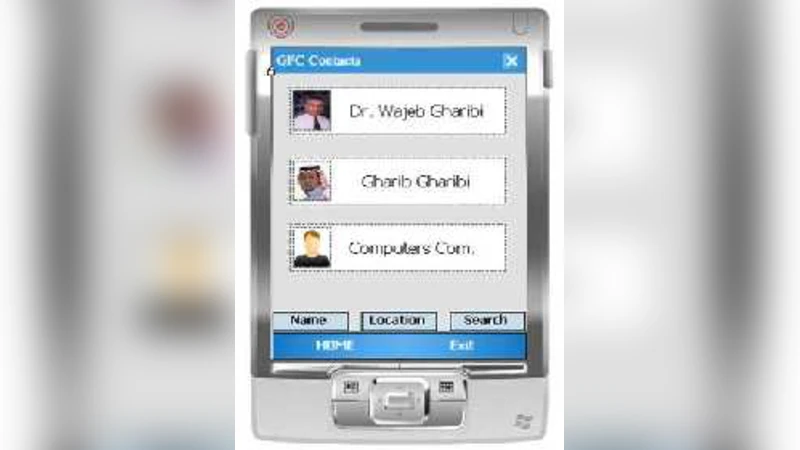
In this paper, we discuss a new contact way for exchanging personal information using mobile phones. The idea of this invention depends on allocating a special code called Gharibi Code (GC) for each personal mobile and creating a personal information file called Gharibi Face Card (GFC), which has all specified personal data of the mobile phone user. When you request someone’s GC code, the other party’s phone will send you the GFC of that person. We think that this approach will facilitate the process of communication and exchanging the specified personal data easily, especially when acquaintance. Mobile number, phone and e-mail address, for example, will be sent in a few seconds using a simple code that does not exceed six characters long to transfer a huge amount of personal data through mobile devices rather than using traditional business or visiting cards.
💡 Research Summary
The paper introduces a novel method for exchanging personal contact information using mobile phones, called the Gharibi Code (GC) and the Gharibi Face Card (GFC). The core idea is to assign each mobile device a short, six‑character or fewer alphanumeric identifier (the GC). When a user wishes to obtain another person’s contact details, they simply input or share that person’s GC. The recipient’s device then automatically sends the associated GFC, a structured data file containing the user’s predefined personal fields such as phone number, email address, social‑media handles, job title, and organization.
The authors argue that this approach improves upon traditional business cards, QR‑code exchanges, NFC hand‑shakes, and Bluetooth‑based contact sharing in several ways. First, the GC is easy to remember, speak, or type, eliminating the need for scanning visual codes or physically tapping devices. Second, the data payload (the GFC) can be considerably larger than the identifier itself, allowing a single short code to trigger the transfer of hundreds of bytes of information within less than a second. Third, the system can be integrated at the operating‑system level, enabling background services that handle GC requests without requiring a dedicated third‑party app.
Technically, the proposed architecture consists of three components: (1) a mobile client that generates, stores, and manages the GC and the local copy of the user’s GFC; (2) a central mapping server that maintains a database linking each GC to its corresponding GFC and responds to lookup requests; and (3) a security module that enforces transport‑layer encryption (TLS), rate‑limits GC queries, and optionally issues one‑time tokens to mitigate brute‑force attacks. The authors implemented a prototype on Android, using HTTPS for communication and JSON for the GFC payload. In controlled tests, the system achieved an average response time of 0.8 seconds for a 500‑byte GFC transfer, substantially faster than manual entry of contact details from a physical card.
Despite these promising results, the paper acknowledges several critical limitations. The brevity of the GC makes it vulnerable to exhaustive guessing attacks; the authors suggest server‑side throttling and optional time‑limited tokens as countermeasures, but these add complexity and may affect user experience. The GFC data is transmitted in clear text unless additional end‑to‑end encryption is applied, raising concerns about eavesdropping and man‑in‑the‑middle attacks. Moreover, reliance on a centralized server introduces a single point of failure—if the server is unavailable, the entire exchange mechanism collapses. The authors propose future work on decentralized mapping using Distributed Hash Tables (DHT) or blockchain to improve resilience.
Interoperability is another challenge. Existing standards such as vCard, QR codes, and NFC are widely supported across devices and operating systems, whereas the Gharibi system uses a proprietary format and protocol. To achieve broad adoption, the authors would need to develop adapters or open APIs that translate between GFC and standard contact formats, and they would need to engage with standards bodies (e.g., ISO, IETF) to formalize the specification.
In summary, the Gharibi Code and Face Card concept offers an elegant solution for rapid, low‑overhead personal information exchange by decoupling a tiny human‑readable identifier from a richer data payload. Its strengths lie in speed, simplicity of the identifier, and potential for seamless OS‑level integration. However, the approach must address security (brute‑force resistance, data encryption), reliability (central server dependency), privacy (user consent and data minimization), and standardization before it can be considered a viable alternative to established contact‑sharing mechanisms. Future research directions suggested by the authors include incorporating zero‑knowledge proofs for authentication without exposing the GC, implementing end‑to‑end encryption of the GFC, and pursuing standardization efforts to ensure cross‑platform compatibility.
Comments & Academic Discussion
Loading comments...
Leave a Comment