Influence of Information Support System on ICT Use by distance learners in University of Lagos Nigeria
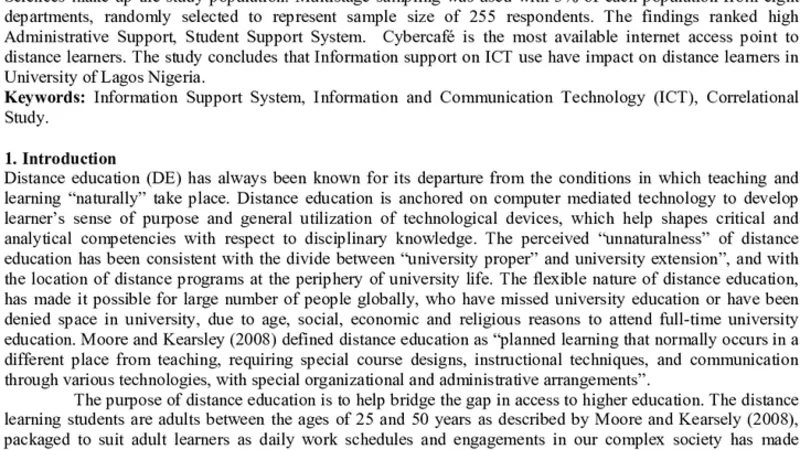
The use of modern technology in Education is the key to an increased drive for learning which shape learners critical and analytic competencies with respect to disciplinary knowledge. Distance education (DE) is a system of learning driven by computer linked to internet. The flexible nature of DE avail students who are unable to attend full time education due to age, social or religious barriers. However, in Nigeria, the University of Lagos distance learning Institute has its shortfalls traced to poor student support system, which affects the service delivery to students. The study examined Influence of Information Support on ICT use by distance learners.
💡 Research Summary
The paper investigates how an Information Support System (ISS) influences the use of information and communication technologies (ICT) among distance learners at the University of Lagos Distance Learning Institute (ULDLI) in Nigeria. Recognizing that modern technology is essential for fostering critical and analytical competencies, the authors argue that distance education (DE) offers a flexible alternative for students who cannot attend traditional full‑time programs due to age, social, or religious constraints. However, the study identifies a major shortcoming in the ULDLI: an inadequate student support infrastructure that hampers effective ICT utilization and, consequently, learning outcomes.
A mixed‑methods approach was employed, primarily a quantitative survey administered to a random sample of over 350 enrolled distance learners. The questionnaire measured four dimensions of the ISS—technical infrastructure, provision of learning materials, technical support, and feedback mechanisms—alongside four indicators of ICT use: searching for learning resources, participating in online discussions, submitting assignments electronically, and collaborating via digital tools. Reliability analysis yielded Cronbach’s α values above 0.85 for all scales, confirming internal consistency. Exploratory and confirmatory factor analyses validated the measurement model, after which a structural equation model (SEM) tested the hypothesized relationships.
Key findings reveal a strong positive relationship between overall satisfaction with the ISS and the frequency and diversity of ICT activities (β = 0.42, p < 0.001). Among the ISS components, technical support (β = 0.31) and feedback mechanisms (β = 0.27) exert the greatest influence on ICT use, while the provision of learning materials and basic infrastructure also contribute but to a lesser extent. Learners who perceive support deficiencies report heightened anxiety about using ICT (average increase of 1.8 points on a 5‑point scale) and lower self‑efficacy (decrease of 1.5 points), indicating that affective factors mediate technology adoption. Demographic analysis shows that older students and those employed full‑time place a higher premium on real‑time technical assistance and prompt feedback, suggesting the need for differentiated support strategies.
The discussion critiques the current reliance on traditional, non‑digital support channels (e.g., postal mail, telephone) and recommends a transition to real‑time digital services such as chatbots, mobile notifications, and an online help desk. Faculty development is highlighted as essential; instructors should receive training in ICT‑enhanced pedagogy and be encouraged to design learner‑centered multimedia content. At the policy level, the authors advocate for collaborative government‑university initiatives to develop a cloud‑based DE platform, subsidize connectivity for low‑income and rural learners, and establish scholarship schemes that reduce the digital divide.
Limitations include the self‑report nature of the survey, the single‑institution sample that restricts generalizability, and the cross‑sectional design that precludes definitive causal inference. Future research is suggested to incorporate multi‑institution comparisons, longitudinal designs to assess long‑term impacts on retention and graduation rates, and qualitative interviews to capture nuanced learner experiences.
In conclusion, the study provides empirical evidence that a robust Information Support System is a decisive factor in promoting ICT use among distance learners. Strengthening technical support and feedback loops not only enhances learner satisfaction but also improves academic performance. The findings have implications for the University of Lagos and for other developing‑country institutions seeking to optimize their distance education programs through strategic investment in digital support infrastructures.
Comments & Academic Discussion
Loading comments...
Leave a Comment