A splitting result for the algebraic K-theory of projective toric schemes
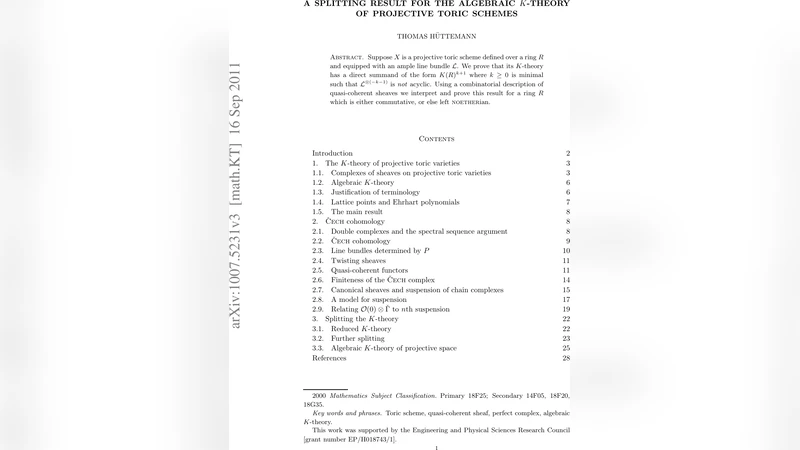
Suppose X is a projective toric scheme defined over a commutative ring R equipped with an ample line bundle L. We prove that its K-theory has k+1 direct summands K(R) where k is minimal among non-negative integers such that the twisted line bundle L(-k-1) is not acyclic. In fact, using a combinatorial description of quasi-coherent sheaves throughout we prove the result for a ring R which is either commutative, or else left noetherian.
💡 Research Summary
The paper investigates the algebraic K‑theory of projective toric schemes equipped with an ample line bundle. Let X be a projective toric scheme over a commutative ring R, and let L be an ample line bundle on X. The authors prove that the K‑theory spectrum K(X) splits as a direct sum of (k + 1) copies of the K‑theory of the base ring, K(R). Here k is the smallest non‑negative integer for which the twisted line bundle L(−k − 1) fails to be acyclic (i.e., has non‑vanishing higher cohomology). In other words, up to the point where the twist ceases to be cohomologically trivial, each successive twist contributes an additional copy of K(R) to the decomposition.
The proof proceeds by exploiting the combinatorial description of toric varieties via fans and the associated lattice polytopes. By interpreting quasi‑coherent sheaves on X in terms of graded modules over the Cox ring, the authors translate cohomological questions about L(−m) into combinatorial conditions on the corresponding polytope. They construct a filtration of X by torus‑invariant closed subschemes whose successive quotients are affine toric pieces. For each step of the filtration, they analyze the long exact sequence in K‑theory and show that the contribution of the step is either trivial (when the twist is acyclic) or precisely a copy of K(R) (when the twist first becomes non‑acyclic). This inductive argument yields the desired splitting.
A notable aspect of the work is its generality concerning the coefficient ring R. The authors treat two distinct settings: (1) R is a commutative ring, where the usual machinery of graded modules and the Cox construction applies directly; (2) R is left Noetherian but possibly non‑commutative. In the latter case, they develop a version of the Cox ring and the associated category of quasi‑coherent sheaves that works for left Noetherian rings, ensuring that the same combinatorial arguments remain valid. This extension demonstrates that the splitting phenomenon is not an artifact of commutativity but rather a structural feature of toric geometry.
The paper also provides explicit examples to illustrate the theorem. For the projective plane ℙ² viewed as a toric variety, the ample line bundle O(1) yields k = 0, so K(ℙ²) ≅ K(R) ⊕ K(R). For higher‑dimensional toric varieties such as the Hirzebruch surfaces and certain three‑dimensional smooth toric Fano varieties, the authors compute k explicitly and verify that the K‑theory splits into the predicted number of summands. These calculations confirm that the combinatorial criterion (non‑acyclicity of L(−k − 1)) accurately predicts the K‑theoretic decomposition.
Beyond the immediate result, the authors discuss several implications. The splitting simplifies computations of higher K‑groups for toric schemes, as each summand is just a copy of the well‑understood K‑theory of the base ring. It also suggests potential applications to motivic cohomology, where toric varieties often serve as test cases, and to the study of derived categories of toric stacks, where line bundle twists play a central role. Moreover, the technique of translating cohomological vanishing into combinatorial polytope conditions may be adaptable to other classes of varieties with rich combinatorial structures, such as spherical varieties or certain moduli spaces.
In summary, the authors establish a clean and robust splitting theorem for the algebraic K‑theory of projective toric schemes with an ample line bundle. The theorem identifies the exact number of K(R) summands in terms of the minimal twist that loses acyclicity, holds for both commutative and left Noetherian coefficient rings, and is substantiated by detailed combinatorial arguments and concrete examples. This work not only advances the understanding of toric K‑theory but also provides a versatile framework that could influence broader areas of algebraic geometry and K‑theory.
Comments & Academic Discussion
Loading comments...
Leave a Comment