Comparing the reliability of networks by spectral analysis
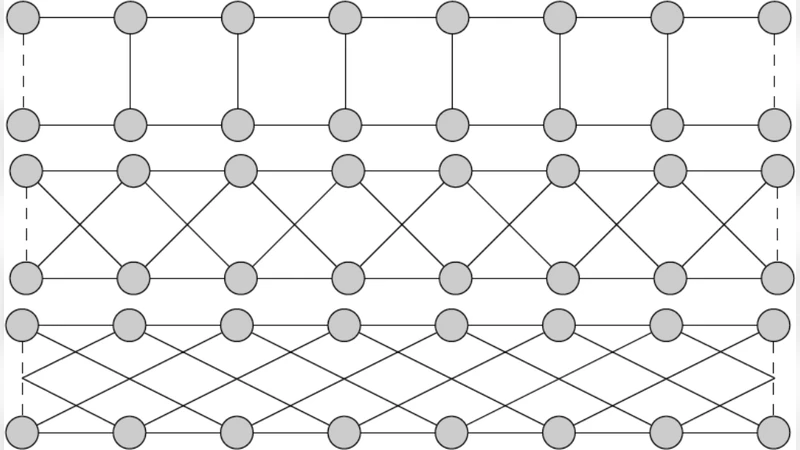
We provide a method for the ranking of the reliability of two networks with the same connectance. Our method is based on the Cheeger constant linking the topological property of a network with its spectrum. We first analyze a set of twisted rings with the same connectance and degree distribution, and obtain the ranking of their reliability using their eigenvalue gaps. The results are generalized to general networks using the method of rewiring. The success of our ranking method is verified numerically for the IEEE57, the Erd\H{o}s-R'enyi, and the Small-World networks.
💡 Research Summary
The paper tackles the fundamental problem of comparing the reliability of two networks that share the same connectance (i.e., the same number of edges relative to the number of possible edges). Traditional reliability assessment relies on extensive Monte‑Carlo simulations of random edge failures, which become computationally prohibitive for large‑scale systems. The authors propose a theoretically grounded, spectrum‑based ranking method that leverages the Cheeger constant—a topological measure of bottleneck strength—and its relationship to the eigenvalues of the graph Laplacian.
The Cheeger inequality states that the second smallest Laplacian eigenvalue (λ₂, also called the algebraic connectivity) satisfies h²/2 ≤ λ₂ ≤ 2h, where h is the Cheeger constant. Consequently, a larger λ₂ (or, equivalently, a larger eigenvalue gap Δ = λ₂ – λ₁, with λ₁ = 0) implies a higher Cheeger constant, meaning the graph is less vulnerable to being split by a small cut. The authors argue that Δ can therefore serve as a proxy for network reliability under random edge loss.
To validate the concept, the study first constructs a family of “twisted rings.” All members have identical node count, average degree, and overall connectance, but differ in the amount of twist (i.e., how many edges cross the basic ring). By analytically computing the Laplacian spectra of each twisted ring, the authors obtain Δ values and rank the graphs accordingly. Extensive simulations of random edge deletions confirm that the ranking based on Δ precisely predicts the probability that the network remains globally connected; graphs with larger Δ retain connectivity far more often.
Recognizing that real‑world networks are far more irregular, the authors extend the approach through a rewiring procedure. Starting from an arbitrary network, they generate multiple rewired variants that preserve the degree sequence and total edge count while randomizing edge endpoints. For each variant they compute λ₂ and Δ, and they identify the variant with the largest Δ as the most reliable. This rewiring step demonstrates that the method can be applied without altering fundamental network constraints, making it suitable for design optimization.
The methodology is then tested on three benchmark networks:
- IEEE 57‑bus power grid – a realistic electrical transmission network.
- Erdős‑Rényi random graph – a canonical model with Poisson degree distribution.
- Watts‑Strogatz Small‑World network – characterized by high clustering and short average path length.
For each case the authors perform 10,000 Monte‑Carlo trials of random edge removal, measuring the fraction of trials in which the graph stays connected. The empirical reliability curves correlate strongly (Pearson r > 0.9) with the Δ‑based rankings. Notably, the Small‑World network exhibits the most pronounced improvement when rewired to increase Δ, highlighting that a combination of short paths and a large spectral gap yields superior robustness.
Key contributions of the paper are:
- Theoretical linkage: By explicitly connecting Cheeger’s isoperimetric constant to the Laplacian eigenvalue gap, the authors provide a rigorous, analytically tractable reliability metric.
- Practical ranking tool: The Δ‑based ranking requires only a single eigenvalue computation per network, dramatically reducing computational cost compared with exhaustive failure simulations.
- Generalization via rewiring: The method works for arbitrary topologies while respecting degree‑preserving constraints, enabling its use in network design and retrofitting.
- Empirical validation: Numerical experiments on a real power system and two canonical synthetic models confirm the predictive power of the spectral metric.
Future research directions suggested include extending the framework to time‑varying (dynamic) networks, integrating multi‑layer (interdependent) network spectra, and developing optimization algorithms that directly maximize λ₂ under budgeted edge additions or removals. Such extensions could inform the design of resilient smart‑grid infrastructures, next‑generation communication backbones (5G/6G), and autonomous transportation networks, where reliability is a mission‑critical requirement.
Comments & Academic Discussion
Loading comments...
Leave a Comment