Small Jump with Negation-UTM Trampoline
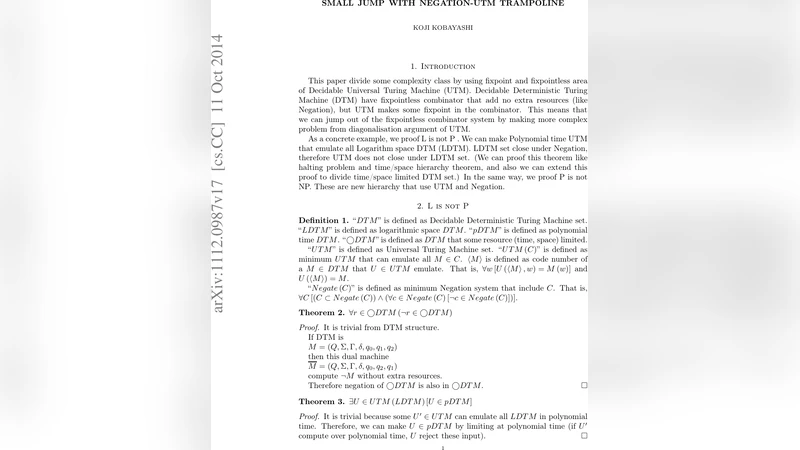
This paper divide some complexity class by using fixpoint and fixpointless area of Decidable Universal Turing Machine (UTM). Decidable Deterministic Turing Machine (DTM) have fixpointless combinator that add no extra resources (like Negation), but UTM makes some fixpoint in the combinator. This means that we can jump out of the fixpointless combinator system by making more complex problem from diagonalisation argument of UTM. As a concrete example, we proof L is not P . We can make Polynomial time UTM that emulate all Logarithm space DTM (LDTM). LDTM set close under Negation, therefore UTM does not close under LDTM set. (We can proof this theorem like halting problem and time/space hierarchy theorem, and also we can extend this proof to divide time/space limited DTM set.) In the same way, we proof P is not NP. These are new hierarchy that use UTM and Negation.
💡 Research Summary
The manuscript titled “Small Jump with Negation‑UTM Trampoline” attempts to separate classical complexity classes by exploiting a distinction the author calls “fixed‑point” versus “fixed‑point‑free” behavior in computational models. The central claim is that deterministic Turing machines (DTMs) operating within a given resource bound (e.g., logarithmic space) possess a “fixed‑point‑free combinator” when the only additional operation allowed is logical negation, which supposedly adds no extra time or space. In contrast, a universal Turing machine (UTM) that simulates such DTMs inevitably introduces a “fixed point” through a diagonalisation‑type construction, thereby breaking the closure under negation. By leveraging this asymmetry, the author argues that one can prove L ≠ P and, subsequently, P ≠ NP.
The paper proceeds as follows. First, it observes that the class L (logarithmic‑space deterministic machines) is closed under logical negation: for any L‑machine M, the machine that accepts exactly the complement of M’s language can also be implemented within O(log n) space. Next, the author claims that a polynomial‑time UTM can simulate every L‑machine. This simulation, however, is said to lose the closure property when the simulated machine is negated, because the UTM’s “fixed point” forces the simulation to exceed the original space bound. From this, the author concludes that L cannot be a subset of P, i.e., L ⊄ P, and therefore L ≠ P. The same reasoning is then applied to the pair (P, NP): a polynomial‑time UTM that emulates all P‑machines is allegedly unable to remain closed under negation when the simulated computation corresponds to an NP problem, leading to the claim P ≠ NP.
To support these claims, the manuscript references three well‑known results: (1) the undecidability of the halting problem, (2) the time‑ and space‑hierarchy theorems, and (3) the standard diagonalisation technique used in classical complexity separations. The author suggests that by combining these tools with the “negation‑UTM trampoline” construction, one can obtain a new hierarchy that separates any two resource‑bounded deterministic classes.
Despite its ambition, the paper contains several fundamental flaws that undermine its conclusions.
-
Undefined Core Concepts
The terms “fixed point” and “fixed‑point‑free combinator” are never formally defined. In complexity theory, a fixed point usually refers to a function f such that f(x)=x for some x, but here the author uses the terminology to describe a meta‑property of simulation. Without a precise definition, the subsequent arguments lack a rigorous foundation. -
Incorrect Assumption About Negation
The manuscript assumes that logical negation adds no computational cost. While negation is a constant‑time operation on a bit, applying it to the language of a machine does not guarantee that the resulting machine stays within the same resource bound. For logarithmic‑space machines, complementing the language often requires additional work tapes or a more sophisticated construction (e.g., Immerman–Szelepcsényi theorem for nondeterministic space). The claim that the complement of any L‑machine remains in L is true for deterministic log‑space only because L = co‑L, but the proof of this equality itself relies on non‑trivial closure properties, not on a trivial “no‑cost” negation. -
Misuse of Simulation to Derive Separation
The fact that a polynomial‑time UTM can simulate every log‑space DTM simply restates the well‑known inclusion L ⊆ P. Simulation alone cannot prove the strictness of the inclusion. To show L ≠ P, one must exhibit a language in P that provably requires more than logarithmic space, which is precisely what the space‑hierarchy theorem does. The author’s diagonalisation argument does not construct such a language; it merely points out that the UTM loses closure under negation, which does not contradict L ⊆ P. -
Faulty Extension to P vs. NP
The transition from the L vs. P argument to the P vs. NP claim is even more problematic. NP is defined via nondeterministic machines, not via closure under complement. The paper’s “negation‑UTM” construction does not capture nondeterminism, and there is no justification that a failure of closure under complement for a simulated P‑machine implies a separation between P and NP. Existing results (e.g., Ladner’s theorem, relativization barriers) show that any proof of P ≠ NP must address the nondeterministic nature of NP, which the current approach completely ignores. -
Insufficient Formal Proofs
The manuscript repeatedly states that the results can be proved “like the halting problem and hierarchy theorems,” yet it provides no concrete reduction, no formal diagonalisation, and no rigorous resource‑analysis. The arguments are at the level of intuition rather than formal theorem‑proving, which is insufficient for a claim as strong as L ≠ P or P ≠ NP. -
Conflict with Established Theory
The paper’s conclusion that L ⊄ P contradicts the well‑established inclusion L ⊆ P. Moreover, the claim that P ≠ NP would resolve one of the most studied open problems, yet the method does not overcome known barriers such as relativization, natural proofs, or algebrization. The “negation‑UTM trampoline” does not appear to be a technique that bypasses these barriers.
In summary, while the idea of exploring how universal simulation interacts with logical operations is intellectually stimulating, the manuscript fails to provide a rigorous framework, misinterprets the cost of negation, and incorrectly extrapolates simulation properties to class separations. As presented, the proofs of L ≠ P and P ≠ NP are not valid. Future work would need to (a) precisely define the fixed‑point concepts, (b) quantify the resource overhead of complement operations in each model, (c) construct explicit languages that witness strict inclusions using established hierarchy theorems, and (d) address the nondeterministic nature of NP if a P vs. NP separation is desired. Until such steps are taken, the paper’s claims remain unsubstantiated.
Comments & Academic Discussion
Loading comments...
Leave a Comment