Determination of the local contrast of interference fringe patterns using continuous wavelet transform
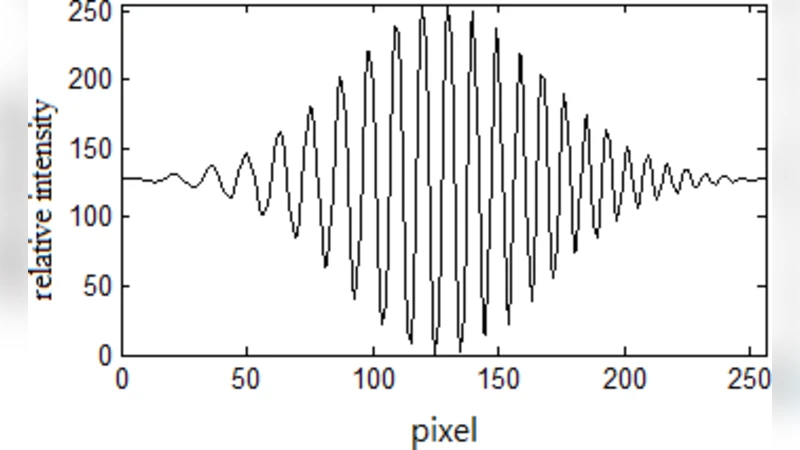
This essay gives the determination method of the local contrast of interference fringe patterns using continuous wavelet transform.
💡 Research Summary
The paper presents a novel method for estimating the local contrast of interference fringe patterns by exploiting the continuous wavelet transform (CWT). Interference fringes are widely used in optical metrology, surface profiling, vibration analysis, and related fields because the fringe intensity encodes phase information that can be converted into quantitative measurements. However, in practical setups the fringe contrast is rarely uniform across the field of view; variations arise from uneven illumination, optical component imperfections, surface roughness, and environmental disturbances. Conventional contrast estimation techniques—global averaging, Fourier‑based spectral analysis, or simple sliding‑window statistics—either ignore spatial non‑uniformities or suffer from sensitivity to window size and noise, leading to inaccurate phase retrieval and degraded measurement precision.
The authors model the recorded intensity I(x) as a spatially varying amplitude a(x) multiplied by a cosine term with phase φ(x), plus a background term b(x): I(x)=a(x)·cos