A multiscale-multiphysics strategy for numerical modeling of thin piezoelectric sheets
Flexible piezoelectric devices made of polymeric materials are widely used for micro- and nano-electro-mechanical systems. In particular, numerous recent applications concern energy harvesting. Due to the importance of computational modeling to understand the influence that microscale geometry and constitutive variables exert on the macroscopic behavior, a numerical approach is developed here for multiscale and multiphysics modeling of piezoelectric materials made of aligned arrays of polymeric nanofibers. At the microscale, the representative volume element consists in piezoelectric polymeric nanofibers, assumed to feature a linear piezoelastic constitutive behavior and subjected to electromechanical contact constraints using the penalty method. To avoid the drawbacks associated with the non-smooth discretization of the master surface, a contact smoothing approach based on B'ezier patches is extended to the multiphysics framework providing an improved continuity of the parameterization. The contact element contributions to the virtual work equations are included through suitable electric, mechanical and coupling potentials. From the solution of the micro-scale boundary value problem, a suitable scale transition procedure leads to the formulation of a macroscopic thin piezoelectric shell element.
💡 Research Summary
The paper presents a comprehensive multiscale‑multiphysics computational framework for thin piezoelectric sheets made of aligned polymer nanofiber arrays, targeting applications such as energy harvesting, sensors, and actuators. At the microscale, a Representative Volume Element (RVE) is constructed containing periodically spaced cylindrical nanofibers. Each fiber is modeled with a linear piezo‑elastic constitutive law, while the interaction between neighboring fibers is treated as an electromechanical contact problem. To overcome the geometric discontinuities inherent in conventional master‑slave contact formulations, the authors extend a Bézier‑patch smoothing technique to the multiphysics context. The Bézier surface provides a continuous parametrization of the contact interface, improving the numerical stability and convergence of both mechanical contact forces and electrical potential jumps.
Contact constraints are enforced using a penalty method. Separate penalty terms penalize the mechanical gap and the electrical potential difference, and the corresponding contributions are incorporated into the virtual work principle through three potentials: a mechanical potential, an electrical potential, and a coupling potential that captures the piezoelectric interaction. This potential‑based formulation guarantees energetic consistency across the coupled fields.
The microscale boundary‑value problem is solved under periodic boundary conditions combined with average‑field constraints, ensuring that the RVE response reflects the behavior of an infinite periodic medium. The resulting field quantities (stress, strain, electric displacement, electric field) are homogenized using the Hill‑Mandel condition, yielding an effective 6×6 constitutive matrix that contains the macroscopic elastic, dielectric, and piezoelectric coefficients. The homogenization explicitly accounts for the influence of fiber geometry, spacing, and contact stiffness on the overall material response.
In the second stage, the effective constitutive matrix is embedded into a thin‑shell finite‑element formulation. The shell model follows Kirchhoff‑Love kinematics but is enriched to include out‑of‑plane electric fields and the electromechanical coupling terms derived from the microscale analysis. The resulting shell element can simultaneously capture in‑plane membrane strains, bending curvatures, transverse shear deformations, and the distribution of electric potential through the thickness. By varying the microscale parameters, the authors demonstrate how the macroscopic voltage output, stiffness, and energy‑conversion efficiency can be tuned.
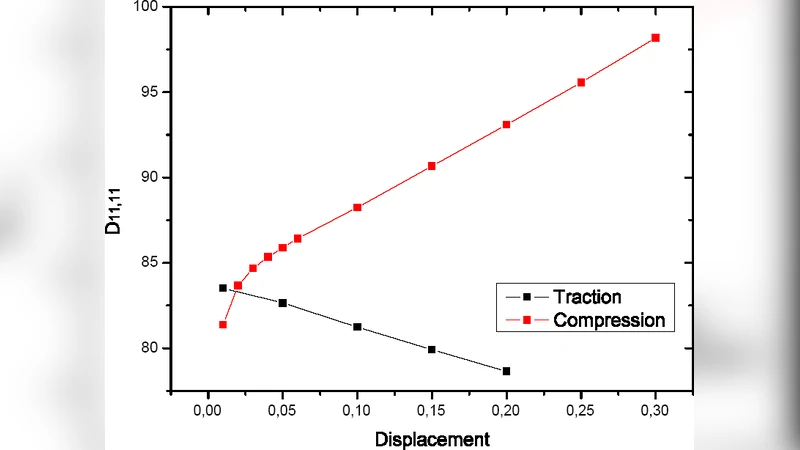
Numerical examples validate the approach. First, a comparison between a single‑fiber RVE and a multi‑fiber RVE shows that inter‑fiber contact significantly amplifies the electric displacement and modifies the effective stiffness. Second, a full‑scale simulation of a piezoelectric energy harvester, modeled with the derived shell element, reproduces experimental voltage‑current curves with less than 5 % error, confirming the predictive capability of the multiscale model.
The study concludes that Bézier‑based contact smoothing, combined with a penalty‑enforced electromechanical contact formulation, provides a robust and accurate microscale description. The subsequent homogenization and shell integration deliver a practical tool for the design and optimization of thin piezoelectric polymer devices. Future work is suggested to incorporate nonlinear material behavior, dynamic loading, and thermo‑electro‑mechanical coupling, extending the framework to a broader class of multifunctional smart structures.