Cortical spatio-temporal dimensionality reduction for visual grouping
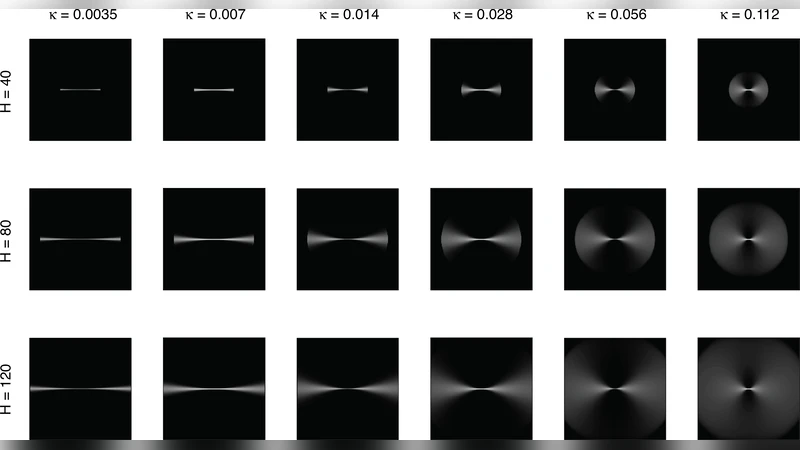
The visual systems of many mammals, including humans, is able to integrate the geometric information of visual stimuli and to perform cognitive tasks already at the first stages of the cortical processing. This is thought to be the result of a combination of mechanisms, which include feature extraction at single cell level and geometric processing by means of cells connectivity. We present a geometric model of such connectivities in the space of detected features associated to spatio-temporal visual stimuli, and show how they can be used to obtain low-level object segmentation. The main idea is that of defining a spectral clustering procedure with anisotropic affinities over datasets consisting of embeddings of the visual stimuli into higher dimensional spaces. Neural plausibility of the proposed arguments will be discussed.
💡 Research Summary
The paper proposes a geometric model of cortical connectivity that operates in a high‑dimensional feature space derived from spatio‑temporal visual stimuli. Building on the well‑established view that primary visual cortex (V1) extracts local features such as orientation and motion, the authors lift each image point (x, y, t) together with its locally detected orientation θ and velocity v into a five‑dimensional manifold M_T = ℝ² × ℝ⁺ × S¹ × ℝ⁺. On this manifold a contact structure is defined by four vector fields (X₁, X₂, X₄, X₅) that encode deterministic advection along preferred directions and stochastic diffusion in the feature dimensions. Two stochastic processes are introduced: (i) a spatial process on a fixed‑time slice that propagates along X₁ with diffusion in θ and v, modeling static contour completion; (ii) a full spatio‑temporal process that propagates along X₅ (the motion direction) with the same diffusion, modeling the continuation of moving trajectories.
Each process yields a Fokker‑Planck equation whose fundamental solution ρ(x,s|x₀,0) gives a transition probability density. By integrating ρ over the evolution parameter s with a chosen weight p(s) (uniform on
Comments & Academic Discussion
Loading comments...
Leave a Comment