Top terms of polynomial traces in Kras plumbing construction
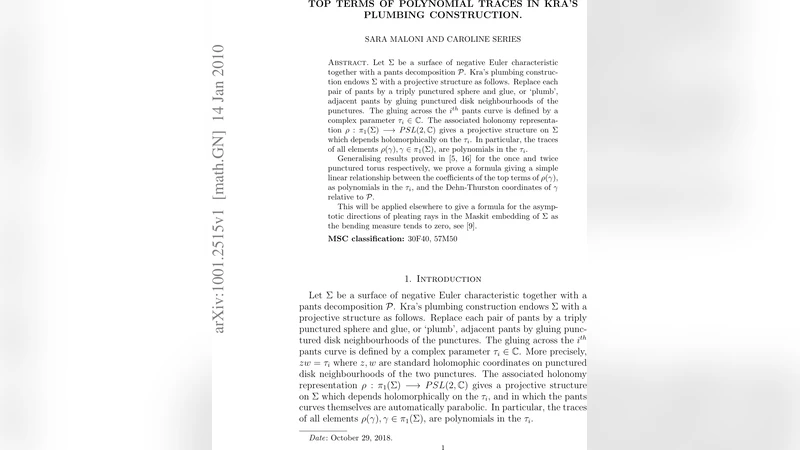
Let $\Sigma$ be a surface of negative Euler characteristic together with a pants decomposition $\P$. Kra’s plumbing construction endows $\Sigma$ with a projective structure as follows. Replace each pair of pants by a triply punctured sphere and glue, or `plumb’, adjacent pants by gluing punctured disk neighbourhoods of the punctures. The gluing across the $i^{th}$ pants curve is defined by a complex parameter $\tau_i \in \C$. The associated holonomy representation $\rho: \pi_1(\Sigma) \to PSL(2,\C)$ gives a projective structure on $\Sigma$ which depends holomorphically on the $\tau_i$. In particular, the traces of all elements $\rho(\gamma), \gamma \in \pi_1(\Sigma)$, are polynomials in the $\tau_i$. Generalising results proved in previous papers for the once and twice punctured torus respectively, we prove a formula giving a simple linear relationship between the coefficients of the top terms of $\rho(\gamma)$, as polynomials in the $\tau_i$, and the Dehn-Thurston coordinates of $\gamma$ relative to $\P$. This will be applied elsewhere to give a formula for the asymptotic directions of pleating rays in the Maskit embedding of $\Sigma$ as the bending measure tends to zero.
💡 Research Summary
The paper investigates the algebraic structure of holonomy traces arising from Kra’s plumbing construction on a hyperbolic surface Σ equipped with a pants decomposition 𝒫. In Kra’s model each pair of pants is replaced by a triply punctured sphere and adjacent pants are “plumbed’’ together by identifying punctured disk neighborhoods of the corresponding cuffs. The gluing across the i‑th cuff is governed by a complex parameter τ_i∈ℂ. This yields a complex projective structure on Σ whose holonomy representation ρ:π₁(Σ)→PSL(2,ℂ) depends holomorphically on the τ_i. Consequently, for any loop γ∈π₁(Σ) the trace Tr ρ(γ) is a polynomial in the τ_i.
The central result of the work is a precise linear relationship between the coefficients of the top‑degree terms of these trace polynomials and the Dehn‑Thurston coordinates of γ relative to the chosen pants decomposition. Recall that the Dehn‑Thurston coordinates assign to γ a pair of integers (a_i,b_i) for each cuff i: a_i records the geometric intersection number with the i‑th cuff, while b_i records the twisting (or “shear’’) around that cuff. The authors prove that the leading term of Tr ρ(γ) is of the form
Coeff_top(Tr ρ(γ)) = ∑_{i} (a_i · Re τ_i + b_i · Im τ_i),
i.e. the coefficient is a simple linear combination of the real and imaginary parts of the plumbing parameters, weighted exactly by the intersection and twist numbers.
To establish this, the paper first rewrites each plumbing map as a 2×2 Möbius matrix M_i(τ_i) whose entries are linear in τ_i. The holonomy of γ is then expressed as a product of such matrices according to a word in the generators of π₁(Σ) dictated by the combinatorics of the pants decomposition. By tracking the degree in each τ_i through matrix multiplication, the authors show that the total degree of Tr ρ(γ) equals Σ_i a_i, and that the coefficient of the monomial ∏_i τ_i^{a_i} is built from the fixed parts of the matrices (the “twist’’ contributions) in a way that yields exactly the linear combination above. The proof generalizes earlier results for the once‑punctured torus (where the formula reduces to a single term) and the twice‑punctured torus, demonstrating that the phenomenon persists for arbitrary finite‑type surfaces.
Beyond the intrinsic interest of this algebraic description, the theorem has a concrete geometric application. In the Maskit embedding of Σ, pleating rays are one‑parameter families of projective structures whose bending measure (the pleating measure) tends to zero. The asymptotic direction of such a ray is determined by the leading term of the trace polynomial for the curve that is being pleated. Because the leading coefficient is now known explicitly in terms of Dehn‑Thurston data, the authors can predict the direction of any pleating ray solely from the combinatorial data (a_i,b_i). This provides a powerful tool for understanding the boundary of the Maskit slice and the geometry of limits of quasifuchsian groups.
The paper also includes several illustrative examples. For a single cuff curve the formula reproduces the familiar linear dependence on τ_i; for more complicated curves the sum over cuffs captures the interaction of multiple intersections and twists. The authors discuss how the result fits into the broader context of Teichmüller theory, complex projective structures, and the study of character varieties.
In the concluding section, the authors outline future research directions: (1) developing computational algorithms that exploit the linear formula to efficiently explore deformation spaces; (2) extending the analysis to other gluing constructions (e.g., grafting or Fenchel–Nielsen coordinates) and comparing the resulting trace polynomials; (3) investigating whether analogous “top‑term” linear relationships hold for higher rank holonomy representations or for surfaces with boundary components treated differently. Overall, the work bridges combinatorial topology (Dehn‑Thurston coordinates) and complex analytic geometry (holonomy traces), offering a clear and usable description of the leading algebraic behavior of projective structures obtained via Kra’s plumbing.
Comments & Academic Discussion
Loading comments...
Leave a Comment