Mapping spaces in Quasi-categories
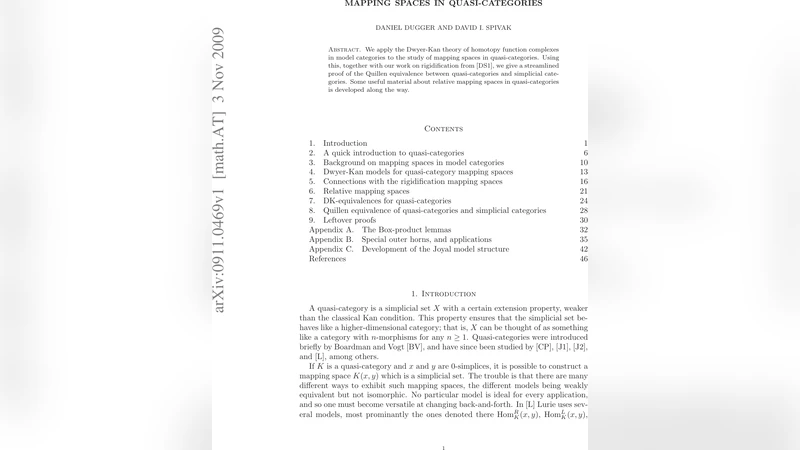
We apply the Dwyer-Kan theory of homotopy function complexes in model categories to the study of mapping spaces in quasi-categories. Using this, together with our work on rigidification from [DS1], we give a streamlined proof of the Quillen equivalence between quasi-categories and simplicial categories. Some useful material about relative mapping spaces in quasi-categories is developed along the way.
💡 Research Summary
The paper investigates mapping spaces in quasi‑categories by importing the Dwyer‑Kan theory of homotopy function complexes from model category theory. The authors begin by recalling that in a model category 𝔐, the homotopy function complex Map𝔐(X,Y) between two objects X and Y is defined via a hammock localization or, equivalently, by taking cofibrant‑fibrant replacements and forming a simplicial mapping space. They observe that the Joyal model structure on simplicial sets, whose fibrant objects are precisely quasi‑categories, admits such cofibrant‑fibrant replacements for any simplicial set. Consequently, for two quasi‑categories C and D one can define a simplicial set of maps Fun(C,D) that coincides with the Dwyer‑Kan homotopy function complex after appropriate replacements.
A central technical tool is the rigidification functor R: sSet_Joyal → sCat introduced in the authors’ earlier work
Comments & Academic Discussion
Loading comments...
Leave a Comment