Faithfulness of a functor of Quillen
There exists a canonical functor from the category of fibrant objects of a model category modulo cylinder homotopy to its homotopy category. We show that this functor is faithful under certain conditions, but not in general.
Authors: William G. Dwyer, Andrei Radulescu-Banu, Sebastian Thomas
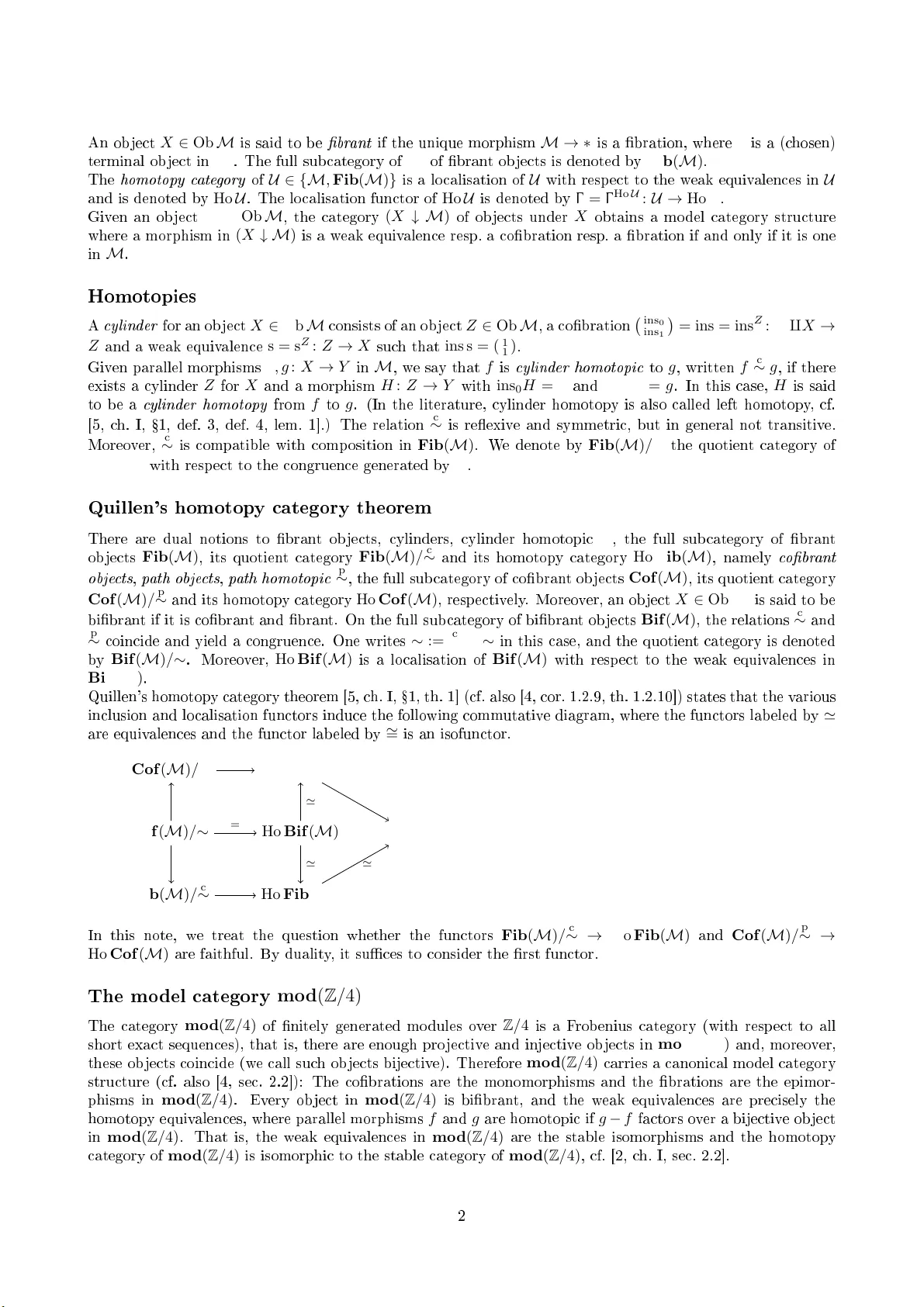
F aithfulness of a funtor of Quillen William G. Dwy er Andrei Rdulesu-Ban u Sebastian Thomas Otob er 6, 2009 Abstrat There exists a anonial funtor from the ategory of bran t ob jets of a mo del ategory mo dulo ylinder homotop y to its homotop y ategory . W e sho w that this funtor is faithful under ertain onditions, but not in general. 1 In tro dution W e let M b e a mo del ategory . Quillen denes in [ 5, h. I, 1℄ a homotop y relation on the full sub ategory Fib ( M ) of bran t ob jets, using ylinders. He obtains a quotien t ategory Fib ( M ) / c ∼ and a anonial funtor Fib ( M ) / c ∼ → Ho Fib ( M ) . The question o urs whether this funtor is faithful. W e sho w that it is faithful if M is left prop er and fullls an additional te hnial ondition. Moreo v er, w e sho w b y an example that it is not faithful in general. Con v en tions and notations • The omp osite of morphisms f : X → Y and g : Y → Z is denoted b y f g : X → Z . • Giv en n ∈ N 0 , w e abbreviate Z /n := Z /n Z . Giv en k , m, n ∈ N 0 , w e write k : Z /m → Z /n, a + m Z 7→ k a + n Z , pro vided n divides k m . • Giv en a ategory C with nite opro duts and ob jets X , Y ∈ Ob C , w e denote b y X ∐ Y a ( hosen) opro dut. The em b edding X → X ∐ Y is denoted b y emb 0 , the em b edding Y → X ∐ Y b y emb 1 . Giv en morphisms f : X → Z and g : Y → Z in C , the indued morphism X ∐ Y → Z is denoted b y f g . • Giv en a ategory C and an ob jet X ∈ Ob C , the ategory of ob jets in C under X will b e denoted b y ( X ↓ C ) . The ob jets in ( X ↓ C ) are denoted b y ( Y , f ) , where Y ∈ O b C and f : X → Y is a morphism in C . 2 Preliminaries from homotopial algebra W e reall some basi fats from homotopial algebra. Our main referene is [5, h. I, 1℄. Mo del ategories Throughout this note, w e let M b e a mo del ategory , f. [5 , h. I, 1, def. 1℄. In M , there are three kinds of distinguished morphisms, alled obr ations , br ations and we ak e quivalen es . Cobrations are losed under pushouts. If w eak equiv alenes in M are losed under pushouts along obrations, M is said to b e left pr op er , f. [3, def. 13.1.1(1)℄. Mathematis Sub jet Classiation 2010: 18G55, 55U35. 1 An ob jet X ∈ Ob M is said to b e br ant if the unique morphism M → ∗ is a bration, where ∗ is a ( hosen) terminal ob jet in M . The full sub ategory of M of bran t ob jets is denoted b y Fib ( M ) . The homotopy ate gory of U ∈ {M , Fib ( M ) } is a lo alisation of U with resp et to the w eak equiv alenes in U and is denoted b y Ho U . The lo alisation funtor of Ho U is denoted b y Γ = Γ Ho U : U → Ho U . Giv en an ob jet X ∈ Ob M , the ategory ( X ↓ M ) of ob jets under X obtains a mo del ategory struture where a morphism in ( X ↓ M ) is a w eak equiv alene resp. a obration resp. a bration if and only if it is one in M . Homotopies A ylinder for an ob jet X ∈ Ob M onsists of an ob jet Z ∈ O b M , a obration ins 0 ins 1 = ins = ins Z : X ∐ X → Z and a w eak equiv alene s = s Z : Z → X su h that ins s = ( 1 1 ) . Giv en parallel morphisms f , g : X → Y in M , w e sa y that f is ylinder homotopi to g , written f c ∼ g , if there exists a ylinder Z for X and a morphism H : Z → Y with ins 0 H = f and ins 1 H = g . In this ase, H is said to b e a ylinder homotopy from f to g . (In the literature, ylinder homotop y is also alled left homotop y , f. [5, h. I, 1, def. 3, def. 4, lem. 1℄.) The relation c ∼ is reexiv e and symmetri, but in general not transitiv e. Moreo v er, c ∼ is ompatible with omp osition in Fib ( M ) . W e denote b y Fib ( M ) / c ∼ the quotien t ategory of Fib ( M ) with resp et to the ongruene generated b y c ∼ . Quillen's homotop y ategory theorem There are dual notions to bran t ob jets, ylinders, ylinder homotopi c ∼ , the full sub ategory of bran t ob jets Fib ( M ) , its quotien t ategory Fib ( M ) / c ∼ and its homotop y ategory Ho Fi b ( M ) , namely obr ant obje ts , p ath obje ts , p ath homotopi p ∼ , the full sub ategory of obran t ob jets Cof ( M ) , its quotien t ategory Cof ( M ) / p ∼ and its homotop y ategory Ho Co f ( M ) , resp etiv ely . Moreo v er, an ob jet X ∈ Ob M is said to b e bibran t if it is obran t and bran t. On the full sub ategory of bibran t ob jets Bif ( M ) , the relations c ∼ and p ∼ oinide and yield a ongruene. One writes ∼ := c ∼ = p ∼ in this ase, and the quotien t ategory is denoted b y Bif ( M ) / ∼ . Moreo v er, Ho Bi f ( M ) is a lo alisation of Bif ( M ) with resp et to the w eak equiv alenes in Bif ( M ) . Quillen's homotop y ategory theorem [5, h. I, 1, th. 1℄ (f. also [ 4, or. 1.2.9, th. 1.2.10℄) states that the v arious inlusion and lo alisation funtors indue the follo wing omm utativ e diagram, where the funtors lab eled b y ≃ are equiv alenes and the funtor lab eled b y ∼ = is an isofuntor. Cof ( M ) / p ∼ Ho Co f ( M ) Bif ( M ) / ∼ Ho Bi f ( M ) Ho M Fib ( M ) / c ∼ Ho Fi b ( M ) ≃ ∼ = ≃ ≃ ≃ In this note, w e treat the question whether the funtors Fib ( M ) / c ∼ → Ho Fib ( M ) and Cof ( M ) / p ∼ → Ho Co f ( M ) are faithful. By dualit y , it sues to onsider the rst funtor. The mo del ategory mo d ( Z / 4) The ategory mo d ( Z / 4) of nitely generated mo dules o v er Z / 4 is a F rob enius ategory (with resp et to all short exat sequenes), that is, there are enough pro jetiv e and injetiv e ob jets in mo d ( Z / 4) and, moreo v er, these ob jets oinide (w e all su h ob jets bijetiv e). Therefore mo d ( Z / 4) arries a anonial mo del ategory struture (f. also [ 4, se. 2.2℄): The obrations are the monomorphisms and the brations are the epimor- phisms in mo d ( Z / 4) . Ev ery ob jet in mo d ( Z / 4) is bibran t, and the w eak equiv alenes are preisely the homotop y equiv alenes, where parallel morphisms f and g are homotopi if g − f fators o v er a bijetiv e ob jet in mo d ( Z / 4) . That is, the w eak equiv alenes in mo d ( Z / 4) are the stable isomorphisms and the homotop y ategory of mo d ( Z / 4) is isomorphi to the stable ategory of mo d ( Z / 4) , f. [ 2, h. I, se. 2.2℄. 2 W e remark that ev ery ob jet in mo d ( Z / 4) is isomorphi to ( Z / 4) ⊕ k ⊕ ( Z / 2) ⊕ l for some k , l ∈ N 0 , and ev ery bijetiv e ob jet is isomorphi to ( Z / 4) ⊕ k for some k ∈ N 0 . 3 F aithfulness of the funtor Fib ( M ) / c ∼ → Ho Fib ( M ) W e giv e a suien t riterion for the funtor under onsideration to b e faithful. Prop osition. If the mo del ategory M is left prop er and if w ∐ w is a w eak equiv alene for ev ery w eak equiv alene w in M , then c ∼ is a ongruene on Fib ( M ) and the anonial funtor Fib ( M ) / c ∼ → Ho Fib ( M ) is faithful. Pr o of. W e supp ose giv en bran t ob jets X and Y and morphisms f , g : X → Y with Γ f = Γ g in Ho Fib ( M ) . By [1, th. 1(ii)℄, there exists a w eak equiv alene w : X ′ → X su h that wf p ∼ w g . It follo ws that wf c ∼ w g b y [5 , h. I, 1, dual of lem. 5℄, that is, there exists a ylinder Z ′ for X ′ and a ylinder homotop y H ′ : Z ′ → Y from wf to wg . W e let X ′ ∐ X ′ X ∐ X Z ′ Z w ∐ w ≈ ins Z ′ i w ′ ≈ b e a pushout of w ∐ w along ins Z ′ . By assumption, w ∐ w and w ′ are w eak equiv alenes. Sine ( w ∐ w ) ( 1 1 ) = ins Z ′ s Z ′ w , there exists a unique morphism s : Z → X with ( 1 1 ) = is and s Z ′ w = w ′ s . Then s is a w eak equiv alene sine s Z ′ , w and w ′ are w eak equiv alenes and therefore Z b eomes a ylinder for X with ins Z := i and s Z := s . Moreo v er, ( w ∐ w ) f g = ins Z ′ H ′ implies that there exists a unique morphism H : Z → Y with f g = ins Z H and H ′ = w ′ H . So in partiular f c ∼ g . X ′ ∐ X ′ X ∐ X Y Z ′ Z Y X ′ X w ∐ w ≈ ins Z ′ “ f g ” ins Z w ′ ≈ s Z ′ ≈ H s Z ≈ w ≈ Altogether, w e ha v e sho wn that morphisms in Fib ( M ) represen t the same morphism in Ho Fib ( M ) if and only if they are ylinder homotopi. In partiular, c ∼ is a ongruene on Fib ( M ) . The follo wing oun terexample sho ws that the anonial funtor Fib ( M ) / c ∼ → Ho Fib ( M ) is not faithful in general. Example. W e onsider the ategory ( Z / 4 ↓ m o d ( Z / 4)) of nitely generated Z / 4 -mo dules under Z / 4 with the mo del ategory struture inherited from mo d ( Z / 4) , f. 2. All ob jets of ( Z / 4 ↓ mo d ( Z / 4)) are bran t sine all ob jets in mo d ( Z / 4) are bran t. W e study morphisms ( Z / 4 , 2 ) → ( Z / 4 ⊕ Z / 2 , ( 2 0 )) in ( Z / 4 ↓ m o d ( Z / 4)) . W e let ( Z, t ) b e a ylinder of ( Z / 4 , 2 ) and w e let H : ( Z, t ) → ( Z / 4 ⊕ Z / 2 , ( 2 0 )) b e a ylinder homotop y (from ins 0 H to ins 1 H ). Then w e ha v e a w eak equiv alene ( Z, t ) → ( Z / 4 , 2) in ( Z / 4 ↓ m o d ( Z / 4)) and hene a w eak equiv alene Z → Z / 4 in mo d ( Z / 4) . Th us Z is bijetiv e and therefore w e ma y assume that Z = ( Z / 4) ⊕ k . Sine ins 0 and ins 1 are morphisms from ( Z / 4 , 2 ) to ( Z, t ) , w e ha v e 2ins 0 = t = 2ins 1 and hene ins 0 ≡ 2 ins 1 as morphisms from Z / 4 to Z . But this implies that the seond omp onen ts of ins 0 H and ins 1 H are the same. In other w ords, w e ha v e sho wn that ylinder homotopi morphisms from ( Z / 4 , 2 ) to ( Z / 4 ⊕ Z / 2 , ( 2 0 )) oinide in the seond omp onen t. It follo ws that the morphisms ( 1 0 ) : ( Z / 4 , 2) → ( Z / 4 ⊕ Z / 2 , ( 2 0 )) and ( 1 1 ) : ( Z / 4 , 2) → ( Z / 4 ⊕ Z / 2 , ( 2 0 )) in ( Z / 4 ↓ m o d ( Z / 4)) represen t dieren t morphisms in the quotien t ategory Fib (( Z / 4 ↓ mo d ( Z / 4))) / c ∼ . 3 On the other hand, sine Z / 4 is bijetiv e, the morphism 2 : Z / 4 → Z / 4 is a w eak equiv alene in mo d ( Z / 4) , and therefore 2 : ( Z / 4 , 1) → ( Z / 4 , 2) is a w eak equiv alene in ( Z / 4 ↓ mo d ( Z / 4)) . But 2 ( 1 0 ) = 2 ( 1 1 ) as morphisms from ( Z / 4 , 1 ) to ( Z / 4 ⊕ Z / 2 , ( 2 0 )) in ( Z / 4 ↓ mo d ( Z / 4)) , so in partiular Γ (2 ( 1 0 )) = Γ (2 ( 1 1 )) and hene Γ ( 1 0 ) = Γ ( 1 1 ) . Referenes [1℄ Br o wn, Kenneth S. Abstrat homotop y theory and generalized sheaf ohomology . T ransations of the Amerian Mathematial So iet y 186 (1974), pp. 419458. [2℄ Happel, Dieter . T riangulated ategories in the represen tation theory of nite-dimensional algebras . Lon- don Mathematial So iet y Leture Note Series v ol. 119. Cam bridge Univ ersit y Press, Cam bridge (1988). [3℄ Hirshhorn, Philip S. Mo del ategories and their lo alizations . Mathematial Surv eys and Monographs v ol. 99. Amerian Mathematial So iet y , Pro videne, RI (2003). [4℄ Ho vey, Mark . Mo del Categories . Mathematial Surv eys and Monographs v ol. 63. Amerian Mathematial So iet y , Pro videne, RI (1999). [5℄ Quillen, D aniel G. Homotopi al A lgebr a . Leture Notes in Mathematis v ol. 43. Springer, Berlin-New Y ork (1967). William G. Dwy er Departmen t of Mathematis Univ ersit y of Notre Dame Notre Dame, IN 46556 dwy er.1nd.edu http://www.nd.ed u/ ~w gd/ Andrei Rdulesu-Ban u 86 Cedar St Lexington, MA 02421 USA andreialum.mit.edu Sebastian Thomas Lehrstuhl D für Mathematik R WTH Aa hen T emplergrab en 64 D-52062 Aa hen sebastian.thomasmath.rwth-aa hen.de http://www.math .rw th - aa h en. de /~ Seb as ti an. Th om as/ 4
Original Paper
Loading high-quality paper...
Comments & Academic Discussion
Loading comments...
Leave a Comment