Nerves and classifying spaces for bicategories
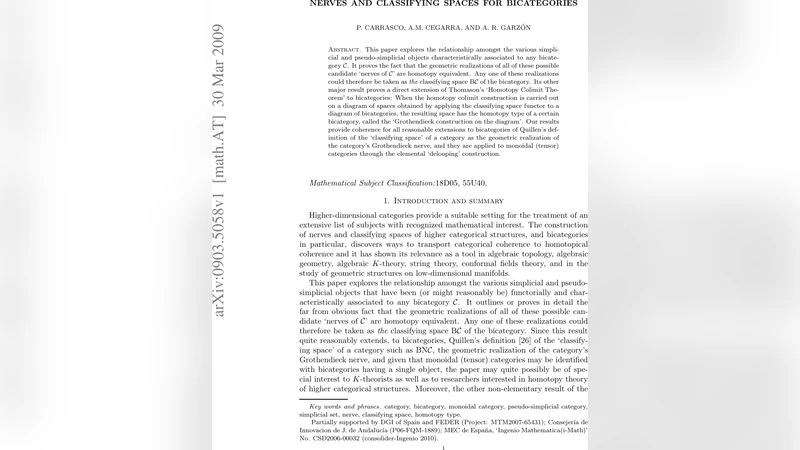
This paper explores the relationship amongst the various simplicial and pseudo-simplicial objects characteristically associated to any bicategory C. It proves the fact that the geometric realizations of all of these possible candidate nerves of C' are homotopy equivalent. Any one of these realizations could therefore be taken as the classifying space BC of the bicategory. Its other major result proves a direct extension of Thomason's Homotopy Colimit Theorem’ to bicategories: When the homotopy colimit construction is carried out on a diagram of spaces obtained by applying the classifying space functor to a diagram of bicategories, the resulting space has the homotopy type of a certain bicategory, called the Grothendieck construction on the diagram'. Our results provide coherence for all reasonable extensions to bicategories of Quillen's definition of the classifying space’ of a category as the geometric realization of the category’s Grothendieck nerve, and they are applied to monoidal (tensor) categories through the elemental `delooping’ construction.
💡 Research Summary
The paper investigates the plethora of nerve constructions that can be associated with an arbitrary bicategory C and establishes that all of their geometric realizations are homotopy equivalent. Consequently, any of these realizations may be taken as the classifying space BC of the bicategory, providing a robust notion of “the” classifying space for bicategories.
The authors begin by recalling the classical nerves for ordinary categories—Grothendieck’s nerve, Duskin’s nerve, and Street’s nerve—and then adapt each construction to the bicategorical setting. In a bicategory, objects (0‑cells), 1‑morphisms, and 2‑morphisms must be encoded simultaneously, and the coherence constraints for horizontal and vertical composition become a central technical obstacle. For each nerve they define a (pseudo‑)simplicial set N_i(C) (i = G, D, S) together with natural normalization and denormalization maps that relate the various models. By invoking Mac Lane’s coherence theorem, Bénabou’s bicategorical coherence results, and the machinery of model categories, they prove that the normalization maps are weak equivalences. Hence the geometric realizations |N_G(C)|, |N_D(C)|, and |N_S(C)| are all homotopy equivalent. This result gives a “coherence theorem for bicategorical nerves”: any reasonable nerve yields the same homotopy type.
The second major contribution is a bicategorical extension of Thomason’s Homotopy Colimit Theorem. Thomason’s original theorem states that for a diagram of spaces obtained by applying the classifying‑space functor to a diagram of small categories, the homotopy colimit is homotopy equivalent to the classifying space of the Grothendieck construction on that diagram. The authors replace categories by bicategories, a diagram 𝔉 : 𝔅 → Bicat, and the ordinary Grothendieck construction by a bicategorical Grothendieck construction ∫_𝔅 𝔉. They show that the homotopy colimit of the diagram of spaces B(𝔉(b)) (b∈𝔅) is homotopy equivalent to B(∫_𝔅 𝔉). The proof requires a careful analysis of the bicategorical coherence data: the 2‑cells of the diagram must be assembled in a way that respects both horizontal and vertical composition, and the resulting bicategory ∫_𝔅 𝔉 encodes precisely the “lax colimit” of the original diagram. By constructing explicit comparison maps and verifying they are weak equivalences, the authors obtain a clean bicategorical analogue of Thomason’s theorem.
Finally, the paper applies the theory to monoidal (tensor) categories via the standard delooping construction. A monoidal category 𝔐 can be viewed as a one‑object bicategory B𝔐; delooping once more yields a bicategory B(B𝔐) whose classifying space is the double classifying space B²𝔐 familiar from algebraic K‑theory and loop‑space theory. The authors verify that their general results recover the known homotopy type of B²𝔐, thereby demonstrating that the bicategorical nerve machinery correctly captures the homotopical information of monoidal structures.
In summary, the paper achieves three intertwined goals: (1) it unifies several existing bicategorical nerve constructions by proving that their realizations are homotopy equivalent; (2) it extends Thomason’s homotopy‑colimit theorem to diagrams of bicategories, showing that the homotopy colimit of classifying spaces coincides with the classifying space of the bicategorical Grothendieck construction; and (3) it illustrates the utility of these results through the delooping of monoidal categories. These contributions provide a solid foundation for further developments in higher‑category theory, homotopy theory of bicategories, and applications such as the study of higher algebraic K‑theory, topological field theories, and homotopical aspects of quantum algebra.
Comments & Academic Discussion
Loading comments...
Leave a Comment