The Atiyah--Segal completion theorem in twisted K-theory
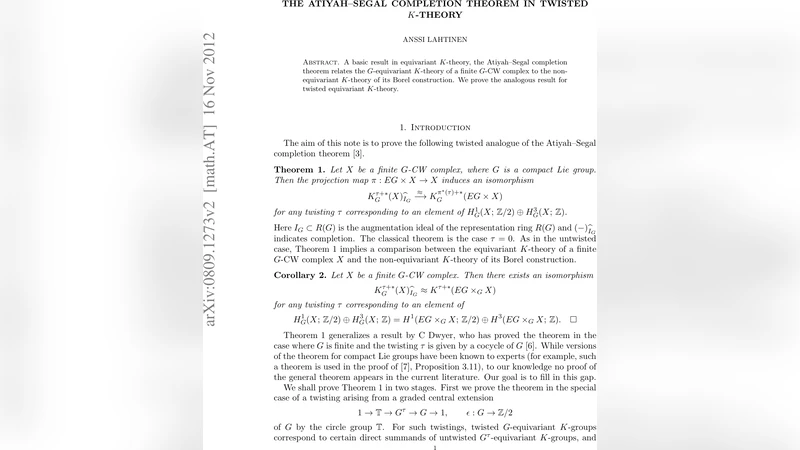
In this note we prove the analogue of the Atiyah-Segal completion theorem for equivariant twisted K-theory in the setting of an arbitrary compact Lie group G and an arbitrary twisting of the usually considered type. The theorem generalizes a result by C. Dwyer, who has proven the theorem for finite G and twistings of a more restricted type. While versions of the general result have been known to experts, to our knowledge no proof appears in the current literature. Our goal is to fill in this gap. The proof we give proceeds in two stages. We first prove the theorem in the case of a twisting arising from a graded central extension of G, following the Adams-Haeberly-Jackowski-May proof of the classical Atiyah-Segal completion theorem. After establishing that the theorem holds for this special class of twistings, we then deduce the general theorem by a Mayer-Vietoris argument.
💡 Research Summary
The paper fills a gap in the literature by establishing a full Atiyah‑Segal completion theorem for equivariant twisted K‑theory with respect to any compact Lie group G and an arbitrary twisting of the usual type. The classical Atiyah‑Segal theorem states that for a G‑space X, the I‑adic completion of the equivariant K‑theory K_G(X) (where I is the augmentation ideal of the representation ring R(G)) is naturally isomorphic to the K‑theory of the Borel construction X×_G EG. Dwyer extended this to finite groups and to twistings coming from central extensions, but a general proof for all compact Lie groups and all twistings has not appeared.
The authors proceed in two main stages.
Stage 1 – Central‑extension twistings.
A twisting τ₀ that arises from a graded central extension
1 → U(1) → Ĝ → G → 1
induces a τ₀‑twisted equivariant K‑theory K_G^{τ₀}(X) which can be identified with the ordinary Ĝ‑equivariant K‑theory. This identification allows the authors to import the Adams‑Haeberly‑Jackowski‑May proof of the classical completion theorem. They view K_G^{τ₀}(X) as an R(G)‑module, form its I‑adic completion \widehat{K_G^{τ₀}(X)}_I, and construct a natural map to K_G^{τ₀}(X×_G EG). By analyzing the effect of the 2‑cocycle defining the central extension on the Fredholm‑operator model of K‑theory, they verify that this map is an isomorphism. Consequently, the completion theorem holds for all twistings that come from graded central extensions.
Stage 2 – Arbitrary twistings.
For a general twisting τ (represented by a class in H³_G(X;ℤ) or equivalently in H³(BG;ℤ)), the authors cover X by a G‑invariant open cover {U_i} such that each U_i is G‑equivariantly contractible. On each U_i the restriction τ|_{U_i} becomes trivial in H³_G, and therefore can be realized as a central‑extension twisting. Hence the result of Stage 1 applies locally.
The key technical tool is a Mayer‑Vietoris argument for twisted equivariant K‑theory. The authors establish a short exact sequence
0 → K_G^{τ}(U∪V) → K_G^{τ}(U)⊕K_G^{τ}(V) → K_G^{τ}(U∩V) → 0
and show that this sequence remains exact after I‑adic completion. By inductively applying the Mayer‑Vietoris sequence over a finite G‑CW decomposition of X, they glue the local completions together to obtain a global isomorphism
\widehat{K_G^{τ}(X)}_I ≅ K_G^{τ}(X×_G EG).
Thus the Atiyah‑Segal completion theorem holds for any compact Lie group G and any twisting of the standard type.
The paper concludes by discussing implications. The theorem provides a powerful computational tool: twisted equivariant K‑theory can be calculated via the (often simpler) Borel construction after completing at the augmentation ideal. This opens the door to applications in areas such as T‑duality, string‑theoretic gerbes, and the study of twisted equivariant elliptic cohomology. Moreover, the Mayer‑Vietoris strategy used here suggests that similar completion results may be obtainable for other equivariant cohomology theories with twists.
Comments & Academic Discussion
Loading comments...
Leave a Comment