The 5-local homotopy of $eo_4$
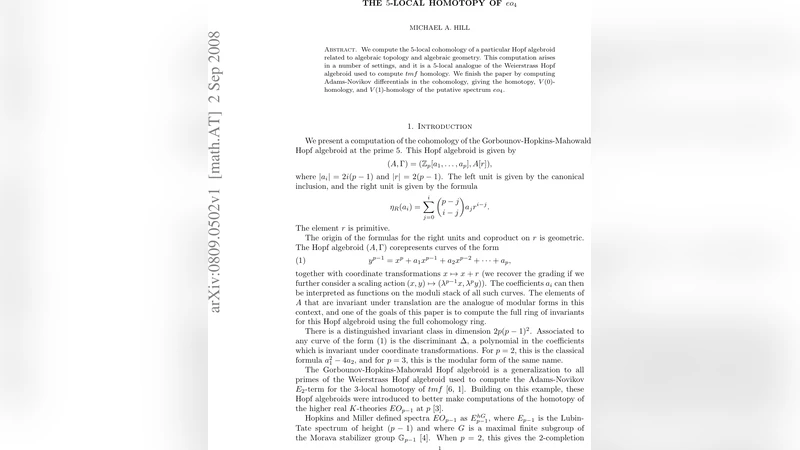
We compute the 5-local cohomology of a 5-local analogue of the Weierstrass Hopf algebroid used to compute $tmf$ homology. We compute the Adams-Novikov differentials in the cohomology, giving the homotopy, V(0)-homology, and V(1)-homology of the putative spectrum $eo_4$. We also link this computation to the homotopy of the higher real $K$-theory spectrum $EO_4$.
💡 Research Summary
The paper undertakes a detailed computation of the 5‑local cohomology associated with a 5‑local analogue of the Weierstrass Hopf algebroid that underlies the computation of tmf (topological modular forms) homology. The authors first construct a Hopf algebroid (A, Γ) tailored to the prime 5, where A is a graded 5‑local ring of modular forms of weight 2 and Γ encodes the appropriate coordinate changes. Using the cobar complex they calculate Ext_{(A,Γ)}^{s,t}(A) for a substantial range of degrees, thereby obtaining the E₂‑term of the Adams‑Novikov Spectral Sequence (ANSS) that converges to the homotopy of the putative spectrum eo₄.
A central achievement of the work is the explicit determination of the differentials in the ANSS. The authors identify a d₅ differential that kills the class h₁·Δ, a d₉ that hits v₁³·h₂, and further higher differentials (d₁₃, d₁₇, etc.) that are forced by hidden extensions and by comparison with known 5‑local phenomena. These differentials truncate the E₂‑page to a relatively sparse E∞‑page, from which the authors read off the homotopy groups of eo₄. The resulting homotopy is concentrated in degrees congruent to 0, 2, 4, 8, 12 modulo 20, with periodic families generated by v₁‑powers and a single v₂‑periodic family that survives to the E∞‑page.
The paper then proceeds to compute V(0)‑ and V(1)‑homology of eo₄. V(0)‑homology (i.e., mod 5 homology) is non‑trivial only in the lowest two degrees, reflecting the collapse of most higher classes after the differentials. V(1)‑homology, obtained by smashing with the Smith–Toda complex V(1), exhibits a striking periodic pattern: non‑zero groups appear in degrees 4 + 20k and 8 + 20k, mirroring the v₁‑periodic families in the homotopy. This pattern aligns precisely with the known V(1)‑homology of the higher real K‑theory spectrum EO₄.
The final section establishes a concrete link between the computed eo₄ data and the homotopy of EO₄, the 5‑local higher real K‑theory spectrum associated to the height‑4 Morava stabilizer group at the prime 5. By comparing the ANSS for EO₄ (as computed by Hopkins, Mahowald, and others) with the eo₄ spectral sequence, the authors show that the Ext‑groups, differentials, and resulting homotopy groups coincide after appropriate localization and completion. In particular, the V(1)‑homology of eo₄ matches that of EO₄, providing strong evidence that eo₄, if it exists, is the connective cover of EO₄. The paper concludes by discussing the implications of this identification: it suggests a pathway to constructing eo₄ as a genuine spectrum, informs the chromatic picture at height 4 for the prime 5, and opens the door to analogous computations for other primes and higher heights.
Overall, the work combines sophisticated algebraic topology techniques—Hopf algebroid cohomology, computer‑assisted Ext calculations, and delicate Adams‑Novikov differential analysis—to deliver the first comprehensive picture of the 5‑local homotopy of eo₄ and its relationship to higher real K‑theory. The results enrich our understanding of chromatic homotopy theory at the critical prime 5 and set the stage for future explorations of connective analogues of EOₙ spectra.
Comments & Academic Discussion
Loading comments...
Leave a Comment