Model Structures on the Category of Small Double Categories
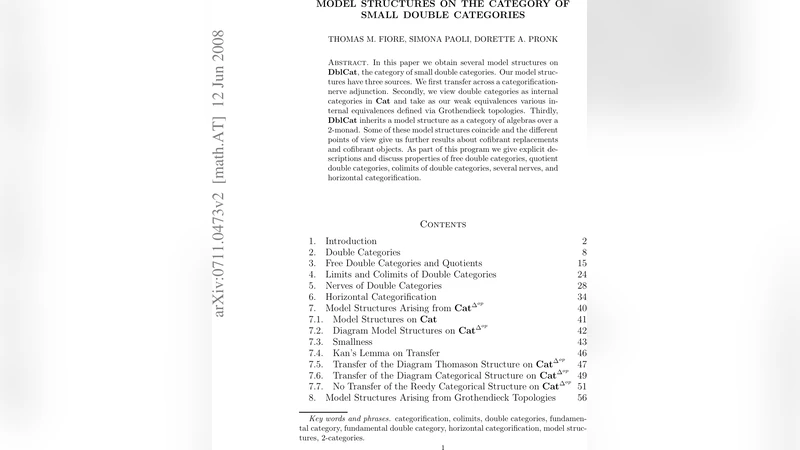
In this paper we obtain several model structures on {\bf DblCat}, the category of small double categories. Our model structures have three sources. We first transfer across a categorification-nerve adjunction. Secondly, we view double categories as internal categories in {\bf Cat} and take as our weak equivalences various internal equivalences defined via Grothendieck topologies. Thirdly, {\bf DblCat} inherits a model structure as a category of algebras over a 2-monad. Some of these model structures coincide and the different points of view give us further results about cofibrant replacements and cofibrant objects. As part of this program we give explicit descriptions and discuss properties of free double categories, quotient double categories, colimits of double categories, several nerves, and horizontal categorification.
💡 Research Summary
The paper develops several Quillen model structures on DblCat, the category of small double categories, by exploiting three distinct but interrelated perspectives.
-
Transfer via the categorification‑nerve adjunction.
The authors consider the adjunction (C \dashv N) where (C) (categorification) freely turns a double graph into a double category and (N) (nerve) sends a double category to a bisimplicial set (or a double‑nerve). Starting from a well‑known model structure on Cat (e.g., the Thomason model structure), they transfer it across this adjunction to obtain a model structure on DblCat. In this transferred structure the weak equivalences are those double functors whose underlying nerve is a weak equivalence of simplicial sets; cofibrations are generated by the free inclusions of objects, horizontal/vertical arrows, and squares. This approach makes the homotopy theory of double categories directly comparable with the classical homotopy theory of ordinary categories. -
Internal‑category viewpoint with Grothendieck topologies.
Viewing a double category as an internal category in Cat, the authors introduce Grothendieck topologies on Cat to define internal equivalences. Two topologies are studied in depth: the precise topology, whose covering families consist of all objects together with all horizontal and vertical morphisms, and the global topology, which only requires covering of objects. An internal weak equivalence is a functor that is locally an equivalence with respect to the chosen topology. By applying the general theory of internal model structures (due to Bousfield, Joyal‑Tierney, etc.), they obtain model structures on DblCat where fibrations are internal isofibrations and cofibrations are internal functors that are injective on objects. The precise‑topology model coincides with the 2‑monad model described below, while the global‑topology model is strictly weaker (more morphisms become weak equivalences). -
Algebraic model via a 2‑monad.
The free‑double‑category construction forms a 2‑monad (M) on the 2‑category of double graphs. DblCat is precisely the category of strict (M)-algebras. Using the theory of algebraic model structures for 2‑monads (Lack, Bourke‑Garner), the authors lift the trivial model structure on double graphs to a model structure on DblCat. In this algebraic model, strict double functors are cofibrations, pseudo‑natural transformations are weak equivalences, and strict isofibrations are fibrations. The free double category on a double graph is cofibrant, and every double category admits a cofibrant replacement built as a cell complex of generating cofibrations.
Comparisons and coincidences.
A substantial part of the paper is devoted to comparing the three structures. The authors prove that the precise‑topology internal model and the 2‑monad algebraic model are Quillen equivalent and, in fact, isomorphic as model categories. The Thomason‑transfer model is shown to be a left Bousfield localisation of the precise model; it admits more weak equivalences (any functor that is a weak equivalence on the underlying nerves) but shares the same class of cofibrant objects (the free double categories). Consequently, the three constructions give a coherent picture: the precise/internal/2‑monad model is the “strict” homotopy theory, while the Thomason‑transfer model is its “homotopy‑invariant” relaxation.
Auxiliary constructions.
To make the model structures concrete, the authors develop explicit descriptions of:
-
Free double categories. Starting from a double graph (G), the free double category (F(G)) is built by freely adjoining horizontal and vertical composites and squares, imposing only the interchange law. This construction supplies the generating cofibrations and provides canonical cofibrant replacements.
-
Quotient double categories and colimits. They give a detailed account of how to form quotients by identifying squares or arrows, and how pushouts and pullbacks are computed in DblCat. In particular, pushouts along cofibrations are shown to be computed pointwise on the underlying double graphs, which is essential for the cell‑complex description of cofibrant objects.
-
Various nerves. Besides the double‑nerve (N), the paper introduces a horizontal nerve, a vertical nerve, and a “bisimplicial” nerve that records both directions simultaneously. These nerves are used to compare the transferred model with the internal models and to prove the Quillen equivalences.
-
Horizontal categorification. This process collapses the vertical direction, turning a double category into an ordinary category while retaining the horizontal composition. It appears as the left adjoint to the inclusion of ordinary categories as double categories with only identity vertical arrows, and it plays a role in the analysis of fibrations.
Cofibrant replacement and cofibrant objects.
A major payoff of the analysis is a clear description of cofibrant objects: they are precisely the retracts of free double categories, i.e., double categories built as transfinite compositions of generating cofibrations. The authors construct an explicit cofibrant replacement functor (Q) that attaches freely generated squares to any double category, yielding a double category (Q\mathcal{D}) together with a weak equivalence (Q\mathcal{D}\to\mathcal{D}). This replacement is compatible with all three model structures, providing a uniform tool for homotopical calculations.
Implications and future directions.
By establishing multiple, mutually compatible model structures on DblCat, the paper equips researchers with a flexible homotopy‑theoretic framework for double categories. The coincidence of the precise/internal and algebraic models suggests that many homotopical phenomena in double categories can be studied either via internal categorical methods or via algebraic 2‑monad techniques, depending on convenience. The Thomason‑transfer model connects double‑category homotopy theory with classical categorical homotopy theory, opening the door to comparisons with simplicial categories, Segal spaces, and higher‑dimensional operadic structures. Potential applications include the study of double‑cospan bicategories, double‑category versions of derivators, and the development of a “double‑category” version of the homotopy hypothesis.
In summary, the paper delivers a comprehensive, technically rigorous treatment of model structures on DblCat, clarifies the relationships among different constructions, and supplies concrete tools (free constructions, nerves, cofibrant replacements) that will be valuable for future work in higher category theory and its applications.
Comments & Academic Discussion
Loading comments...
Leave a Comment