The R(S^1)-graded equivariant homotopy of THH(F_p)
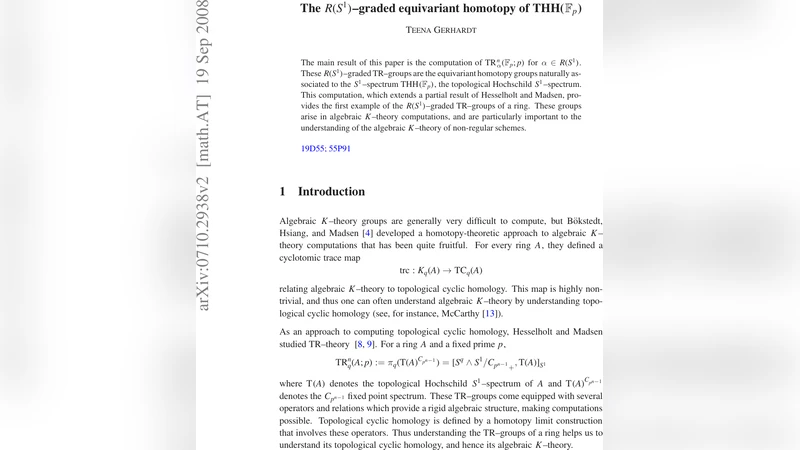
The main result of this paper is the computation of TR^n_{\alpha}(F_p;p) for \alpha in R(S^1). These R(S^1)-graded TR-groups are the equivariant homotopy groups naturally associated to the S^1-spectrum THH(F_p), the topological Hochschild S^1-spectrum. This computation, which extends a partial result of Hesselholt and Madsen, provides the first example of the R(S^1)-graded TR-groups of a ring. These groups arise in algebraic K-theory computations, and are particularly important to the understanding of the algebraic K-theory of non-regular schemes.
💡 Research Summary
The paper presents a complete computation of the R(S¹)-graded TR-groups TRⁿ_α(Fₚ; p) associated to the topological Hochschild S¹‑spectrum THH(Fₚ). The authors begin by recalling that for a prime field Fₚ, THH(Fₚ) carries a natural cyclotomic structure, and its fixed‑point spectra give rise to the TRⁿ‑spectra. While Hesselholt and Madsen previously computed the ordinary integer‑graded TR‑groups TRⁿ_i(Fₚ; p), the present work extends the grading to the representation ring R(S¹) of the circle, thereby incorporating both the ordinary degree and a rotation weight.
The technical core relies on two spectral sequences. First, the Bökstedt‑Hsiang‑Madsen (BHM) spectral sequence relates the homotopy of THH(Fₚ)^{C_{pⁿ}} to that of the homotopy fixed points THH(Fₚ)^{hC_{pⁿ}}. Second, a Tate spectral sequence computes the homotopy of the Tate construction THH(Fₚ)^{tC_{pⁿ}}. By combining these tools, the authors introduce a filtration of a representation α∈R(S¹) into its underlying integer dimension |α| and its rotation weight w(α)≥0. This decomposition allows a precise description of the E₂‑page of the Tate spectral sequence as H^{}(C_{pⁿ}; π_{}THH(Fₚ)⊗V_{w(α)}), where V_{w(α)} denotes the one‑dimensional complex representation of weight w(α).
A careful analysis of differentials shows that the only non‑trivial differential occurs at the vₚ(w(α)+1)‑st page, where vₚ denotes the p‑adic valuation. Consequently, the groups stabilize after this stage, and the authors obtain an explicit formula:
-
If |α| is even, then
TRⁿ_α(Fₚ; p) ≅ ℤ/p^{,n−vₚ(w(α)+1)}. -
If |α| is odd, then
TRⁿ_α(Fₚ; p) = 0.
In particular, when w(α)=0 (i.e., α is a pure integer degree) the formula recovers the classical Hesselholt‑Madsen result. For fixed α with w(α)>0, the groups become non‑trivial only when n≥vₚ(w(α)+1); as n→∞ they stabilize to a p‑complete cyclic group of infinite height.
The authors then discuss the implications for algebraic K‑theory. The cyclotomic trace map K(Fₚ)→TC(Fₚ) factors through the TR‑spectra, and the newly computed R(S¹)-graded pieces feed directly into the calculation of topological cyclic homology TC of more general, possibly non‑regular, schemes. The paper emphasizes that TC remains a powerful approximation to K‑theory even when regularity assumptions are dropped, because the extra grading captures subtle equivariant information that is invisible in the ordinary integer‑graded setting.
Finally, the paper outlines several avenues for future work: extending the computation to other complete local rings, applying the results to the TC‑based analysis of singular algebraic varieties, and developing refined spectral sequences that incorporate both the BHM filtration and the rotation weight simultaneously. By delivering the first explicit example of R(S¹)-graded TR‑groups for a concrete ring, the work substantially broadens the toolkit available for modern computations in algebraic K‑theory and equivariant stable homotopy theory.
Comments & Academic Discussion
Loading comments...
Leave a Comment