Subtraction-free complexity, cluster transformations, and spanning trees
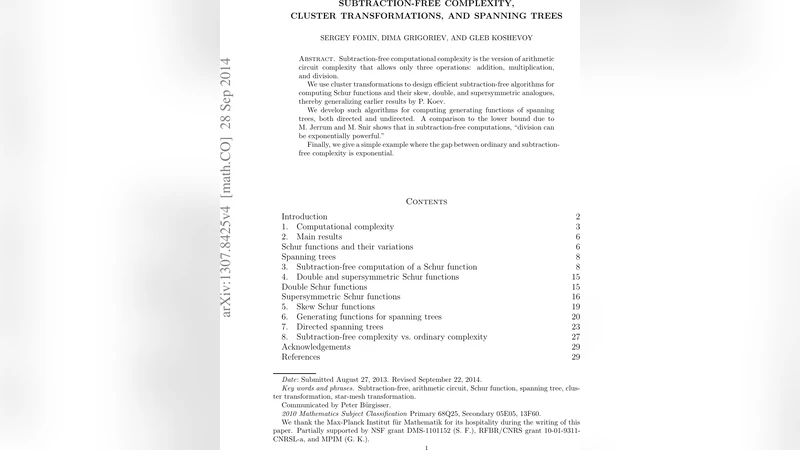
Subtraction-free computational complexity is the version of arithmetic circuit complexity that allows only three operations: addition, multiplication, and division. We use cluster transformations to design efficient subtraction-free algorithms for computing Schur functions and their skew, double, and supersymmetric analogues, thereby generalizing earlier results by P. Koev. We develop such algorithms for computing generating functions of spanning trees, both directed and undirected. A comparison to the lower bound due to M. Jerrum and M. Snir shows that in subtraction-free computations, “division can be exponentially powerful.” Finally, we give a simple example where the gap between ordinary and subtraction-free complexity is exponential.
💡 Research Summary
The paper investigates the computational power of arithmetic circuits when subtraction is disallowed, i.e., when only addition, multiplication, and division are permitted. This “subtraction‑free” model, denoted Z{+, *, /}, is examined through two main families of functions: Schur functions (and several of their extensions) and generating functions for spanning trees in weighted graphs.
The authors first introduce cluster transformations, a class of rational maps originating from cluster algebra theory, which can be expressed using only +, *, /. By systematically applying these transformations, they construct subtraction‑free arithmetic circuits for Schur polynomials s_λ(x₁,…,x_k). The resulting circuit size is O(n³) where n = k + λ₁, and the bit‑complexity is O(n³ log n). This reproduces and simplifies the earlier O(n³) algorithm of P. Koev, but now the whole process is framed in terms of cluster algebraic operations. The method extends seamlessly to double Schur functions s_λ(x|y), supersymmetric Schur functions, and skew Schur functions s_{λ/ν}(x). For the latter, the circuit size grows to O(n⁵), still polynomial. Thus, even without subtraction, a wide range of symmetric and skew‑symmetric polynomials can be evaluated efficiently.
Next, the paper turns to spanning‑tree generating functions. For undirected graphs, Kirchhoff’s matrix‑tree theorem expresses the generating function as a determinant of a Laplacian minor. The authors replace Gaussian elimination with a sequence of star‑mesh transformations, each realizable with only +, *, /. This yields a subtraction‑free algorithm of polynomial size for the undirected case. For directed graphs, Jerrum and Snir had shown that in the semiring model {+, *} (no division) the circuit complexity of the directed spanning‑tree polynomial for the complete digraph on n vertices is exponential. By allowing division, the authors construct a subtraction‑free circuit of size O(n³) for the same function, demonstrating that division can be “exponentially powerful” when subtraction is forbidden.
The paper also addresses the relationship between ordinary arithmetic‑circuit complexity and subtraction‑free complexity. It presents an explicit family of polynomials f_n whose ordinary (full) circuit complexity is linear, O(n), yet any subtraction‑free circuit (using only +, *, /) must have size at least exp(Ω(n)). This provides a concrete example of an exponential gap between the two models, complementing earlier results (e.g., Valiant’s separation between {+, *} and {+, −, *}) and showing that the presence of division dramatically changes the landscape when subtraction is absent.
Throughout, the authors discuss the implications for numerical computation: subtraction is the only operation that can cause uncontrolled round‑off error for positive inputs, so eliminating it while retaining division can lead to algorithms that are both fast and numerically stable. The work thus bridges algebraic complexity theory, combinatorial enumeration, and practical algorithm design, offering new tools (cluster and star‑mesh transformations) for building efficient subtraction‑free circuits and highlighting the profound effect of operation restrictions on computational power.
Comments & Academic Discussion
Loading comments...
Leave a Comment