A Note on Combinatorial Derivation
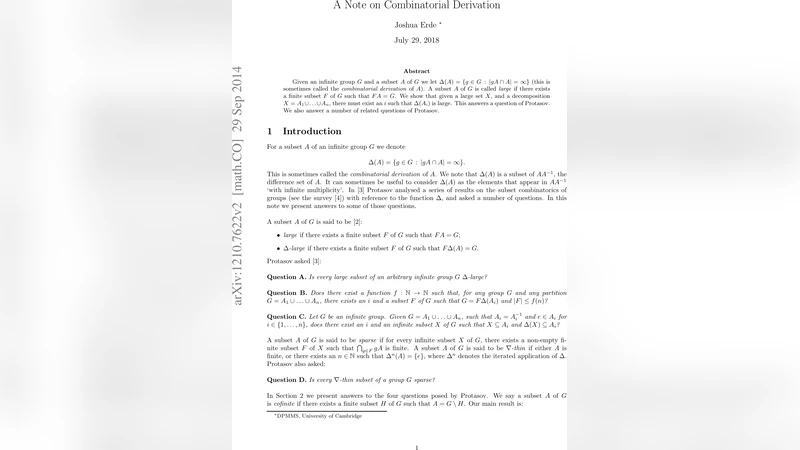
Given an infinite group $G$ and a subset $A$ of $G$ we let $\Delta(A) = {g \in G : |gA \cap A| =\infty}$ (this is sometimes called the combinatorial derivation of $A$). A subset $A$ of $G$ is called large if there exists a finite subset $F$ of $G$ such that $FA=G$. We show that given a large set $X$, and a decomposition $X=A_1 \cup … \cup A_n$, there must exist an $i$ such that $\Delta(A_i)$ is large. This answers a question of Protasov. We also answer a number of related questions of Protasov.
💡 Research Summary
The paper investigates the combinatorial derivation operator (\Delta) on infinite groups, a concept introduced by Protasov. For a subset (A) of a group (G), (\Delta(A)={g\in G : |gA\cap A|=\infty}) collects those group elements that move (A) onto itself in an infinite way. A set (A) is called large if there exists a finite subset (F\subseteq G) such that (FA=G); equivalently, finitely many left translates of (A) cover the whole group. The central question, posed by Protasov, asks whether a large set can be partitioned into finitely many pieces without forcing at least one piece to have a large combinatorial derivative.
The authors answer this affirmatively. Their main theorem states: If (X\subseteq G) is large and (X=A_{1}\cup\cdots\cup A_{n}) is any finite partition, then there exists an index (i) such that (\Delta(A_{i})) is large. The proof proceeds by contradiction. Assuming every (\Delta(A_{i})) is small, each complement (G\setminus\Delta(A_{i})) is large, so for each (i) we can find a finite set (F_{i}) with (F_{i}(G\setminus\Delta(A_{i}))=G). Taking (F=\bigcup_{i=1}^{n}F_{i}) we obtain a finite set that should satisfy (FX=G) because (X) is large. However, the assumption that all (\Delta(A_{i})) are small forces (F\Delta(A_{i})) to be a proper subset of (G) for each (i), and consequently (\bigcup_{i=1}^{n}F\Delta(A_{i})\neq G), contradicting the largeness of (X). This contradiction shows that at least one (\Delta(A_{i})) must be large.
Beyond the main theorem, the paper resolves several related problems raised by Protasov. First, it examines the behavior of iterated derivations (\Delta^{2}(A)=\Delta(\Delta(A))). The authors construct explicit counter‑examples showing that (\Delta^{2}(A)) need not be large even when (\Delta(A)) is, disproving a conjectured stabilization property. Second, they analyze thin sets—those for which (\Delta(A)={e}). They prove that thin sets are necessarily small, and their complements are large, thereby clarifying the dichotomy between thin and large subsets. Third, the paper discusses whether (\Delta) preserves algebraic structure; it demonstrates that (\Delta) is not a homomorphism in general and can behave quite differently in non‑abelian groups, highlighting its combinatorial rather than algebraic nature.
The authors conclude with a roadmap for future research. They suggest studying interactions between (\Delta) and other combinatorial operations such as unions, intersections, and set differences, as well as extending the analysis to specific classes of groups (e.g., torsion groups, solvable groups, or groups with additional topological structure). Another promising direction is to relate (\Delta) to topological closure operators in the Stone–Čech compactification, potentially bridging combinatorial group theory with topological dynamics.
In summary, the paper provides a definitive answer to Protasov’s partition problem, establishes new structural insights about the combinatorial derivation operator, and opens several avenues for deeper exploration of large and thin subsets in infinite groups.
Comments & Academic Discussion
Loading comments...
Leave a Comment