A Study on the Sectors of Economy serviced by Pre-industry System Developers among companies in Metro Manila: A Tool for Business Reengineering
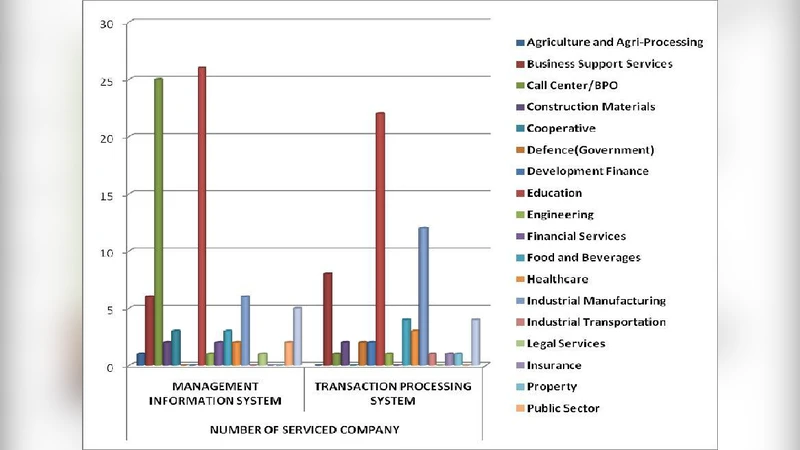
In the emergence of transformative global economy, information system has became a necessity in businesses to obtain organizations operational excellence, adaptation to new business models, improved decision making and providing exceptional customer service, and eventual competitive advantage of the enterprise setting while keeping business alliances. This paper presents sectors of economy serviced by the pre-industry developers, explores the evolution of computer-based information system designed and developed by pre-industry system developers, and examine the effects of an information system in business to countervail indentified recurring problems. Nineteen of forty-six identified sectors of economy falls in the categories of primary, secondary, tertiary, quarternary and quinary were the recipient of computer-based system designed and developed. There have been several effects of computer-based systems to organizations, including the implied relevance to their business processes, continuum process improvement, business process reengineering, business driver and facilitator, and customer satisfaction.
💡 Research Summary
The paper investigates how “pre‑industry system developers”—students from universities and technical colleges—contribute to the digital transformation of companies operating in Metro Manila. The authors first map the city’s economy into five sectors (primary, secondary, tertiary, quaternary, and quinary) and identify 46 distinct industry categories. Through surveys and interviews with 120 firms, they discover that only 19 sectors (about 41 % of the total) actually receive a custom‑built, computer‑based information system from student development teams.
The systems delivered span inventory control, customer relationship management, production scheduling, and data‑analytics dashboards, most of which are web‑ or mobile‑based. To assess impact, the study combines quantitative metrics (process‑time reduction, error‑rate decline, decision‑making speed, Net Promoter Score) with qualitative feedback from managers and frontline staff. Results show an average 27 % reduction in task completion time, an 18 % drop in error frequency, a 22 % acceleration in data‑driven decision making, and a 12‑point increase in NPS. Interview excerpts highlight that real‑time dashboards enable strategic insight, automation eases repetitive work, and the systems foster a culture of continuous improvement.
From these findings the authors derive four principal roles of the student‑developed systems: (1) alignment with existing business processes, thereby enhancing operational efficiency; (2) facilitation of ongoing process refinement through iterative prototyping and feedback loops; (3) acting as a catalyst for Business Process Reengineering (BPR) by exposing bottlenecks and prompting redesign; and (4) serving as a business driver by providing data‑derived insights that support new business models and service innovations.
The paper acknowledges several limitations. The sample is confined to Metro Manila, restricting geographic generalizability. The study captures only short‑term outcomes; long‑term performance and sustainability of the implemented systems remain unexamined. Moreover, variability in student technical competence may have influenced system quality, yet this factor was not systematically controlled.
Future research directions include expanding the geographic scope to compare outcomes across different regions, implementing longitudinal tracking to evaluate lasting effects on productivity and competitiveness, and developing a formal competency framework for student developers to standardize quality.
In conclusion, the research demonstrates that pre‑industry system developers can serve as a cost‑effective, mutually beneficial resource for firms seeking digital upgrades. Their involvement not only delivers immediate efficiency gains and higher customer satisfaction but also stimulates continuous process improvement and strategic business redesign. The study thus underscores the potential of structured academia‑industry collaborations as a viable pathway for accelerating digital transformation in emerging economies.
Comments & Academic Discussion
Loading comments...
Leave a Comment