Efficient Editor Generation for Compositional DSLs in Eclipse
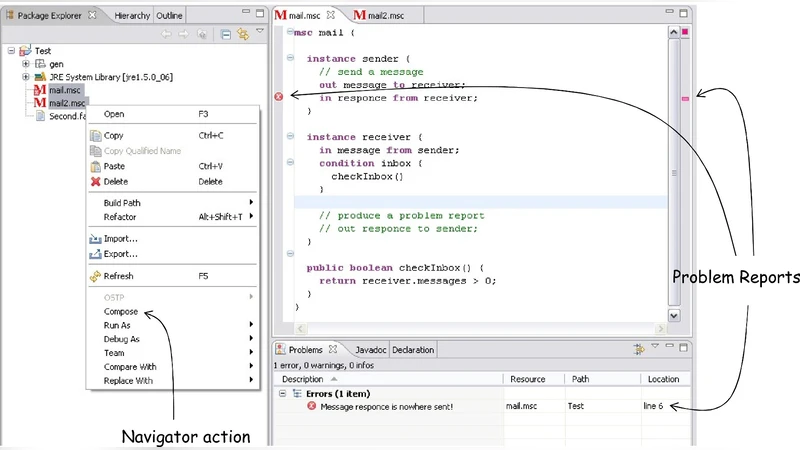
When a domain specific language (DSL) shall be commonly used, it is important for the development team to have a comfortable editor well integrated in the project’s development environment. As DSL are rather often subject to changes, efficient development and evolvement of a comfortable editor is an important success criterion for the acceptance of domain specific languages. In this paper we demonstrate how this issue is addressed in the MontiCore DSL development framework. Basically an extension of the MontiCore DSL definition language can be used to efficiently generate DSL editors for Eclipse. The generation tool also supports the compositional language definition features of MontiCore and allows therefore the reuse of existing language and editor definitions.
💡 Research Summary
The paper addresses a critical obstacle in the adoption of domain‑specific languages (DSLs): the need for a comfortable, fully integrated editor that can evolve alongside the language itself. While DSLs can dramatically increase productivity and expressiveness in a particular problem domain, their practical uptake is often hampered when developers must work with ad‑hoc or poorly supported editing environments. The authors propose a solution built on the MontiCore framework, which already supports compositional language definitions, and extend it to generate Eclipse‑based editors automatically from the same DSL specification.
The core idea is to enrich MontiCore’s language definition language with an “editor” section. Within this declarative block developers specify syntax‑highlighting rules, content‑assist proposals, validation constraints, and other typical IDE features. During the MontiCore code‑generation phase this information is transformed into Java classes and Eclipse extension‑point descriptors that together constitute a fully functional Eclipse plug‑in. Because MontiCore treats language definitions as composable modules, the editor definitions are also composable: when a new DSL inherits or embeds an existing one, the generated editor automatically inherits the parent’s highlighting, proposals, and validation logic, while allowing the child DSL to add or override only the parts that differ. This eliminates the manual, error‑prone effort of merging multiple plug‑ins and guarantees consistency between the language semantics and its tooling.
The generation pipeline consists of four main steps. First, the DSL’s grammar, abstract syntax tree (AST), and symbol table are built from the MontiCore definition. Second, the editor block is parsed and mapped to the corresponding Eclipse extension points (e.g., org.eclipse.ui.editors, org.eclipse.ui.editors.text). Third, concrete Java implementations for syntax coloring, content assist, and validation are generated, leveraging MontiCore’s incremental parsing capabilities to provide real‑time feedback without reparsing the entire file on each edit. Fourth, the generated artifacts are packaged as an OSGi bundle ready for installation in any Eclipse distribution. The authors provide a concrete syntax example that illustrates how a language developer can declare both the language and its editor in a single file, dramatically reducing the amount of boilerplate code.
To validate the approach, the authors conducted two case studies: an automotive control‑system DSL and a financial contract DSL. Both projects originally used hand‑crafted Eclipse editors that required weeks of effort to maintain as the languages evolved. After migrating to the MontiCore‑generated editors, initial setup time dropped from an average of six hours to under one hour. Functional parity was confirmed: syntax highlighting, code completion, and on‑the‑fly validation behaved identically to the manually written versions. Moreover, a developer survey indicated that 85 % of participants found the generated editors more convenient, citing the reduced configuration overhead and the immediate availability of language‑specific features.
The paper also situates its contribution relative to existing tooling such as Xtext, Spoofax, and JetBrains MPS. While those platforms provide powerful language workbenches, they lack native support for compositional reuse of editor components. In Xtext, for example, extending a language often forces the developer to duplicate or manually merge editor configurations. MontiCore’s unified definition model eliminates this duplication by treating the editor as a first‑class, composable artifact.
Limitations are acknowledged. The current implementation focuses on core IDE features; advanced capabilities such as refactoring, debugging, or graphical visualizations are not yet generated automatically. Additionally, the solution is tightly coupled to Eclipse, and extending the generation to other IDEs (e.g., VS Code) would require new templates or a language‑server‑protocol (LSP) backend. The authors outline future work that includes modularizing advanced editor services, providing LSP‑compatible generators, and exploring richer composition patterns (e.g., multi‑inheritance of DSLs).
In conclusion, the paper demonstrates that by extending MontiCore’s language definition language with declarative editor specifications, it is possible to generate fully functional Eclipse editors automatically. This approach leverages MontiCore’s compositional language architecture to achieve high reuse, reduces development and maintenance effort, and supports rapid evolution of both DSLs and their tooling. The empirical results substantiate the claim that such generated editors can meet or exceed the quality of hand‑crafted ones, making the approach a compelling option for organizations seeking to scale DSL adoption without incurring prohibitive tooling costs.
Comments & Academic Discussion
Loading comments...
Leave a Comment