Critical Systems Development Using Modeling Languages. (CSDUML-04): Current Developments and Future Challenges (Report on the Third International Workshop)
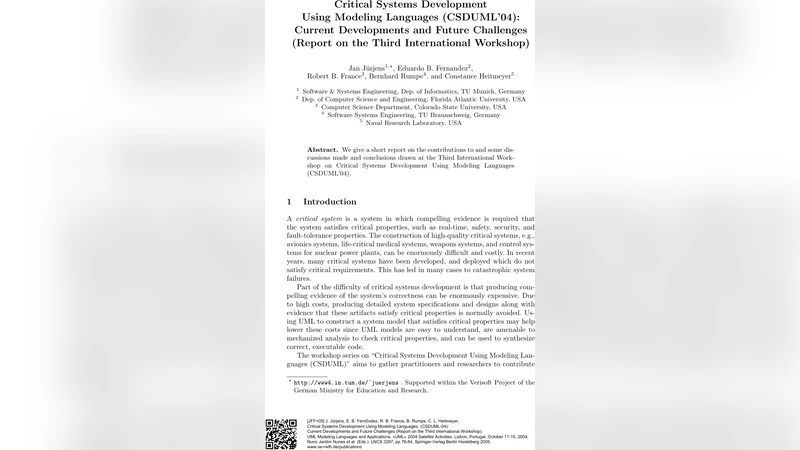
We give a short report on the contributions to and some discussions made and conclusions drawn at the Third International Workshop on Critical Systems Development Using Modeling Languages (CSDUML'04).
💡 Research Summary
The paper reports on the Third International Workshop on Critical Systems Development Using Modeling Languages (CSDUML’04), summarizing the contributions, discussions, and conclusions presented at the event. The workshop gathered researchers and practitioners who explored how modeling languages—primarily UML, SysML, and the MARTE profile—can be combined with formal methods to support the development of safety‑critical, security‑critical, and high‑reliability systems such as aerospace control software, medical device firmware, and power‑grid protection logic.
Key themes emerged from the 30 presented papers and demonstrations. First, participants emphasized domain‑specific profiling: extending UML with stereotypes and constraints that capture real‑time deadlines, fault‑tolerance levels, and safety integrity levels. By embedding these attributes directly in the model, traceability from requirements to design and ultimately to generated code becomes automated. Second, a substantial portion of the workshop focused on formal transformation and verification. Several tool chains (e.g., U2CSP, UML2B) were showcased that automatically translate UML class diagrams, state machines, and OCL constraints into formal languages such as CSP, Z, B, or TLA⁺. The transformed models are then fed to model checkers (FDR, PAT) or theorem provers (Coq, Isabelle) to verify properties like dead‑lock freedom, invariant preservation, and timing correctness. Participants discussed abstraction techniques and compositional verification to mitigate state‑space explosion.
Third, simulation‑driven testing was highlighted. By converting sequence diagrams and activity diagrams into executable scenarios, the workshop demonstrated automatic generation of test cases that exercise both functional behavior and timing constraints. A prototype simulation engine allowed participants to inject fault conditions (sensor failures, communication delays) and observe system recovery, providing valuable insight into dynamic safety properties. Fourth, industrial case studies illustrated concrete adoption. In aerospace, a collaboration with Boeing used UML/OCL to capture DO‑178C requirements, automatically generate C code, and produce verification artifacts for certification. In the medical domain, a cardiac pacemaker project employed SysML to integrate functional and safety requirements, with the resulting models feeding into IEC 62304 compliance processes. A power‑grid protection project modeled protective relay logic as UML state machines, then verified logical consistency with a model checker.
The workshop discussions converged on several critical challenges. Balancing model precision and abstraction proved essential: overly detailed models hinder maintainability, while too abstract models lack the information needed for formal analysis. Tool interoperability remains limited; there is no widely accepted standard for exchanging models between UML editors, formal translators, and verification engines, which hampers the construction of seamless, automated pipelines. Aligning model‑based development with certification standards (DO‑178C, IEC 61508, ISO 26262) is still an open problem—producing the required evidence artifacts directly from models requires further methodological work. Finally, cultural and educational barriers were identified; organizations accustomed to code‑centric processes need structured training and demonstrable success stories to adopt model‑centric approaches.
To address these gaps, the authors propose a forward‑looking research roadmap. First, they call for a bidirectional transformation meta‑model that formally defines mappings between UML/SysML and target formal languages, enabling round‑trip engineering and consistent synchronization of models, code, and verification results. Second, they envision a cloud‑based collaborative modeling environment where multiple stakeholders can concurrently edit, simulate, and verify models, with built‑in version control and continuous integration of formal checks. Third, an automatic evidence generation engine would harvest verification results, test logs, and traceability matrices to produce certification‑ready documentation with minimal manual effort. Fourth, they suggest leveraging AI‑driven model quality assessment to automatically detect modeling anti‑patterns, incomplete state transitions, or contradictory constraints, thereby improving model robustness early in the development lifecycle.
In conclusion, CSDUML’04 demonstrated that integrating modeling languages with formal verification techniques can deliver tangible benefits for critical systems development—enhancing requirement traceability, enabling early detection of design flaws, and supporting certification activities. However, realizing the full potential of model‑based approaches will require concerted efforts in standardizing tool interfaces, aligning with regulatory frameworks, and fostering education and cultural change within engineering organizations. The paper’s synthesis of workshop outcomes provides a clear map of current achievements and outlines the research directions necessary to advance the state of the art in critical systems development using modeling languages.