Limitations of Agile Software Processes
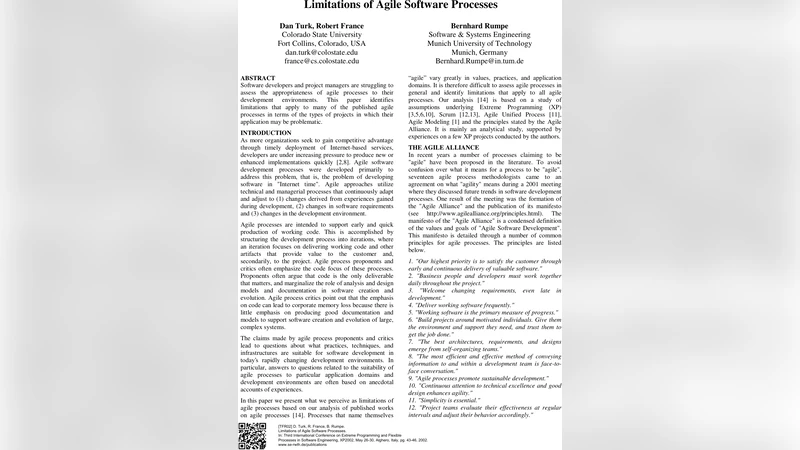
Software developers and project managers are struggling to assess the appropriateness of agile processes to their development environments. This paper identifies limitations that apply to many of the published agile processes in terms of the types of projects in which their application may be problematic.
💡 Research Summary
The paper “Limitations of Agile Software Processes” addresses a growing concern among software developers and project managers: the difficulty of determining when agile methods are appropriate for a given development environment. While agile methodologies—characterized by iterative development, close customer collaboration, and an emphasis on responding to change—have demonstrated clear benefits in many contexts, the authors argue that these benefits are not universal. They systematically identify and categorize the circumstances under which agile practices can become problematic, and they propose a decision‑making framework to help organizations assess suitability before adoption.
Core Argument
Agile’s core values (individuals and interactions over processes and tools, working software over comprehensive documentation, customer collaboration over contract negotiation, and responding to change over following a plan) are highly effective when projects are small, requirements are volatile, and teams are co‑located with strong communication channels. However, the paper highlights four major categories of limitation that undermine agile’s effectiveness in many real‑world settings:
-
Scale and Complexity – Large‑scale, enterprise‑level systems often involve thousands of components, intricate interdependencies, and long‑term maintenance considerations. In such environments, lightweight documentation and short sprint cycles fail to provide the architectural visibility and integration assurance required. The authors cite case studies where insufficient upfront design led to costly integration defects and regression testing bottlenecks.
-
Regulatory and Security Constraints – Industries such as healthcare, finance, aerospace, and defense are subject to strict standards (e.g., ISO 26262, HIPAA, GDPR) that demand exhaustive traceability, formal verification, and audit trails. Agile’s “working software first” mindset does not automatically generate the necessary compliance artifacts, creating a tension between rapid delivery and mandatory documentation.
-
Fixed‑Price, Fixed‑Scope Contracts – When customers require detailed specifications and a firm budget up front, the inherent flexibility of agile—continuous reprioritization and scope evolution—conflicts with contractual obligations. The paper explains how ambiguous change‑control mechanisms can lead to disputes, especially when external stakeholders cannot attend sprint reviews or when scope creep is not formally captured.
-
Organizational Culture and Skill Maturity – Agile assumes high team autonomy, cross‑functional expertise, and a culture that embraces self‑organization. In organizations with hierarchical decision‑making, heavy reliance on documentation, or limited technical proficiency, agile adoption often results in a superficial “agile façade” rather than genuine transformation. Resistance from management and insufficient coaching exacerbate the problem.
Suitability Matrix
To operationalize these insights, the authors introduce a “Suitability Matrix” that cross‑references four dimensions: project size (small, medium, large), regulatory intensity (low, medium, high), contract type (flexible, fixed), and team maturity (initial, growing, mature). Each cell receives a risk score based on empirical evidence and expert judgment. A total score exceeding a predefined threshold signals that a pure agile approach is inadvisable without mitigation. The matrix serves as a diagnostic tool for executives and project leads to make evidence‑based decisions.
Mitigation Strategies
Recognizing that many organizations cannot simply abandon agile, the paper outlines concrete hybrid strategies to address each limitation:
-
Scaling Frameworks – Adoption of Scaled Agile Framework (SAFe), Large‑Scale Scrum (LeSS), or Spotify’s model introduces hierarchical backlogs, program increments, and coordinated integration testing, preserving agile cadence while providing the governance needed for large systems.
-
Compliance‑Embedded Agile – A “Agile‑Compliance Hybrid” inserts regulatory checkpoints into each sprint, uses automated documentation generators, and maintains a living compliance backlog. This approach ensures that audit evidence is produced continuously rather than retroactively.
-
Flexible Fixed‑Price Contracts – Negotiating time‑and‑material clauses within an overall fixed‑price envelope, defining clear sprint‑level deliverables, and establishing change‑control windows allow teams to retain agility while satisfying contractual constraints.
-
Cultural Transition Programs – Deploying dedicated agile coaches, running continuous training, and instituting incremental empowerment (e.g., starting with pilot teams) help shift mindsets. The authors stress that cultural change must be staged, with measurable milestones to avoid backlash.
Conclusions and Future Work
The paper concludes that agile is not a one‑size‑fits‑all solution; its success is highly context‑dependent. Organizations should conduct a rigorous upfront risk assessment using the proposed matrix and tailor their process mix accordingly. Ignoring the identified limitations can increase the likelihood of project overruns, quality issues, and compliance failures. The authors recommend further empirical research to develop quantitative risk models based on industry data and to evaluate the long‑term impact of hybrid scaling approaches across multi‑project portfolios.
In summary, the study provides a balanced view: while agile can deliver speed and adaptability, its limitations must be acknowledged and mitigated through structured assessment, scaling techniques, compliance integration, contract flexibility, and cultural evolution. This nuanced perspective equips practitioners with a pragmatic roadmap for deciding when and how to apply agile methods responsibly.
Comments & Academic Discussion
Loading comments...
Leave a Comment