Variability within Modeling Language Definitions
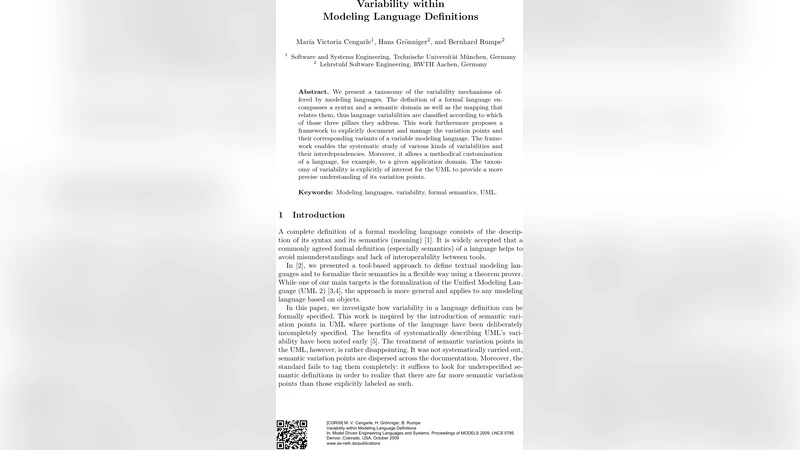
We present a taxonomy of the variability mechanisms offered by modeling languages. The definition of a formal language encompasses a syntax and a semantic domain as well as the mapping that relates them, thus language variabilities are classified according to which of those three pillars they address. This work furthermore proposes a framework to explicitly document and manage the variation points and their corresponding variants of a variable modeling language. The framework enables the systematic study of various kinds of variabilities and their interdependencies. Moreover, it allows a methodical customization of a language, for example, to a given application domain. The taxonomy of variability is explicitly of interest for the UML to provide a more precise understanding of its variation points.
💡 Research Summary
The paper addresses the problem of unmanaged variability in large modeling languages such as UML, where numerous extension mechanisms exist but are rarely documented in a systematic way. To bring order to this situation, the authors first propose a taxonomy that classifies variability according to the three fundamental pillars of a formal language definition: syntax, semantic domain, and the mapping that connects the two.
Syntax variability concerns the concrete and abstract syntactic structures—tokens, grammar rules, and meta‑model elements—that can be added, removed, or altered. Typical examples include the introduction of new relationship types in a class diagram or the deactivation of a particular construct.
Semantic‑domain variability deals with the conceptual structures that give meaning to the syntax, such as type systems, execution models, and constraint languages. This covers UML profiles that add domain‑specific constraints or the incorporation of a time model for real‑time systems.
Mapping variability refers to changes in the interpretation function that translates syntactic artifacts into semantic representations. It captures situations where the algorithm that maps a syntax tree to a semantic model must be adapted for a specific application domain.
Building on this three‑dimensional taxonomy, the authors present a framework for explicitly documenting and managing variation points (the places where a language can be altered) and their associated variants. The framework consists of four main components:
- Variation‑point registry – stores each variation point together with metadata indicating which pillar it belongs to.
- Variant catalog – enumerates concrete alternatives for each variation point.
- Dependency and constraint engine – models inter‑point relationships (e.g., “if a mapping variant is selected, a corresponding semantic‑domain variant must also be activated”) and automatically checks consistency.
- Automated documentation generator – produces human‑readable specifications (UML profile documents, HTML pages, etc.) that make the variability structure transparent to language designers and domain experts.
The framework is validated through a comprehensive case study on UML. The authors identify a set of prominent UML variation points—profiles, stereotypes, meta‑class extensions, OCL constraints, and others—and map them into the registry. They then construct domain‑specific UML profiles such as MARTE for real‑time systems and SysML for embedded engineering by selecting appropriate variants. During this process the dependency engine detects conflicts (e.g., incompatible meta‑class extensions) and enforces the defined constraints, allowing designers to resolve issues early and systematically. Empirical results show a substantial reduction in the time required to configure a language and a marked decrease in configuration errors.
Beyond UML, the paper argues that the taxonomy and framework are applicable to any meta‑model‑based language, including domain‑specific languages (DSLs) and model transformation languages. By making variability explicit, the approach supports automated reasoning about language evolution, versioning, and co‑design of syntax and semantics.
In conclusion, the authors demonstrate that classifying variability along syntax, semantic domain, and mapping dimensions, together with a dedicated meta‑model‑level management framework, yields a powerful method for customizing modeling languages, improving reuse, and ensuring consistency across complex language families. Future work is outlined as the development of automated variation‑point detection techniques, scalability studies on large language ecosystems, and the integration of variability management into language version‑control systems.
Comments & Academic Discussion
Loading comments...
Leave a Comment