Mean field theory of spin glasses
These lecture notes focus on the mean field theory of spin glasses, with particular emphasis on the presence of a very large number of metastable states in these systems. This phenomenon, and some of
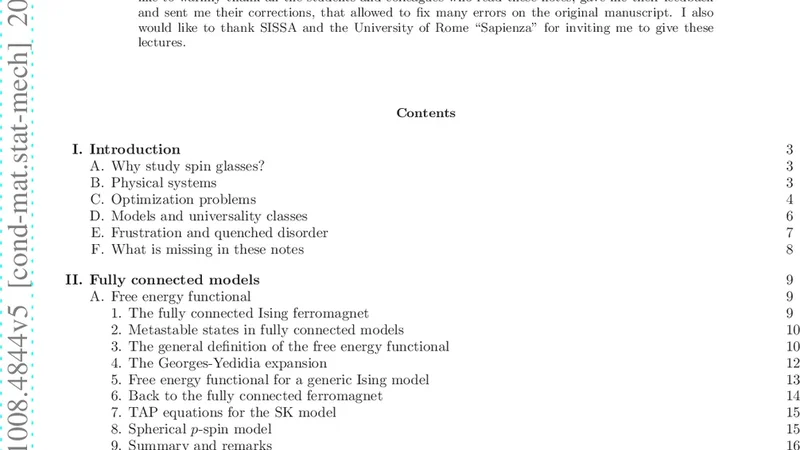
These lecture notes focus on the mean field theory of spin glasses, with particular emphasis on the presence of a very large number of metastable states in these systems. This phenomenon, and some of its physical consequences, will be discussed in details for fully-connected models and for models defined on random lattices. This will be done using the replica and cavity methods. These notes have been prepared for a course of the PhD program in Statistical Mechanics at SISSA, Trieste and at the University of Rome “Sapienza”. Part of the material is reprinted from other lecture notes, and when this is done a reference is obviously provided to the original.
💡 Research Summary
The lecture notes present a comprehensive treatment of the mean‑field theory of spin glasses, focusing on the profound role of an exponentially large number of metastable states. The exposition is divided into several logically connected parts, each building on the previous one to give the reader a full picture of both the theoretical framework and its practical implications.
The first section introduces the spin‑glass problem, emphasizing the random, frustrated interactions that give rise to a rugged energy landscape with countless local minima. It explains why conventional thermodynamic methods fail in such systems and motivates the use of mean‑field approximations, which become exact in the limit of infinite connectivity (the fully‑connected or Sherrington–Kirkpatrick model).
The second section develops the replica method. By replicating the system n times and taking the limit n→0, the authors derive an expression for the disorder‑averaged free energy. The discussion highlights the central concept of replica symmetry (RS) and its spontaneous breaking (RSB). When RS holds, the overlap matrix q_{ab} reduces to a single constant q, implying that all replicas are statistically identical. However, for the SK model the correct solution requires breaking this symmetry. The authors introduce the Parisi order parameter function q(x), defined on the interval 0≤x≤1, which encodes a hierarchical organization of pure states. They explain the one‑step RSB (1‑RSB) and the full, continuous RSB scheme, showing how the function q(x) determines the distribution of overlaps P(q) and therefore all observable correlation functions.
The third section switches to the cavity (or message‑passing) approach, which is particularly suited to models defined on sparse random graphs (e.g., Erdős–Rényi or regular random graphs). By removing a spin and studying the effective fields (“cavities”) transmitted by its neighbors, one obtains recursive distributional equations for the cavity messages. In the thermodynamic limit these equations close exactly because the underlying graph is locally tree‑like. The fixed‑point solution of the cavity equations is shown to be mathematically equivalent to the Parisi RSB solution: the distribution of cavity fields is parametrized by the same function q(x). This equivalence provides a powerful computational tool, allowing one to solve mean‑field spin‑glass models numerically via population dynamics.
The fourth section addresses the entropy of metastable states, often called the “complexity”. By differentiating the replicated free energy with respect to the replica number n, the authors obtain a quantity Σ that counts the logarithm of the number of pure states at a given free‑energy level. They discuss the phase diagram in terms of three characteristic temperatures: the static transition temperature T_c where replica symmetry first breaks, the dynamical (or mode‑coupling) temperature T_d where the system becomes trapped in metastable states, and the Kauzmann temperature T_K (or T_s in the notes) where the complexity vanishes. In the interval T_K<T<T_c the system possesses an exponential number of metastable states, yet the equilibrium thermodynamics is still described by the RS solution—a subtle but important distinction.
The fifth section connects the theoretical results to concrete applications in combinatorial optimization and inference problems. Many NP‑hard problems (K‑coloring, random SAT, MAX‑CUT) map onto spin‑glass Hamiltonians, and the mean‑field analysis predicts algorithmic thresholds that coincide with the onset of replica symmetry breaking. Below these thresholds, simple heuristics such as simulated annealing encounter glassy dynamics and fail to find optimal solutions. Conversely, algorithms inspired by the cavity method—belief propagation, survey propagation, and their variants—explicitly exploit the hierarchical structure of states and can operate efficiently down to the dynamical transition. The notes emphasize that understanding the RSB structure is essential for designing algorithms that approach the theoretical limits.
The final part reflects on the pedagogical purpose of the notes and outlines future directions. It stresses that the replica and cavity methods are complementary: the replica approach offers rigorous analytical insight, while the cavity method provides a practical, algorithmic framework. Together they form a versatile toolbox for tackling not only traditional spin glasses but also modern complex systems such as deep neural networks, financial markets, and biological networks, where disorder and frustration play a central role.
Overall, the lecture notes deliver a clear, self‑contained, and technically detailed account of mean‑field spin‑glass theory, making the intricate concepts of replica symmetry breaking, metastable‑state complexity, and cavity fixed points accessible to graduate students and researchers alike.
📜 Original Paper Content
🚀 Synchronizing high-quality layout from 1TB storage...