Optimal network modularity for information diffusion
We investigate the impact of community structure on information diffusion with the linear threshold model. Our results demonstrate that modular structure may have counter-intuitive effects on information diffusion when social reinforcement is present. We show that strong communities can facilitate global diffusion by enhancing local, intra-community spreading. Using both analytic approaches and numerical simulations, we demonstrate the existence of an optimal network modularity, where global diffusion require the minimal number of early adopters.
💡 Research Summary
This paper investigates how community structure (modularity) influences the spread of information when social reinforcement is present, using the linear threshold model (LTM). In the LTM each node becomes active only when a fixed fraction θ of its neighbors are already active; once active, a node stays active forever. The authors focus on the transition from a state with no diffusion to one with global diffusion, varying the initial fraction of seed nodes ρ₀ while keeping θ constant.
To study the effect of modularity, they generate synthetic networks composed of two equally sized communities (A and B). A total of M undirected edges are distributed such that a fraction (1‑µ) of the edges lie inside the same community and a fraction µ connects nodes across communities. The parameter µ therefore controls the strength of community structure: µ≈0 → strongly modular (few inter‑community links), µ≈½ → no modularity (edges placed uniformly at random). All seeds are placed in community A, so diffusion always originates there.
Two analytical approximations are employed. The first is a mean‑field (MF) approach that assumes the network is otherwise random and uses the degree distribution p(k) to write a self‑consistency equation for the final active density ρ∞. For the two‑community case the MF equations (2)–(4) incorporate the probability q_A (or q_B) that a randomly chosen neighbor is active, which depends on µ and on the yet‑unknown final densities ρ_A∞ and ρ_B∞. The second approximation is tree‑like (TL), which treats the network as an infinite tree and iteratively updates the probability y_Aⁿ (or y_Bⁿ) that a node at level n is active given the state of its parent. TL is known to be more accurate for sparse, locally tree‑like graphs.
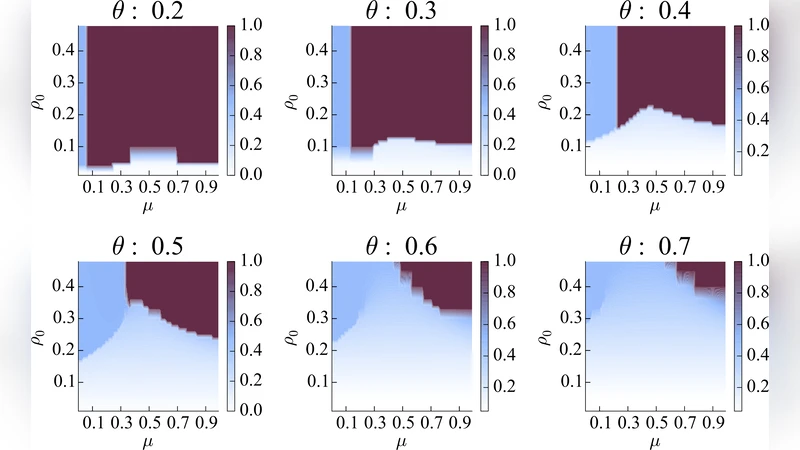
Numerical simulations (N≈1.3 × 10⁵, average degree z=20, θ=0.4) are performed for a wide range of ρ₀ and µ. The results reveal three distinct regimes:
- No diffusion – when ρ₀ is too small, even a fully connected community A cannot sustain a cascade.
- Local diffusion – for small µ (strong modularity) the cascade spreads throughout community A but fails to cross the sparse inter‑community bridges, leaving B inactive.
- Global diffusion – for intermediate µ, the intra‑community cohesion is still sufficient to activate A, while enough bridges exist to trigger a cascade in B, leading to activation of the whole network.
Crucially, there exists an optimal range of µ (approximately µ≈0.2 for the parameters used) that minimizes the required seed fraction ρ₀ for global diffusion. Below this optimal µ the number of bridges is insufficient; above it the internal connectivity of A becomes too weak to generate a self‑sustaining cascade. The analytical MF predictions tend to overestimate the size of the global‑diffusion region, whereas TL matches the simulations closely.
The authors test the robustness of their findings by varying several aspects: the number of communities, the degree distribution (including power‑law LFR benchmark graphs), network size, average degree, and the threshold θ. In all cases the qualitative picture remains unchanged: a non‑monotonic dependence of global cascade probability on modularity, with a clear optimal intermediate value.
From a practical perspective, the study suggests that maximizing information spread is not simply a matter of increasing connectivity. Strongly modular clusters act as “incubators” that amplify reinforcement effects locally; a modest number of well‑placed inter‑cluster links then serve as conduits for the amplified signal to reach the rest of the system. This insight has direct implications for viral marketing, public‑health messaging, and any scenario where limited resources (seed nodes) must be allocated efficiently. Designing campaigns that first saturate tightly knit sub‑communities and then exploit a few bridge individuals can achieve global reach with fewer seeds than a naïve, uniformly distributed seeding strategy.
In summary, the paper demonstrates that the interplay between intra‑community cohesion and inter‑community connectivity creates a sweet spot of modularity that facilitates global information diffusion under social reinforcement. The analytical framework (MF and TL) is flexible enough to accommodate arbitrary degree distributions and more than two communities, opening avenues for future work on dynamic networks, heterogeneous thresholds, and empirical validation on real‑world social platforms.
Comments & Academic Discussion
Loading comments...
Leave a Comment