Bounds on the quantum satisfiability threshold
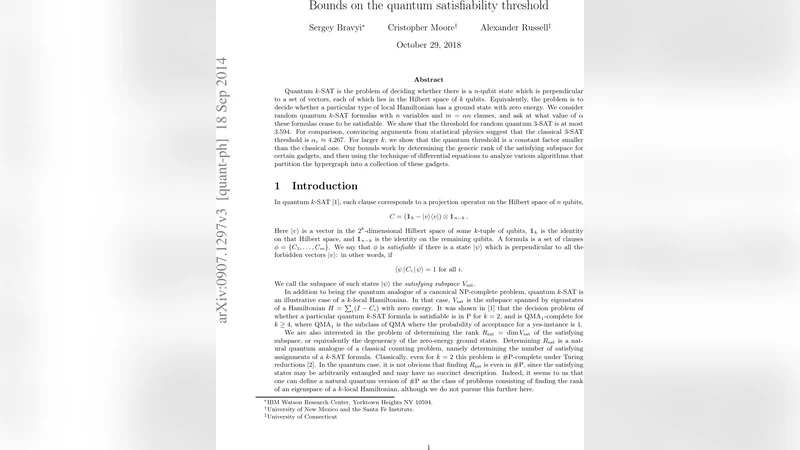
Quantum k-SAT is the problem of deciding whether there is a n-qubit state which is perpendicular to a set of vectors, each of which lies in the Hilbert space of k qubits. Equivalently, the problem is to decide whether a particular type of local Hamiltonian has a ground state with zero energy. We consider random quantum k-SAT formulas with n variables and m = \alpha n clauses, and ask at what value of \alpha these formulas cease to be satisfiable. We show that the threshold for random quantum 3-SAT is at most 3.594. For comparison, convincing arguments from statistical physics suggest that the classical 3-SAT threshold is \alpha \approx 4.267. For larger k, we show that the quantum threshold is a constant factor smaller than the classical one. Our bounds work by determining the generic rank of the satisfying subspace for certain gadgets, and then using the technique of differential equations to analyze various algorithms that partition the hypergraph into a collection of these gadgets. Our use of differential equation to establish upper bounds on a satisfiability threshold appears to be novel, and our techniques may apply to various classical problems as well.
💡 Research Summary
The paper investigates the satisfiability threshold for random quantum k‑SAT, a quantum analogue of the classical k‑SAT problem. In quantum k‑SAT one asks whether there exists an n‑qubit state that is orthogonal to a collection of m = αn vectors, each vector living in the Hilbert space of k qubits. Equivalently, the question is whether a particular k‑local Hamiltonian has a zero‑energy ground state. The authors focus on the random ensemble where each clause (vector) is chosen uniformly at random, and they ask for the critical clause density α at which the probability of satisfiability drops from near‑one to near‑zero as n→∞.
The main contributions are twofold. First, the authors introduce a set of small hypergraph “gadgets” (e.g., a pair of clauses sharing a variable, a triangle of three mutually overlapping clauses, and the complete k‑clause hypergraph) and compute the generic rank of the satisfying subspace for each gadget. The generic rank is the dimension of the solution space for a typical random choice of vectors; the paper proves that, with probability 1‑o(1), every instance of a given gadget has exactly this rank. This step translates the quantum geometric constraints into a purely combinatorial quantity that can be handled analytically.
Second, they design an algorithm that repeatedly extracts these gadgets from the global hypergraph, thereby reducing the problem to a sequence of smaller, independent sub‑problems. The evolution of the numbers of remaining variables (x) and clauses (y) during the algorithm is captured by expected change equations. By scaling to the large‑n limit, these discrete recurrences become a system of differential equations. Solving this system yields the trajectory (x(t), y(t)) and, crucially, the point at which either y(t) reaches zero (all clauses have been satisfied) or x(t) reaches zero (no variables remain, implying the leftover clauses cannot be satisfied).
Applying this framework to quantum 3‑SAT, the authors obtain an upper bound α ≤ 3.594 for the satisfiability threshold. This is significantly lower than the empirically estimated classical 3‑SAT threshold α ≈ 4.267, confirming that the quantum version becomes unsatisfiable at a smaller clause density. For general k, the analysis shows that the quantum threshold is a constant factor smaller than the classical one; asymptotically α_q(k) ≈ α_c(k)·(1 – 2⁻ᵏ), where α_c(k) denotes the classical threshold.
The methodological novelty lies in the use of differential‑equation techniques to derive upper bounds on a satisfiability threshold. While differential equations have been employed to study algorithmic dynamics in classical random CSPs, this is the first work that leverages them to bound the quantum threshold directly. The gadget‑rank analysis combined with the differential‑equation method provides a powerful template that could be adapted to other random constraint‑satisfaction problems, both quantum and classical.
Beyond the specific bounds, the paper offers conceptual insight: quantum constraints impose stricter structural limitations than their classical counterparts, leading to earlier unsatisfiability. This has implications for the complexity classification of QMA‑complete problems, for the design of quantum error‑correcting codes (where the existence of a zero‑energy state is a design criterion), and for understanding phase transitions in random quantum Hamiltonians. The authors also suggest that their techniques might be extended to study more intricate quantum CSPs, to improve lower bounds via complementary methods, or to explore algorithmic strategies that approach the threshold from below. Overall, the work advances our quantitative grasp of where quantum satisfiability “breaks down” and introduces a versatile analytical toolbox for future studies in random quantum and classical constraint satisfaction.
Comments & Academic Discussion
Loading comments...
Leave a Comment