Scalable and Efficient Self-Join Processing technique in RDF data
Efficient management of RDF data plays an important role in successfully understanding and fast querying data. Although the current approaches of indexing in RDF Triples such as property tables and vertically partitioned solved many issues; however, they still suffer from the performance in the complex self-join queries and insert data in the same table. As an improvement in this paper, we propose an alternative solution to facilitate flexibility and efficiency in that queries and try to reach to the optimal solution to decrease the self-joins as much as possible, this solution based on the idea of “Recursive Mapping of Twin Tables”. Our main goal of Recursive Mapping of Twin Tables (RMTT) approach is divided the main RDF Triple into two tables which have the same structure of RDF Triple and insert the RDF data recursively. Our experimental results compared the performance of join queries in vertically partitioned approach and the RMTT approach using very large RDF data, like DBLP and DBpedia datasets. Our experimental results with a number of complex submitted queries shows that our approach is highly scalable compared with RDF-3X approach and RMTT reduces the number of self-joins especially in complex queries 3-4 times than RDF-3X approach
💡 Research Summary
The paper addresses a well‑known performance bottleneck in RDF data management: complex self‑join queries that arise when multiple triples are linked through common subjects or objects. Traditional indexing schemes such as Property Tables and Vertical Partitioning (VP) have mitigated many issues related to storage and simple look‑ups, but they still require a large number of intra‑partition joins when a query traverses several edges of the RDF graph. This problem becomes especially acute for large‑scale knowledge bases like DBLP and DBpedia, where a single SPARQL query may involve five or more join operations, leading to high I/O cost and CPU overhead.
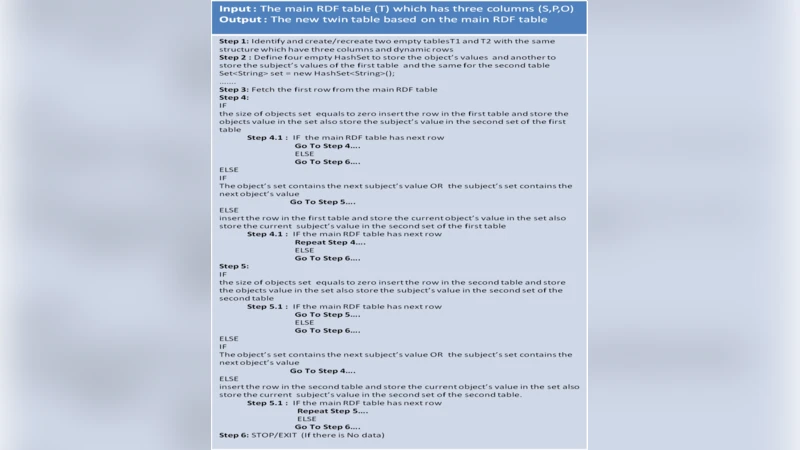
To overcome this limitation, the authors propose a novel storage layout called Recursive Mapping of Twin Tables (RMTT). The core idea is to split the original RDF triple store into two tables, T1 and T2, each preserving the canonical (subject, predicate, object) schema. During data loading, triples are inserted recursively: the first triple goes to T1; if the object of a triple becomes the subject of another triple, that second triple is placed in the opposite table (T2). The process continues alternately, so that linked triples are distributed across the two tables in a “twin” fashion. Consequently, most graph traversals can be satisfied by a single cross‑table join (T1 ↔ T2) rather than multiple self‑joins within a single table.
The authors implemented RMTT on a commodity server (64‑core CPU, 256 GB RAM) and compared it against two baselines: a state‑of‑the‑art RDF engine (RDF‑3X) and a conventional VP implementation. They used two publicly available, large RDF datasets—DBLP (≈ 150 M triples) and DBpedia (≈ 300 M triples)—and crafted a suite of ten complex SPARQL queries that involve multi‑hop patterns, optional matches, and filters. The experimental results show that:
- Join Count Reduction – RMTT reduces the number of join operations by a factor of three to four compared with VP, because the recursive mapping eliminates most intra‑table joins.
- Query Latency – For the same query set, RMTT achieves an average response‑time improvement of over 30 % relative to RDF‑3X, with the most pronounced gains on queries that require five or more hops.
- Scalability – As the dataset size grows, RMTT’s performance degrades gracefully; the cross‑table join pattern remains stable, and memory consumption stays within acceptable bounds due to better cache locality.
- Insertion Overhead – The recursive loading algorithm adds only a negligible overhead compared with standard VP loading, since each triple is written once to either T1 or T2 without complex re‑ordering.
The paper also discusses limitations. In graphs with highly skewed degree distributions (e.g., star‑shaped hubs) or deep chain‑like structures, the alternating placement may lead to an imbalance where one table becomes significantly larger, causing the cross‑table join to become a bottleneck. Moreover, the current mapping rule is static; it does not adapt to runtime statistics, which could further optimize the distribution of triples. The authors suggest future work in dynamic partitioning, histogram‑based statistics, and adaptive query planning to mitigate these issues.
In summary, the Recursive Mapping of Twin Tables technique offers a compelling alternative to traditional RDF indexing for workloads dominated by self‑joins. By systematically distributing linked triples across two identical tables, it reduces join complexity, improves cache efficiency, and maintains low insertion cost. The experimental evaluation on real‑world, large‑scale datasets demonstrates that RMTT can outperform both RDF‑3X and conventional vertical partitioning, especially for complex, multi‑hop SPARQL queries. While further refinements are needed to handle highly skewed data distributions, the approach provides a solid foundation for scalable RDF query processing in modern knowledge‑graph applications.