An Aspect-Oriented Approach for SaaS Application Customization
Multi-tenancy is one of the most important concepts for any Software as a Service (SaaS) application. Multi-tenant SaaS application serves a large number of tenants with one single application instance. Complex SaaS application that serves significant number of tenants could have a huge number of customizations with complicated relationships, which increases the customization complexity and reduces the customization understandability. Modeling such customizations, validating each tenant’s customization, and adapting SaaS applications on the fly based on each tenant’s requirements become very complex tasks. To mitigate these challenges, we propose an aspect-oriented approach that makes use of the Orthogonal Variability Model (OVM) and Metagraphs. The OVM is used to provide the tenants with simple and understandable customization model. A Metagraph-based algorithm has been developed to validate tenants’ customizations. On the other hand, the aspect-oriented approach offers a high level of runtime adaptability.
💡 Research Summary
The paper addresses the escalating complexity of customizing multi‑tenant Software‑as‑a‑Service (SaaS) applications. Traditional approaches either maintain separate code bases per tenant or rely on simple configuration files that cannot capture intricate dependency and exclusion relationships among features. This leads to high maintenance costs, error‑prone deployments, and limited scalability. To overcome these challenges, the authors propose an integrated framework that combines three key techniques: the Orthogonal Variability Model (OVM) for clear variability modeling, a Metagraph‑based validation algorithm for automatic consistency checking, and Aspect‑Oriented Programming (AOP) for runtime adaptability.
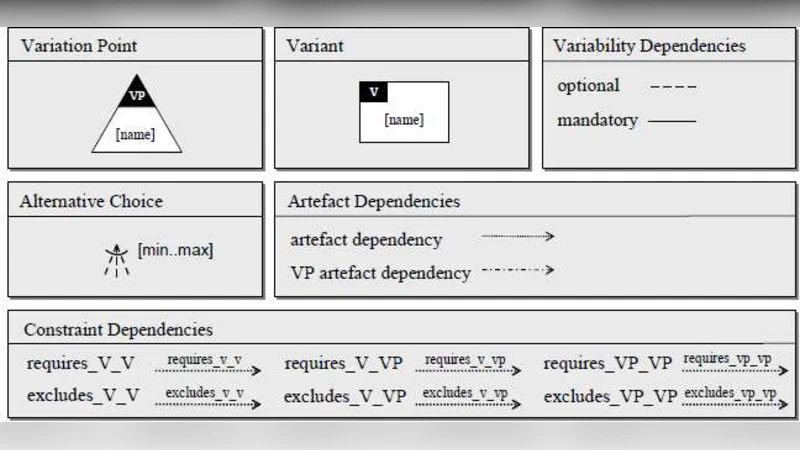
OVM serves as the front‑end modeling language. It separates variability into “options” (the selectable features) and “constraints” (relationships such as requires, excludes, and mandatory inclusion). By visualizing OVM as a graph, non‑technical tenants can compose their desired feature set through a web‑based UI, while the model itself enforces syntactic correctness. The authors extend the generic OVM meta‑model to suit SaaS domains, adding constructs for service‑level agreements, pricing tiers, and deployment preferences.
The second pillar is a Metagraph representation of the OVM. In a Metagraph, vertices correspond to options and hyper‑edges represent constraints that may involve any number of vertices. The validation algorithm traverses these hyper‑edges, checking that all required options are present, no mutually exclusive options are selected together, and that any conditional constraints are satisfied. When a conflict is detected, the algorithm computes a minimal correction set, offering the tenant a concise list of changes to achieve a consistent configuration. Empirical evaluation on synthetic models with up to 500 options and 2,000 constraints shows an average validation time of 120 ms, demonstrating feasibility for interactive, on‑the‑fly validation.
Runtime adaptability is achieved through AOP. The core SaaS functionality is implemented as a set of base components. Each tenant’s customization requirements are expressed as aspects containing pointcuts (where to intervene) and advice (what to execute). At deployment time, a weaving engine reads a tenant‑specific configuration file and dynamically weaves the relevant aspects into the running system. This enables on‑demand activation of new business rules, feature toggles, or validation logic without restarting the application or redeploying the entire code base. Performance tests reveal that the weaving overhead stays below 3 % of baseline request latency, which is acceptable for production SaaS services.
A concrete case study involves an e‑commerce platform with twelve variability domains (payment methods, shipping options, promotion policies, etc.). The OVM captures 96 distinct options and 45 constraints. Tenants use the UI to select their preferred payment and shipping configurations; the Metagraph validator confirms that all selections are logically consistent. When a tenant introduces a new promotional rule, the AOP layer injects the rule at runtime, instantly affecting the tenant’s storefront while other tenants remain unaffected.
The authors acknowledge limitations. Metagraph size can grow dramatically for large SaaS portfolios, potentially increasing validation time beyond linear scaling. They propose future work on distributed validation and heuristic pruning to keep response times low. The AOP weaving step, while lightweight, still adds a modest performance penalty; upcoming research will explore cache‑based weaving and Just‑In‑Time compilation to mitigate this. Finally, they suggest developing automated synchronization tools that keep the OVM model and the underlying code base in lockstep, reducing manual effort and preventing drift.
In summary, the paper demonstrates that coupling OVM’s intuitive variability modeling with Metagraph‑driven automatic validation and AOP’s dynamic composition yields a powerful, scalable solution for SaaS customization. This integrated approach reduces the cognitive load on tenants, guarantees configuration correctness, and enables rapid, zero‑downtime adaptation of services, thereby addressing key operational challenges of modern multi‑tenant cloud platforms.
Comments & Academic Discussion
Loading comments...
Leave a Comment